FTO Substrates for Laboratories and Pilot Production
FTO substrates for research and pilot production
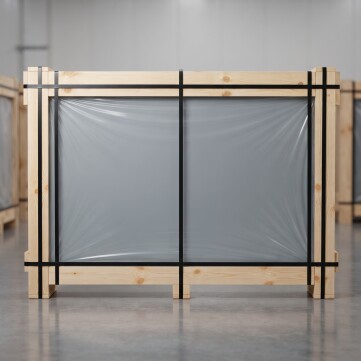
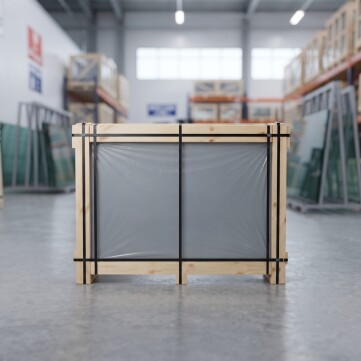
FTO coated glass is offered for laboratories, industrial development teams and pilot manufacturing projects requiring a transparent conductive support. The starting material has a nominal thickness of 2.1 mm and a sheet format of 2000 x 1400 mm. Smaller blanks can be prepared by agreement. This offer focuses on substrate supply and preparation rather than complete electrochemical cells or assembled devices.
Composition and material identification
The functional coating is fluorine doped tin oxide, expressed as SnO2:F. It belongs to the transparent conductive oxide family, commonly abbreviated as TCO. The supplied material has a hard coating deposited by chemical vapour deposition, or CVD. A chemical identifier for tin oxide alone does not describe the complete coated substrate. Customs classification follows the actual supplied article and its condition.
Electrical, optical and dimensional data
- Nominal substrate thickness: 2.1 mm.
- Starting sheet dimensions: 2000 x 1400 mm.
- Reported sheet resistance: approximately 30 ohms per square.
- Reported light transmission: 85 percent from a production measurement.
- Blank dimensions and edge preparation: subject to agreement.
Reported values support initial selection. Guaranteed limits, sampling positions and measurement methods require confirmation before ordering. Visible transmission does not define performance throughout the ultraviolet or infrared range. Surface roughness, film thickness and spectral transmission are not specified here and should be raised separately if they affect the experiment.
Substrate formats and sample preparation
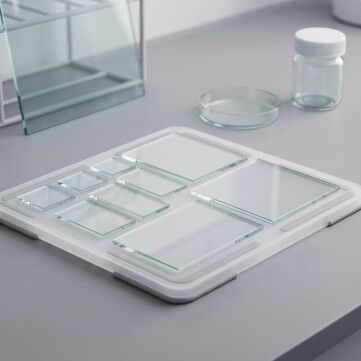
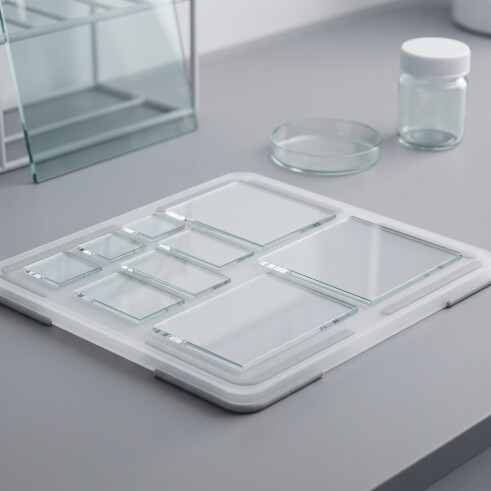
Requests can cover whole sheets or blanks cut to agreed dimensions. Cutting and edge grinding are available by agreement. Minimum dimensions, tolerances, quantities and packaging are confirmed for the actual request. Patterning, selective coating removal, contact deposition and cleanroom preparation are not implied by an order for cut substrates. Any additional operation requires separate technical review.
Specifications and research documentation
Acceptance should follow an agreed specification rather than a general claim of laboratory grade. Optical measurements may use ISO 9050 where suitable, while a particular experiment may need additional spectral data. Batch measurement information is available through the agreed quality documentation. Any required calibration, traceability, sampling plan or report format should be identified before purchase, not assumed from the material name.
For comparative studies, identify which variables must remain consistent across samples. These may include the source sheet, cutting direction, contact position and cleaning sequence. If surface analysis is planned, specify the relevant technique and acceptance requirement in advance. A general visual inspection does not establish atomic cleanliness, a particular roughness value or compatibility with every thin film deposition method.
How the transparent electrode functions
The coating combines useful optical transmission with electrical conduction. A functional layer can be deposited onto the FTO surface while an external contact provides connection to the measurement circuit. Electrode behaviour depends on the substrate, deposited layers, exposed area and contact arrangement. The glass support is not a reference electrode, and its own electrochemical response may contribute to a measurement.
Applications in research and development
- Electrochromic prototypes requiring transparent current collection.
- Photoelectrochemical electrodes and semiconductor film evaluation.
- Supported photocatalytic layers connected to an external circuit.
- Experimental photovoltaic structures and process development.
- Electrochemical sensors and other multilayer research devices.
These are potential application areas, not a qualification of this batch for every published procedure. Laboratory teams should compare the reported resistance with the device dimensions and expected current. Reproducing a study may require a different substrate specification, surface texture or optical spectrum, even when both materials are described as FTO.
Comparison with ITO and other supports
FTO and ITO differ in coating composition and may respond differently to processing and electrochemical exposure. Compare the actual products through resistance, transmission, roughness and compatibility with the proposed layers. Metal supports and opaque electrodes serve different optical requirements. No substrate should be selected solely because another experiment used the same broad material abbreviation.
Common experimental mistakes
- Depositing the active layer on the uncoated side.
- Confusing a two point resistance reading with a defined sheet resistance measurement.
- Leaving an unintended area of the conductive substrate exposed to electrolyte.
- Ignoring the response of a blank substrate during data interpretation.
- Assuming unlimited stability in every electrolyte and potential range.
- Applying an unverified cleaning or thermal cycle to all available samples.
Quality control and baseline measurements
Useful checks include dimensions, thickness, surface condition, transmission and sheet resistance. A handheld meter can help identify the conductive face but does not replace a defined quantitative procedure. Where suitable, compare a blank substrate with the coated working sample under the same conditions. Record contact position and exposed area so that changes in geometry are not mistaken for material effects.
Storage and laboratory handling
Keep substrates dry, protected from dust and separated from abrasive surfaces. Use handling methods that avoid contaminating the working face. Confirm any cleaning procedure against the planned experiment and subsequent deposition process. Transport packaging should protect edges and prevent coated surfaces from rubbing. Requirements for individually packed or specially cleaned samples must be discussed explicitly rather than assumed.
FTO can undergo degradation under unsuitable electrochemical conditions, including sufficiently aggressive polarization. Literature stability ranges belong to the stated electrolyte and test conditions and should not be treated as universal operating limits. Initial substrate checks and a suitable control experiment help distinguish coating changes from the behaviour of the deposited active material.
Choosing an equivalent research substrate
Compare thickness, usable area, sheet resistance, optical behaviour and compatibility with the manufacturing route. Where electrochemistry is involved, consider electrolyte composition, pH, temperature, exposure time and applied potential relative to the stated reference electrode. Thermal processing should also be evaluated using the intended atmosphere and duration. Similar nominal resistance does not establish complete interchangeability between research substrates.
Supply planning for worldwide projects
Worldwide enquiries can cover initial evaluation material, repeated experimental batches and larger pilot requirements. Availability and preparation time are confirmed for each order. A forecast of sample consumption helps distinguish a single experiment from an ongoing development programme. The actual supply scope is established through the commercial offer, including agreed cutting, edge work and any special packaging.
Logistics and customs coordination
Transport arrangements should suit the dimensions, quantity and fragility of the consignment. Road, rail, sea or multimodal options may be considered where appropriate. Dispatch packaging, receiving arrangements and unloading responsibilities are agreed before shipment. Freight coordination, customs brokerage and financial arrangements are separate matters when required. They are not automatically included in the supply of glass blanks.
Purchasing economics for laboratory teams
Substrate purchasing should consider usable sample yield as well as the starting material. Cutting layout, edge requirements, packaging and qualification tests all affect the practical cost of an experiment. Evaluation samples can establish process compatibility before a larger order. An agreed dimension schedule also helps compare full sheet supply with prepared blanks without overlooking the preparation work retained by the laboratory.
Frequently asked questions
Can substrates be cut to the required dimensions?
Cutting and edge grinding are available by agreement. Submit dimensions, quantities and any essential edge or tolerance requirements.
Are the substrates patterned or supplied with contacts?
Patterning and electrical contacts are not included by default. Any additional preparation must be described and separately reviewed.
Is the coating stable in every electrochemical experiment?
No universal stability window is declared. Compatibility depends on electrolyte, potential, temperature, exposure time and the actual coating.
Can a published annealing cycle be used directly?
The intended cycle should be checked for this material. Evaluate samples and compare properties before and after processing.
Is the reported resistance suitable for every device?
No. Approximately 30 ohms per square must be assessed against current, geometry, contact arrangement and acceptable electrical losses.
Can the same material support a later pilot order?
A larger requirement can be discussed after evaluation. Availability, consistency requirements and preparation scope are confirmed separately.
Summary for research procurement
The offer provides a defined FTO coated starting material and preparation options for laboratories and pilot development. An agreed specification and initial process evaluation help connect purchasing with the actual experiment. Substrate selection should preserve traceability of the properties that matter to the device rather than rely on a general material label.
Contact Us
info@apptrade.ru