Lubricant and Fuel Additives
What Lubricant and Fuel Additives Are and Why They Matter
Lubricant and fuel additives are chemical compounds or compositions introduced into base oils and fuels at concentrations from 0.01 to 10 percent to purposefully modify their performance properties. Base oil or fuel without additives cannot provide the required level of protection against wear, corrosion, oxidation and deposits in modern engines and transmissions. The additive package determines oil life, parts cleanliness, cold startability and exhaust emission performance.
For procurement teams, this group is complex because additives are rarely purchased as finished end-use products. More often they are components for blending oils and fuels at refineries and blending plants. Each additive has a narrow functional purpose, and its compatibility with other package components and with the base oil determines the stability and effectiveness of the finished product. An error in additive selection or dosage can lead to sediment formation, loss of detergency or corrosion of non-ferrous metals.
The key feature of the group that determines logistics is the diversity of physical and chemical properties and hazard classes. Many additives are flammable, some are toxic, and certain compositions are classified as environmentally hazardous. This requires sealed packaging, protection from moisture and heat, and correct labeling in accordance with dangerous goods transport rules.
Chemical Identification and Procurement Data
Identification of additives relies on functional purpose, chemical class and normative document. Russian products use GOST standards, imported products use manufacturer specifications and international standards.
- Zinc dialkyldithiophosphate (ZDDP): the main anti-wear and antioxidant additive for engine oils. CAS 68649-42-3 (for typical ZDDP).
- Calcium sulfonate: detergent additive, for example SB-3 per GOST 10534-78. CAS 68783-96-0 for overbased calcium sulfonate.
- Calcium alkylphenolate: AFK additive per GOST 12261-87, intended to lower the pour point of oils.
- AKOR-1: protective (preservative) additive per GOST 15171-78 based on nitrated oil.
- KP additive: per GOST 23639-79, a component of additive packages.
- Cetane improvers: 2-ethylhexyl nitrate (EHN), di-tert-butyl peroxide (DTBP).
- Pour point depressant-dispersant additives: ethylene-vinyl acetate copolymers.
- HS code: 3811210000 for additives for lubricating oils containing petroleum or bituminous minerals; 3811900000 for other fuel additives; 3812 for antiknock preparations and fuel additives.
The supplier confirms batch conformity to the normative document and provides a certificate of quality with actual values for each parameter, including active element content (zinc, calcium, phosphorus, sulphur, nitrogen) and key physical and chemical characteristics.
Quality Parameters Relevant to Processing
For lubricant additives, the key parameters are active element content (zinc, phosphorus, sulphur, calcium, nitrogen, boron), kinematic viscosity at 100 degrees Celsius, flash point, density, mechanical impurity and water content. For ZDDP, zinc content is typically 8-10 percent, phosphorus 7-9 percent, sulphur 15-18 percent. For sulfonate detergents, total base number (TBN) is a critical parameter and can reach 300-400 mg KOH per gram for overbased grades.
For fuel additives, active substance content, flash point, density, viscosity and fuel compatibility are standardized. For cetane improvers based on EHN, active component content is typically at least 99 percent, and the recommended dosage in diesel fuel is from 0.05 to 0.2 percent to increase the cetane number by 2-5 units.
For the processor, stability of the active element and absence of contamination are critical. Additives with reduced active element content require increased dosage, which is economically disadvantageous, and the presence of water or mechanical impurities can lead to package separation and loss of functional properties.
Technical Groups and Supply Forms
Dispersants and Detergents
Dispersants (ashless) prevent agglomeration of oxidation products and keep them suspended, ensuring engine cleanliness at low temperatures. Detergents (metallic, ash-containing) neutralize acids and prevent high-temperature piston deposits. Russian detergent additives include calcium sulfonate SB-3 per GOST 10534-78, calcium alkylphenolates and alkylsalicylates. Supplied in steel drums and in bulk in tank cars.
Anti-Wear and Antioxidant (ZDDP)
Zinc dialkyldithiophosphate is the main anti-wear and antioxidant additive for engine oils. Supplied as a liquid or viscous concentrate in steel drums, IBCs and in bulk. Requires protection from moisture because it hydrolyzes with hydrogen sulfide release.
Pour Point Depressants and Depressant-Dispersants
Lower the pour point of oils and improve diesel fuel filterability at low temperatures. AFK additive per GOST 12261-87 is a calcium alkylphenolate intended to lower the pour point of engine oils. Depressant-dispersant fuel additives are supplied in canisters and drums.
Cetane Improvers
Based on 2-ethylhexyl nitrate (EHN) or di-tert-butyl peroxide. Increase diesel fuel cetane number, improve cold start and reduce smoke. Supplied in steel drums, canisters and IBCs. Require protection from heat and oxidizers.
Protective and Preservative Additives
AKOR-1 additive per GOST 15171-78 improves the protective properties of oils and fuels and is used as a preservative material. Supplied in drums and canisters.
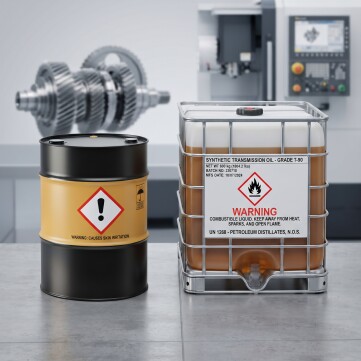
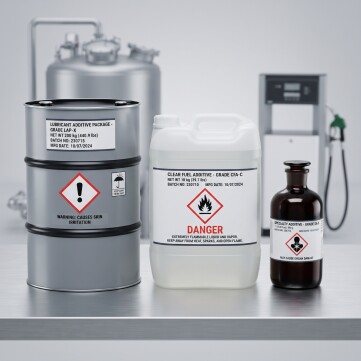
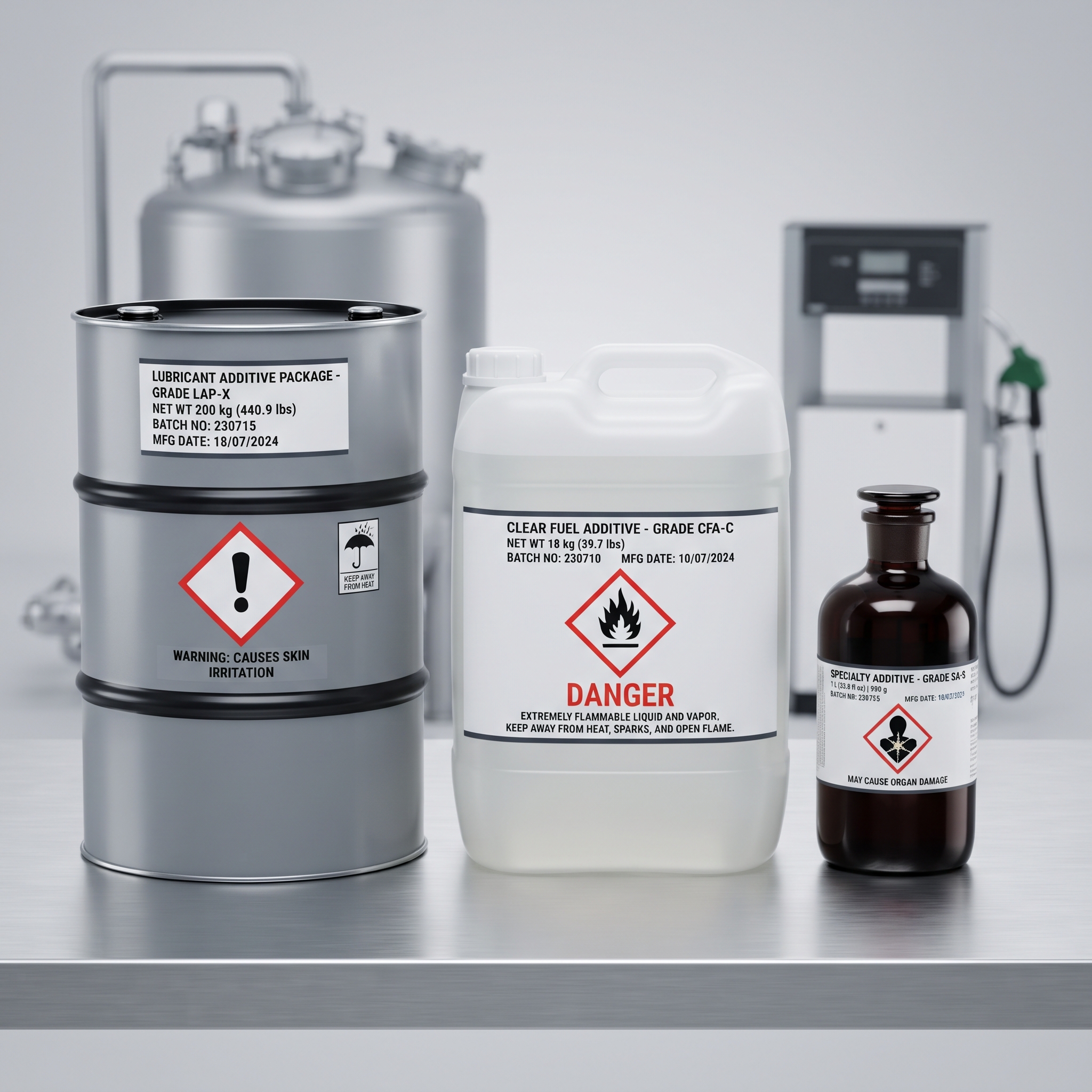
Supply forms: 216 L steel drums, 1000 L IBCs, 20 L polyethylene canisters, bulk in tank cars. Glass packaging for small batches.
Packaging, Containers and Labeling
Additives are packed in steel drums, IBCs, polyethylene canisters and metal containers. Packaging must be clean, sealed and compatible with the chemical composition of the additive. Bulk additives are transported in specialized tank cars.
Transport Marking
Transport marking is applied per GOST 14192 and GOST 19433-88. Depending on additive properties, hazard labels of class 3 (flammable liquids), class 6.1 (toxic substances), class 8 (corrosive substances) or class 9 (miscellaneous dangerous substances, including environmentally hazardous) may apply. For additives classified as environmentally hazardous, UN number 3082 (environmentally hazardous substance, liquid, n.o.s.) may be used. Under GHS, pictograms GHS02, GHS07, GHS08 or GHS09 are applied depending on classification, along with the signal word Danger or Warning.
Storage Conditions
Additives are stored in closed warehouses protected from moisture, direct sunlight and heat sources. The temperature regime depends on the additive type: for ZDDP and cetane improvers, a temperature not above 30 degrees Celsius is recommended; for pour point depressants, not below minus 20 degrees Celsius. The shelf life is typically 12-24 months from the date of manufacture.
Regulatory Framework for Incoming Inspection
- GOST 10534-78 - sulfonate additive SB-3. Specifications.
- GOST 12261-87 - AFK additive. Specifications.
- GOST 15171-78 - AKOR-1 additive. Specifications.
- GOST 23639-79 - KP additive. Specifications.
- GOST 19433-88 - classification and labeling of dangerous goods.
- GOST 30333-2022 - safety data sheet for chemical products.
- API 1509 - Engine Oil Licensing and Certification System (for engine oil additives).
- ACEA sequences - European oil sequences (for lubricant additives).
Mechanism of Action and Functional Role
Detergents are surfactants whose molecules have a polar head group and a hydrocarbon tail. The polar group adsorbs on the metal surface or contaminant particles, and the hydrocarbon tail provides oil solubility. This allows detergents to neutralize acids and prevent particles from adhering to metal. Dispersants act differently: they adsorb on the surface of insoluble particles, forming a shell of hydrocarbon radicals that prevents coagulation and settling. Polar additive molecules create an electric double layer that imparts like charges to the particles, further preventing agglomeration.
ZDDP acts as an anti-wear additive through thermal decomposition on contact with a heated metal surface. Decomposition products form a thin protective film of zinc sulfides and phosphates on the surface, preventing scoring and seizure. At the same time, ZDDP acts as an antioxidant by decomposing peroxides. Pour point depressants act by adsorbing on the surface of paraffin crystals formed during oil cooling and preventing their growth and aggregation. Cetane improvers based on nitrates decompose on heating in the cylinder with the release of active radicals that initiate ignition and shorten the ignition delay period.
Applications by Industry
Engine and Transmission Oil Production
The largest consumption direction. Additive packages are used for blending engine oils for gasoline and diesel engines, transmission and hydraulic oils. The package includes dispersants, detergents, ZDDP, antioxidants, pour point depressants and antifoam agents.
Diesel Fuel Production
Cetane improvers, anti-wear, depressant-dispersant and antifoam additives are introduced into diesel fuel to improve ignitability, lubricity and low-temperature properties.
Gasoline Production
Antiknock agents, detergents and antioxidants are used to increase octane number and maintain fuel system cleanliness.
Industrial Equipment and Hydraulics
Additives are used in hydraulic oils, compressor oils, gearbox and bearing oils to protect against wear and corrosion.
Marine and Power Generation
Special additive packages are used for cylinder oils of marine diesel engines and gas turbines.
Comparison with Alternative Solutions
Additives have no direct analogues among base oils: without them, the required performance characteristics cannot be achieved. However, individual additives can be partially replaced by products with a similar functional purpose. For example, ZDDP can be partially replaced by ashless anti-wear additives based on boron or molybdenum, but this requires reformulation and confirmation of effectiveness. Pour point depressants based on ethylene-vinyl acetate copolymers compete with polymethacrylate-based depressants, with the choice determined by compatibility with the base oil.
For fuel additives, cetane improvers based on EHN compete with DTBP and other peroxides. EHN is more effective and widely used in Russia, while DTBP requires more careful handling.
Supplier Selection Criteria and Specification Development
The specification must include the functional purpose of the additive, chemical class, active element content, kinematic viscosity, flash point, density, water and mechanical impurity content, as well as recommendations for dosage and compatibility with base oils or fuels.
The supplier confirms batch-to-batch quality consistency, a valid safety data sheet under GOST 30333-2022 and readiness to provide packaging corresponding to the hazard class of the product. For imported additives, compliance with API or ACEA specifications must be verified.
Typical Processing, Storage and Logistics Errors
- Overdosing or underdosing the additive. Leads to package imbalance and deterioration of finished oil or fuel properties.
- Mixing incompatible additives. May cause sediment formation, separation and loss of functional properties.
- Water ingress into ZDDP. Causes hydrolysis with hydrogen sulfide release and loss of anti-wear properties.
- Overheating cetane improvers. May lead to decomposition and loss of effectiveness.
- Use of contaminated packaging. Mechanical impurities and residues of other chemicals contaminate the additive.
- Violation of dangerous goods labeling. Absence of required hazard labels or UN number leads to customs delays and penalties.
Quality Control and Laboratory Methods
Incoming inspection includes determination of active element content (zinc, phosphorus, sulphur, calcium, nitrogen, boron) by atomic absorption spectrometry or X-ray fluorescence analysis, kinematic viscosity, flash point, density, water content by the Fischer method and mechanical impurities. For detergents, total base number is additionally controlled. Sampling is performed by standardized methods; the combined sample is analyzed in the plant laboratory.
Storage and Transportation Conditions
Additives are stored in closed warehouses protected from moisture, direct sunlight and heat sources. The temperature regime depends on the product type and is specified in the safety data sheet. Transportation is carried out in steel drums, IBCs, canisters and in bulk in tank cars in accordance with dangerous goods transport rules. For sea transport, IMDG requirements apply.
Finding Analogues and Interchangeability
When replacing an additive, a product with a similar functional purpose and active element content is selected. Replacing ZDDP with ashless anti-wear additives requires confirmation of effectiveness in the specific formulation. Replacing a pour point depressant with a product of a different chemical class is possible only after laboratory testing for compatibility with the base oil and confirmation of low-temperature properties. The decision is based on laboratory and bench testing.
Supply Routes: Russia, China and Other Regions
Domestic supply is provided by petrochemical and chemical enterprises producing additives and components for blending oils and fuels. Products are supplied to the domestic market and for export.
Chinese producers have large capacities for lubricant and fuel additives, including ZDDP, detergents and cetane improvers. Supplies are delivered by sea with subsequent transfer to rail or road transport. Other global producers are located in Europe, the USA and the Middle East. Suppliers from these regions are engaged when required, taking into account logistical and regulatory factors.
Logistics and Customs Clearance
Transportation of additives is carried out in specialized packaging in compliance with dangerous goods transport rules. Customs clearance includes HS code classification, preparation of a safety data sheet under GOST 30333-2022 and conformity declaration. The portal provides customs broker services and supports all clearance stages.
Risk Factors and Safety Measures
The main risks are associated with flammability, toxicity and irritating effects of additives on skin and respiratory tract. Some additives, especially those containing zinc and phosphorus, may release toxic vapors on heating. Work is performed in ventilated rooms with gloves, protective goggles and protective clothing. In case of skin contact, wash the affected area with water and soap. Used additives and packaging must be disposed of in accordance with requirements.
FAQ: Common Questions from Procurement and Process Specialists
How do dispersants differ from detergents
Dispersants (ashless) keep oxidation products suspended and prevent low-temperature deposits, while detergents (metallic, ash-containing) neutralize acids and prevent high-temperature piston deposits.
What is ZDDP and why is it needed
Zinc dialkyldithiophosphate is the main anti-wear and antioxidant additive for engine oils. It forms a protective film on friction surfaces and slows oil oxidation.
Which additive should be selected to increase diesel fuel cetane number
2-Ethylhexyl nitrate (EHN) or di-tert-butyl peroxide (DTBP) are used to increase cetane number. EHN is widely used in Russia and provides a 2-5 unit increase at a dosage of 0.05-0.2 percent.
Which packaging is used for additives
216 L steel drums, 1000 L IBCs, 20 L polyethylene canisters, and bulk in tank cars are used. Glass packaging for small batches.
What documents are required for additive import
Import requires a contract, invoice, packing list, safety data sheet under GOST 30333-2022, certificate of quality and transport documents. For dangerous goods, transport permits and compliance with carriage rules are additionally confirmed.
Conclusion
Lubricant and fuel additives remain a critical component that determines the performance properties of modern lubricants and fuels. GOST 10534-78, GOST 12261-87, GOST 15171-78 and GOST 23639-79 establish requirements for individual Russian additives, while international practice relies on API and ACEA specifications. For procurement teams, the practical task reduces to correct selection of the functional group and chemical class of the additive, confirmation of active element content and compatibility with the base oil or fuel, and organization of supplies in compliance with dangerous goods transport rules and storage conditions.
Contact Us
For procurement inquiries and supply chain organization, contact the portal team at info@apptrade.ru.