















Ammonium Nitrate
What Ammonium Nitrate Is and Why It Remains a Critical Oxidizer and Nitrogen Source
Ammonium nitrate (NH4NO3) is a white or slightly colored granule without mechanical impurities, produced by neutralization of nitric acid with ammonia followed by granulation and drying. The nitrogen content in the commercial product is 34.4-34.6 percent, with nitrogen present in two forms, ammonium and nitrate, providing a prolonged effect when used as a fertilizer.
For procurement teams, ammonium nitrate matters in two main roles. Grade A is intended for industry, primarily for the production of emulsion and granular explosives, as well as a reagent in special chemical processes. Grade B is oriented toward agriculture and is used as a universal nitrogen fertilizer for base application, side-dressing and fertilizer blends. The combination of high nitrogen concentration, availability and relatively low cost makes ammonium nitrate one of the most demanded nitrogen products.
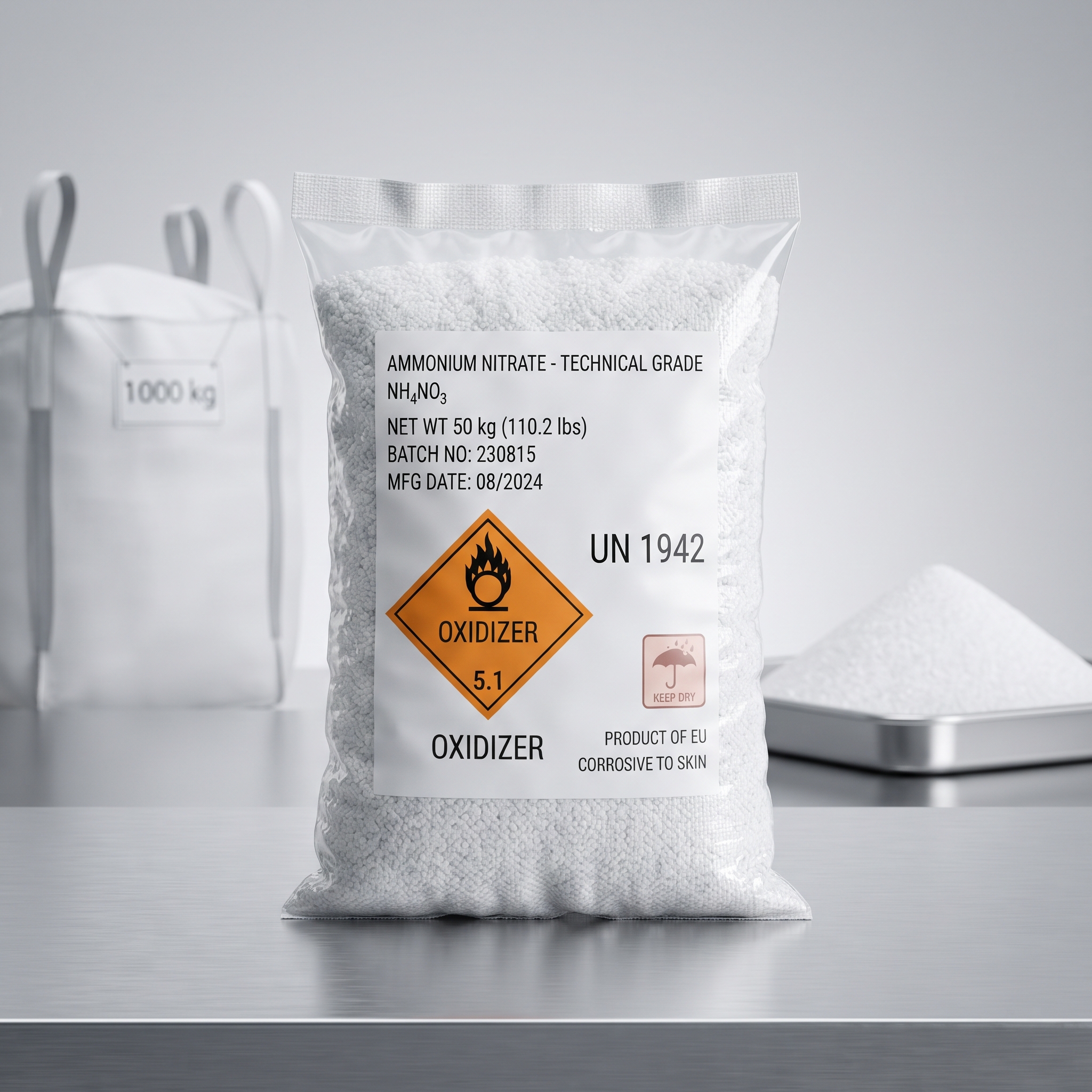
The key feature of ammonium nitrate that determines the entire supply chain is its oxidizing properties and ability to support combustion. The product is classified as a class 5.1 hazardous good (oxidizers), UN number 1942, and requires protection from moisture, temperature control during storage and special measures during bulk transport. GOST 2-2013 establishes requirements for granular ammonium nitrate of grades A and B, including moisture, granulometric composition and static granule strength.
Chemical Identification and Procurement Data
- Chemical name: ammonium nitrate, ammonium salt of nitric acid.
- Chemical formula: NH4NO3.
- Molar mass: 80.04 g/mol.
- CAS number: 6484-52-2.
- UN number: 1942 for ammonium nitrate; 2067 for ammonium nitrate based fertilizers.
- Hazard class: 5.1 (oxidizers) per GOST 19433-88, classification code 5113, category 511.
- HS code: 3102300000 for ammonium nitrate in packages of not more than 10 kg net; 3102400000 for mixtures of ammonium nitrate with calcium carbonate or other inorganic substances.
- Commercial form: white or slightly colored granules without mechanical impurities.
In the Russian regulatory system, the primary document for ammonium nitrate is GOST 2-2013, which covers product intended for agriculture, industry and export. The standard provides for grades A and B, as well as requirements for physical and chemical parameters, packaging, labeling and analytical methods. The supplier confirms batch conformity to GOST 2-2013 and provides a certificate of quality with actual values for each parameter.
Quality Parameters Relevant to Processing
- Total mass fraction of nitrate and ammonium nitrogen calculated as NH4NO3 on a dry basis: at least 98 percent for grade A.
- Total mass fraction of nitrogen calculated as nitrogen on a dry basis: at least 34.4 percent for grade B.
- Water mass fraction: not more than hygroscopic 0.3 percent, total 0.6 percent for grade A; for grade B not more than 0.5 percent.
- Hydrogen index of 10 percent solution: not less than 5.
- Mass fraction of substances insoluble in 10 percent nitric acid solution: not more than 0.2 percent for grade A.
- Mass fraction of magnesium nitrate additives calculated as MgO: 0.2-0.4 percent for grade A.
- Static granule strength: not less than 5 N per granule for grade A.
- Granulometric composition: mass fraction of granules sized 1-3 mm at least 93 percent, less than 1 mm not more than 4 percent, more than 6 mm absent for grade A.
- Flowability: 100 percent for grade B.
For the processor, moisture and granulometric composition are critical: increased moisture leads to caking and loss of flowability during pneumatic transport and bulk storage, while a non-uniform granulometric composition leads to uneven distribution in mixtures and instability of explosive properties.
Technical Grades and Supply Forms
Grade A
Intended for industry. Used as the main oxidizer in the production of emulsion and granular industrial explosives prepared directly at blasting sites or at stationary plants. Also used as a reagent for dissolving zirconium cladding of fuel elements in irradiated nuclear fuel reprocessing. Nitrogen content calculated as NH4NO3 is at least 98 percent, with stricter moisture limits.
Grade B
Intended for agriculture and used as a universal nitrogen fertilizer containing ammonium and nitrate nitrogen in equal proportions. Applied for pre-sowing application, early spring dressing of cereals and other crops, as well as for fertilizer blends. Nitrogen content is at least 34.4 percent, with flowability and granulometric composition standardized.
Supply is in bulk, in polypropylene bags with a polyethylene liner of 50 kg, as well as in flexible specialized containers (big bags) of 800, 900, 1000 or 1200 kg capacity depending on grade and manufacturer. For export batches, packaging and net weight are established in accordance with the foreign trade organization order.
Packaging, Containers and Labeling
Ammonium nitrate is a class 5.1 hazardous good, so packaging must provide moisture protection, mechanical strength and sufficient sealing to prevent spillage and contact with organic materials. Polypropylene bags with a polyethylene liner, paper bags and big bags made of polypropylene fabric are used for packaging.
Transport Marking
Transport marking is applied per GOST 14192 with the Keep Dry handling symbol on bags. The hazard label per GOST 19433 is mandatory: class 5, subclass 5.1, drawing 5, category 511, classification code 5113, as well as the UN serial number 1942. The marking characterizing the packaged product must contain the manufacturer name or trademark, product name, indication of organic additives, product grade, batch number and date of manufacture, standard designation and guaranteed nitrogen content.
Bulk Packaging
For bulk supply, the product is transported in specialized self-unloading cars such as mineral carriers or hopper cement cars, as well as covered road transport. When transported in bulk or loose form in quantities exceeding 3000 kg by inland water and rail transport, the cargo is classified as a high-hazard good.
Regulatory Framework for Incoming Inspection
- GOST 2-2013 - ammonium nitrate. Specifications. Establishes requirements for grades A and B, analytical methods and acceptance rules.
- GOST 19433-88 - dangerous goods. Classification and labeling. Defines class 5.1, code 5113 and the hazard label.
- GOST 12.1.007-76 - classification of hazardous substances. Ammonium nitrate belongs to moderately hazardous substances of the third class.
- GOST 14192 - cargo marking.
- GOST 30333-2022 - safety data sheet for chemical products.
- GOST 26319 - packaging for export batches.
For imported batches, the specification is based on manufacturer standards and international dangerous goods transport rules (IMDG, RID, ADR), taking into account labeling and packaging compatibility requirements. The batch specification is confirmed by the manufacturer certificate of quality and the results of incoming laboratory control by the recipient.
Mechanism of Action and Functional Role
In industrial explosives, ammonium nitrate acts as the main oxidizer. On initiation, it decomposes to release oxygen, which ensures rapid oxidation of fuel components such as diesel fuel or aluminum powder. This property underlies emulsion and granular explosives used in mining and construction.
In agriculture, ammonium nitrate acts as a source of nitrogen in two forms: nitrate nitrogen is immediately available to plants, while ammonium nitrogen is available gradually as nitrification occurs in the soil. This combination provides both rapid supply during active growth and prolonged nutrition. The nitrate is highly soluble in water, allowing use in fertigation systems and for preparing liquid dressings.
In special chemical processes, ammonium nitrate is used as a reagent for dissolving zirconium cladding of fuel elements in irradiated nuclear fuel reprocessing. High product purity and minimal content of impurities capable of affecting the process are important for this application.
Applications by Industry
Industrial Explosives
The main consumption direction for grade A. Ammonium nitrate serves as an oxidizer in emulsion and granular explosives (ammonites, granulites) used in mining, construction and seismic exploration.
Agriculture
Grade B is used as a universal nitrogen fertilizer for base application, side-dressing and top-dressing during the growing season. It is particularly effective for early spring dressing of cereal crops, as well as for preparing fertilizer blends.
Special Chemical Processes
Used as a reagent for dissolving zirconium cladding of fuel elements in irradiated nuclear fuel reprocessing.
Other Industries
Ammonium nitrate is used in the production of fire-retardant compositions, as a component of drilling fluids, and in some organic synthesis processes.
Comparison with Alternative Nitrogen Products
Compared with carbamide, ammonium nitrate contains less nitrogen (34.4 percent versus 46.2 percent) but acts faster in cold soils and does not require urease hydrolysis to release nitrogen. Compared with ammonium sulfate, nitrate provides a higher nitrogen concentration and contains no sulfate sulfur, which is important for crops sensitive to chloride and sulfates.
In industrial explosives, ammonium nitrate competes with other oxidizers but remains the most available and economical component for large-tonnage emulsion compositions. Its main limitation is its oxidizing properties and the associated storage and transport requirements.
For agriculture, carbamide is an alternative that has an advantage in nitrogen concentration but is inferior in speed of action during cold periods. The choice between them is determined by soil type, crop and timing of application.
Supplier Selection Criteria and Specification Development
The specification for ammonium nitrate must include the grade (A or B), nitrogen content calculated as NH4NO3 or as nitrogen, moisture, granulometric composition and static granule strength, as well as the supply form (bulk, bags, big bags) and transport conditions. For industrial use, limits for nitric acid-insoluble substances and magnesium nitrate additives are additionally specified; for agricultural use, flowability and suitability for fertilizer blends.
The supplier confirms batch-to-batch quality consistency, a valid safety data sheet under GOST 30333-2022, readiness to provide packaging that protects against moisture and to organize transport in compliance with class 5.1 dangerous goods rules. For imported batches, it is important to verify labeling and actual parameters, as well as storage conditions at the warehouse before shipment.
Typical Processing, Storage and Logistics Errors
- Violation of storage conditions. Ammonium nitrate is hygroscopic; storage in humid areas or in the open leads to caking and loss of flowability. The product is stored in a dry isolated room.
- Co-storage with organic materials, oils and reducing agents. As an oxidizer, nitrate can promote ignition on contact with combustible substances; co-storage is not permitted.
- Overheating of the product. At 210-235 degrees Celsius nitrate decomposes, and at 350 degrees Celsius self-ignition temperature is possible. Contact with heat sources and open flame must be excluded.
- Use of contaminated packaging. Residues of other products, especially organic ones, can contaminate nitrate and increase storage hazards.
- Use of product beyond its shelf life without control. The shelf life of ammonium nitrate is not more than 6 months from the date of manufacture; after this period, incoming inspection of nitrogen and moisture content is required.
- Neglecting dust protection. Nitrate dust irritates the respiratory tract and mucous membranes; a respirator is recommended when working with bulk and bags.
- Errors in dangerous goods labeling. Absence of the 5.1 hazard label or UN 1942 number violates transport rules and may lead to cargo delays.
Quality Control and Laboratory Methods
Incoming inspection of ammonium nitrate includes determination of total nitrogen mass fraction (titration or Kjeldahl method), water mass fraction (drying or Fischer method), granulometric composition (sieve analysis), static granule strength and hydrogen index of the solution. Sampling is performed by standardized methods; the combined sample is analyzed in the plant laboratory.
When changing supplier or batch for industrial use, a control run of the target product (explosive or solution) is recommended to confirm compatibility with the process.