















Petroleum Waxes
What Petroleum Waxes Are and Why They Span Two States of Matter
Petroleum waxes are a mixture of saturated hydrocarbons of the methane series, predominantly of normal structure, with a composition from C18H38 to C35H72. At room temperature, solid paraffins form a white crystalline mass, with gray or yellow tints permitted, while liquid paraffins are clear, odorless oily liquids. Depending on the ratio of heavy to light hydrocarbons, paraffin can be liquid, solid or microcrystalline (ceresin).
For procurement teams, petroleum waxes matter primarily as multi-industry feedstock. High-purity solid grades P-1 and P-2 are used in the production of food-contact containers and packaging materials, in the perfume, cosmetics and pharmaceutical industries, and for coating cheeses and impregnating flexible packaging. Refined technical grades T-1, T-2, T-3 and C are used for candle production, household chemicals, impregnation of paper, cardboard and textiles, and as feedstock in petrochemical synthesis. Liquid paraffins serve as feedstock for synthetic detergents, plasticizers, hydrophobizers and demulsifiers.
The key feature of the group that determines logistics is temperature dependence and combustibility. Solid paraffins melt at 45-65 degrees Celsius, so bulk transport in heated tank cars must maintain the temperature above the melting point while avoiding overheating that leads to oxidation and yellowing. Liquid paraffins have a high flash point but remain combustible liquids. Dust and vapors on heating irritate the respiratory tract.
Chemical Identification and Procurement Data
- Chemical name: petroleum paraffin, solid paraffin, liquid paraffin, paraffin wax.
- Chemical formula: CnH2n+2 (alkane mixture), n = 18-35 for solid, 10-17 for liquid.
- CAS number: 8002-74-2 for paraffin of general designation; 92062-09-4 for petroleum paraffin.
- HS code: 2712200000 for paraffin with an oil content of less than 0.75 percent.
- UN number: not assigned for solid forms; liquid paraffins may be classified as a class 3 dangerous good during transport depending on flash point.
- Commercial form: solid as granules, slabs, briquettes, powder; liquid as a clear liquid.
In the Russian regulatory system, solid petroleum paraffins are governed by GOST 23683-2021, which covers refined solid paraffins of crystalline structure obtained from distillate feedstock. The standard establishes ten grades: high-purity P-1, P-2, V2, V3, V4, V5 and refined technical T-1, T-2, T-3, C. Liquid paraffins are governed by separate standards and specifications, in particular for fractions C10-C13, C13 and C14-C17. The supplier confirms batch conformity to the applicable standard and provides a certificate of quality with actual values for each parameter.
Quality Parameters Relevant to Processing
For solid paraffins per GOST 23683-2021, the key parameters are melting point, needle penetration at 25 degrees Celsius, oil mass fraction, colour and content of mechanical impurities and water. For grade P-1, the melting point is not lower than 54.0 degrees Celsius, penetration at 25 degrees Celsius not more than 14 units, and oil mass fraction not more than 0.45 percent. For grade T-1, the melting point is 52.0-56.0 degrees Celsius, penetration not more than 24 units, and oil mass fraction not more than 1.5 percent. For grade T-3, the melting point is 52.0-58.0 degrees Celsius, and the product is used for impregnating technical paper and cardboard.
For liquid paraffins, the pour point (not higher than minus 5 degrees Celsius for pharmaceutical grades), viscosity (26.0-38.5 cSt at 50 degrees Celsius), n-alkane content and impurity content are standardized. For the C10-C13 fraction, the n-alkane content must be at least 95 percent; for C14-C17, at least 90 percent.
For the processor, stability of melting point and oil content are critical. Elevated oil content reduces hardness and melting point, which is unacceptable for candle production and food packaging. For liquid paraffins, stability of fractional composition is important.
Technical Grades and Supply Forms
High-Purity Grades (P-1, P-2, V2-V5)
P-1 is used for rigid food-contact containers and packaging materials, adhesives and melts, and perfume, cosmetics and pharmaceutical products. P-2 is used for coating and impregnating flexible food packaging, as well as in wax compositions and medical devices. V2 is used for rubber goods; V3, V4 and V5 for industries with special purity requirements.
Refined Technical Grades (T-1, T-2, T-3, C)
T-1 is used for household chemicals, in particular candles, and other industries. T-2 is used in the chemical and petrochemical industry. T-3 is intended for impregnating and coating technical grades of paper, cardboard, textiles, wooden and metal surfaces. C is used in petrochemistry for the production of synthetic fatty acids.
Liquid Paraffins
Fractions C10-C13, C13 and C14-C17 are used in the chemical industry for the production of hydrophobizers, demulsifiers, synthetic detergents, plastics and pharmaceuticals. Supplied in steel drums, IBCs and in bulk in tank cars.
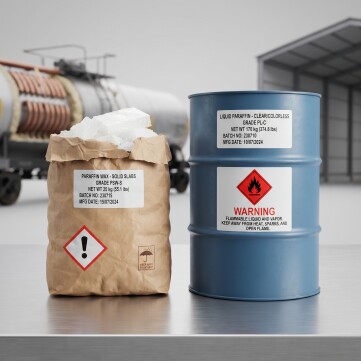
Solid paraffins are supplied in 25-50 kg bags, 500-1000 kg big bags, corrugated cardboard boxes, as well as in bulk in heated tank cars. Liquid paraffins in drums, IBCs and tank cars.
Packaging, Containers and Labeling
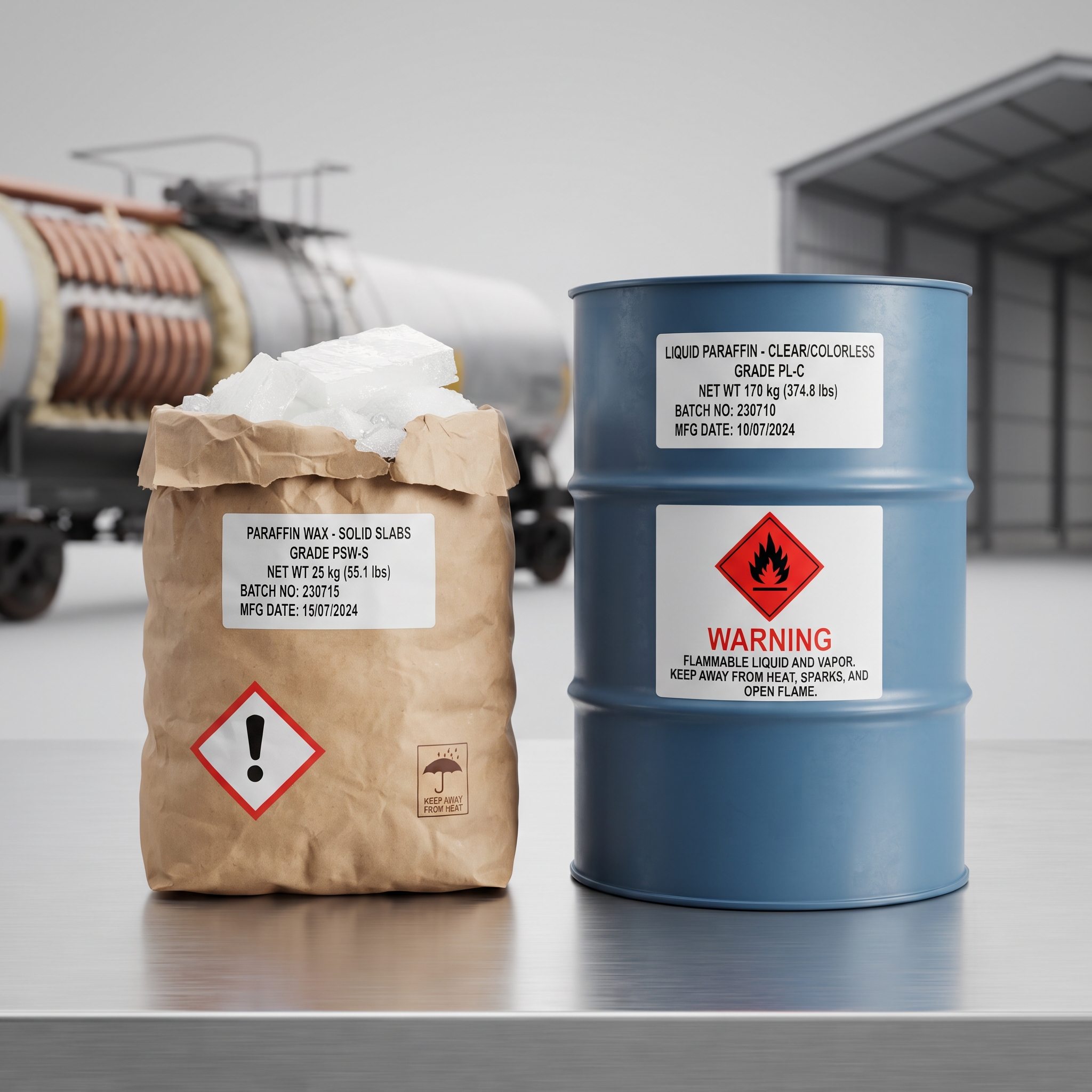
Solid paraffins are packed in four-ply paper bags of grades PM or NM per GOST 2226 with a mass of 50 kg, corrugated cardboard boxes with a mass of 25 kg, and big bags with a polyethylene liner. Food grades use packaging that provides protection from moisture and contamination. Liquid paraffins are filled into steel drums, IBCs and specialized tank cars.
Transport Marking
Transport marking is applied per GOST 14192 with the Keep Dry handling symbol and, for solid paraffins, indication of the temperature regime. Solid paraffins are not classified as a dangerous good under GOST 19433, and class 4.1 hazard labels are not applied to bags and big bags. Liquid paraffins may require a class 3 hazard label depending on flash point. Under GHS, paraffin dust and vapors may be labelled with GHS07 as irritating to the respiratory tract, and liquid forms with GHS02 as flammable liquids.
Storage Conditions
Solid paraffins are stored in closed warehouses, protected from moisture and direct sunlight. Liquid paraffins in sealed tanks. Bulk storage must maintain the temperature above the melting point without overheating.
Regulatory Framework for Incoming Inspection
- GOST 23683-2021 - solid petroleum paraffins. Specifications.
- GOST 23683-89 - predecessor standard often referenced in contracts.
- GOST 1510-2022 - petroleum and petroleum products. Marking, packaging, transport and storage.
- GOST 2226 - paper bags. Specifications.
- GOST 19433-88 - classification and labeling of dangerous goods.
- GOST 30333-2022 - safety data sheet for chemical products.
Mechanism of Action and Functional Role
In candle production, paraffin acts as the main combustible material, providing an even flame and low smoke. In packaging, paraffin creates a barrier layer that reduces vapor permeability and protects food products from drying out and external contamination. In the rubber industry, paraffin acts as an antiozonant, migrating to the rubber surface and protecting it from atmospheric aging.
In cosmetics and pharmaceuticals, paraffin is used as a structure-forming component of ointments, creams and wax compositions. In petrochemistry, liquid paraffins serve as feedstock for sulfonation and production of surfactants, as well as for microbiological synthesis.
Applications by Industry
Candle Production
The largest consumption direction for technical grades T-1 and T-2. Paraffin provides hardness, whiteness and even burning of candles.
Packaging Industry
P-1 and P-2 are used for coating and impregnating food-contact packaging materials, including cheese coatings, paper cups and flexible packaging.
Rubber Industry
Grade V2 and technical paraffins are used as antiozonants and components of rubber compounds.
Cosmetics and Pharmaceuticals
High-purity paraffins are used for creams, ointments, cosmetic waxes and paraffin therapy.
Petrochemical Synthesis
Liquid paraffins serve as feedstock for synthetic detergents, plasticizers, hydrophobizers and demulsifiers.
Comparison of Solid and Liquid Paraffins
Solid paraffins provide mechanical strength, heat resistance and barrier properties, but require heating for liquid application. Liquid paraffins are convenient for dosing and mixing at room temperature but are inferior in strength and heat resistance. Solid paraffins are indispensable for candles and packaging; liquid paraffins for surfactants and plasticizers.
Supplier Selection Criteria and Specification Development
The specification must include the paraffin type (solid or liquid), grade, melting or pour point, penetration, oil content, colour and supply form (bags, big bags, drums, bulk). For food grades, confirmation of suitability for food contact is additionally required.
The supplier confirms quality consistency, availability of a safety data sheet and readiness to ensure the temperature regime during bulk transport.
Typical Processing, Storage and Logistics Errors
- Overheating of paraffin during melting. Leads to oxidation, yellowing and odor deterioration.
- Moisture ingress into solid paraffins. Moisture causes foaming on melting.
- Solidification of bulk paraffin in tank cars. Requires reheating and may damage equipment.
- Mixing different grades without confirmation. May alter melting point and final product properties.
- Neglecting dust protection when handling powder forms. Paraffin dust irritates the respiratory tract.
Quality Control and Laboratory Methods
Incoming inspection includes determination of melting point, penetration, oil mass fraction, colour and mechanical impurity content. For liquid paraffins, pour point, viscosity and n-alkane content. Sampling is performed by standardized methods.
Storage and Transportation Conditions
Solid paraffins are stored in closed warehouses, liquid paraffins in sealed tanks. Transportation is carried out in bags, big bags, drums and in bulk in heated tank cars. When transporting in bulk, the temperature regime is observed.
Finding Analogues and Interchangeability
Solid paraffins can be partially replaced by ceresin or stearin in candle production, but this changes melting point and hardness. Liquid paraffins can be replaced by vaseline oil in some applications, but compatibility must be confirmed.
Supply Routes: Russia, China and Other Regions
Russia has large refineries producing solid and liquid paraffins. Supplies are delivered throughout the country and for export.
Chinese producers supply paraffins of various grades, including food and technical. Other global producers are located in the Middle East, Europe and Asia. Suppliers from these regions are engaged when required, taking into account logistical and regulatory factors.
Logistics and Customs Clearance
Customs clearance includes classification under HS code 2712200000, preparation of a safety data sheet and conformity declaration. The portal provides customs broker services.
Risk Factors and Safety Measures
The main risks are associated with the combustibility and high temperature of molten paraffin. Work is performed with heat-resistant gloves, protective goggles and protective clothing. On heating, vapors may be released that irritate the respiratory tract.
FAQ: Common Questions from Procurement and Process Specialists
How does food-grade paraffin differ from technical paraffin
Food-grade paraffin (P-1, P-2) undergoes deeper refining, has lower oil and impurity content, and is approved for food contact. Technical paraffin (T-1, T-2, T-3) contains more oil and is used in industrial applications not involving food contact.
Which paraffin grade is suitable for candles
Paraffin T-1 with a melting point of 52-56 degrees Celsius and penetration not more than 24 units is typically used for candles. Harder candles may use paraffin with a higher melting point.
In what packaging is solid paraffin supplied
In 25-50 kg paper bags, corrugated cardboard boxes, big bags. In bulk in heated tank cars.
What documents are required for paraffin import
Contract, invoice, packing list, safety data sheet, certificate of quality and transport documents. For food grades, confirmation of suitability for food contact may be required.
Conclusion
Petroleum waxes remain a key feedstock for candle production, packaging, rubber goods, cosmetics and petrochemical synthesis. GOST 23683-2021 establishes ten solid paraffin grades, while liquid paraffins are governed by separate standards. For procurement teams, the practical task reduces to correct type and grade selection, confirmation of batch conformity to the standard, and organization of supplies with observance of the temperature regime for bulk forms and moisture protection for solid forms.
Contact Us
For procurement inquiries and supply chain organization, contact the portal team at info@apptrade.ru.