















Caustic Soda
What Caustic Soda Is and Why It Remains a Base Product of Inorganic Chemistry
Caustic soda, also known as sodium hydroxide or lye (NaOH), is a white solid in the form of flakes, granules or fused blocks, as well as a colorless clear solution. Industrially, it is produced by electrolysis of sodium chloride solution (mercury, diaphragm or membrane process), as well as by the chemical method from soda and lime. Global sodium hydroxide production exceeds 70 million tonnes per year, placing it among the largest-volume chemical products.
For procurement teams, caustic soda matters primarily as a reagent for the pulp and paper industry, aluminum production from bauxite, synthetic detergents, viscose fibers, and for degreasing and cleaning process equipment in the food and other industries. GOST 2263-79 establishes requirements for technical caustic soda of grades TR, TD, RR, RH and RD, while GOST R 55064-2012 covers product intended for the chemical, petrochemical, oil refining, pulp and paper, mining, textile, food industries, non-ferrous metallurgy, energy and microelectronics.
The key feature of caustic soda that determines the entire supply chain is its extremely high corrosiveness toward living tissues and many metals, as well as the hygroscopicity of the solid product and the tendency of solutions to crystallize at low temperatures. The product is classified as a class 8 hazardous good (corrosive substances), UN numbers 1823 for the solid product and 1824 for solutions. This requires specialized packaging, protective measures and strict compliance with transport regulations.
Chemical Identification and Procurement Data
- Chemical name: sodium hydroxide, caustic soda, lye.
- Chemical formula: NaOH.
- Molar mass: 40.00 g/mol.
- CAS number: 1310-73-2.
- UN number: 1823 for solid sodium hydroxide; 1824 for aqueous solutions.
- HS code: 2815110000 for solid product; 2815120000 for solutions.
- Commercial form: flakes, granules, fused blocks (solid product); clear colorless or colored liquid, crystallized sediment permitted (solutions).
In the Russian regulatory system, GOST 2263-79 applies to technical caustic soda intended for the chemical, petrochemical, pulp and paper industries, non-ferrous metallurgy and other sectors. The standard provides for solid grades TR (solid mercury, flaked) and TD (solid diaphragm, fused), as well as solutions RR (mercury solution), RH (chemical solution) and RD (diaphragm solution). The supplier confirms batch conformity to the applicable standard and provides a certificate of quality with actual values for each parameter.
Physical and Chemical Properties Relevant to Processing and Logistics
- Density: 2.13 g/cm3 for the solid product at 20 degrees Celsius.
- Melting point: 318-324 degrees Celsius for solid sodium hydroxide.
- Boiling point: about 1378-1403 degrees Celsius.
- Sodium hydroxide mass fraction: at least 98.5 percent for grade TR; at least 94.0 percent for grade TD; 42.0-46.0 percent for solutions depending on grade and sort.
- Sodium carbonate (Na2CO3) mass fraction: not more than 0.8 percent for TR; not more than 1.0 percent for TD; 0.5-2.0 percent for solutions.
- Sodium chloride (NaCl) mass fraction: not more than 0.05 percent for TR; not more than 3.5 percent for TD; standardized for solutions.
- Iron mass fraction calculated as Fe2O3: not more than 0.004 percent for TR; not more than 0.03 percent for TD.
- Solubility: readily soluble in water, glycerol and ethanol; insoluble in acetone and ether. Dissolution is accompanied by strong heating.
For the processor and logistics specialist, the critical factors are the hygroscopicity of the solid product (absorption of moisture and carbon dioxide from air to form carbonate), the tendency of solutions to crystallize at low temperatures, and the extremely high corrosive attack on aluminum, zinc and their alloys. Handling requires protection of skin, eyes and respiratory tract.
Technical Grades and Supply Forms
Solid Mercury (TR) and Solid Diaphragm (TD)
Grade TR is produced as white flaked mass; slight coloration is permitted. NaOH mass fraction is at least 98.5 percent; sodium chloride content is minimal (not more than 0.05 percent), which is important for demanding applications. Grade TD is produced as white fused mass; slight coloration is also permitted. NaOH mass fraction is at least 94.0 percent, and chloride content is higher (up to 3.5 percent).
Solutions RR, RH and RD
Mercury solution (RR) and chemical solution (RH) are produced with a NaOH mass fraction of 42.0-46.0 percent and are used in productions requiring increased purity for chlorides and iron. Diaphragm solution (RD) also contains 42.0-46.0 percent NaOH but allows wider impurity limits, in particular for sodium chloride (up to 3.0-3.8 percent depending on sort). Solutions are supplied in bulk in specialized tank cars and containers, as well as in welded steel drums.
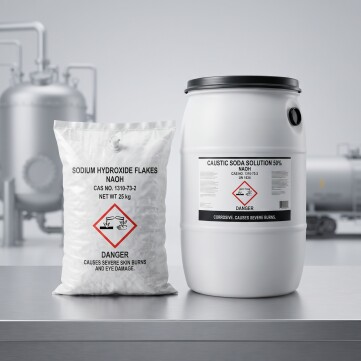
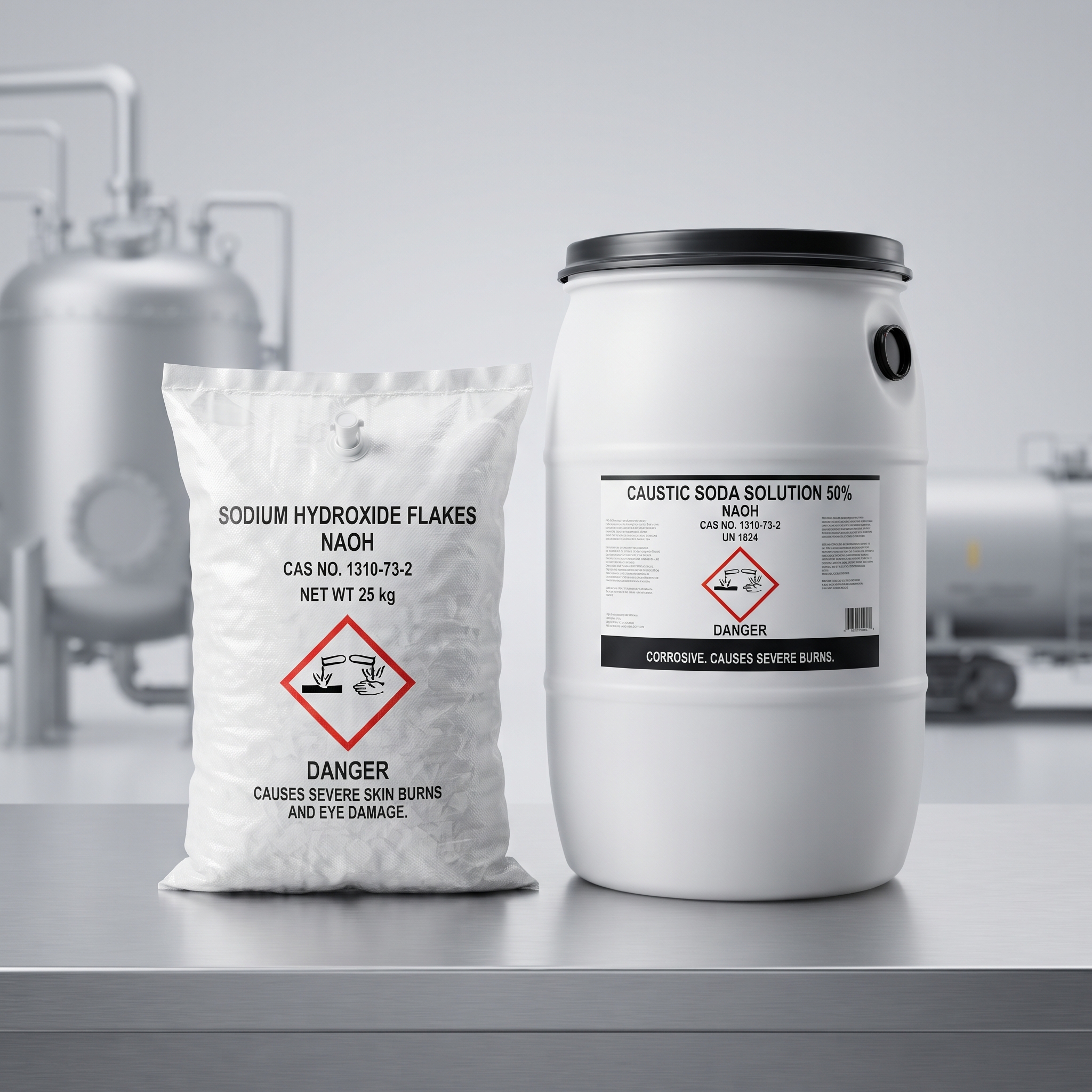
The solid product is supplied in steel drums, polypropylene bags with a polyethylene insert of 25 kg capacity, as well as in flexible specialized containers (big bags) of up to 1000 kg capacity. Polypropylene valve bags with a polyethylene insert protect against atmospheric moisture. Solutions are transported in rail and road tank cars, as well as in welded steel drums per GOST 13950.
Packaging, Containers and Labeling
The choice of packaging for caustic soda is determined by its corrosiveness and hygroscopicity. Aluminum, zinc and their alloys are categorically unsuitable for storage and transport because sodium hydroxide reacts with them to release hydrogen. Paper and cardboard are also unsuitable due to porosity and combustibility.
Solid Product
Packed in polypropylene bags with a polyethylene insert (25 kg), airtight polyethylene FFS bags (25 kg), steel drums, as well as specialized big bags made of polypropylene fabric with a capacity of up to 1000 kg. Bags with solid product must be stored in closed warehouses protected from moisture; the shelf life in original packaging, provided the integrity of the pallet packaging is maintained, is up to 5 years.
Solutions
Transported in bulk in specially designated rail and road tank cars, as well as in welded steel drums of 100-200 dm3 capacity. Storage of solutions is carried out in closed tanks made of materials resistant to caustic alkalis (carbon steel with appropriate coating, stainless steel, polyethylene, polypropylene).
Hazard Labeling
Caustic soda is labeled in accordance with dangerous goods transport rules. Hazard label 8 (corrosive) is mandatory. For the solid product and solutions, the risk of corrosive attack on metals may be additionally indicated. Transport marking includes warning inscriptions and handling signs, including Keep Dry for the solid product.
Regulatory Framework for Incoming Inspection
- GOST 2263-79 - technical caustic soda. Specifications. Establishes requirements for grades TR, TD, RR, RH, RD, analytical methods and acceptance rules.
- GOST R 55064-2012 - technical caustic soda. Specifications. Covers product for the chemical, petrochemical, pulp and paper, mining, textile, food industries and other sectors.
- GOST 12.1.007-76 - classification of hazardous substances. Sodium hydroxide belongs to hazard class 2 (highly hazardous substance).
- GOST 19433 - classification and labeling of dangerous goods.
- GOST 30333-2022 - safety data sheet for chemical products.
- GOST 14192 - cargo marking.
- ISO 979 - technical sodium hydroxide. Test methods for harmonization with international practice.
For imported batches, the specification is based on manufacturer standards and harmonized ISO methods. The batch specification is confirmed by the manufacturer certificate of quality and the results of incoming laboratory control by the recipient.
Mechanism of Action and Functional Role
Sodium hydroxide is a strong base that completely dissociates in aqueous solutions to form sodium and hydroxide ions, creating a highly alkaline environment (pH of concentrated solutions exceeds 13). In the pulp and paper industry, it is used for cellulose cooking: the alkaline environment breaks down lignin, releasing cellulose fibers. In aluminum production, sodium hydroxide dissolves bauxite to form sodium aluminate, from which pure aluminum oxide is then isolated.
In synthetic detergent production, sodium hydroxide saponifies fats and neutralizes acidic components, providing detergency. In the textile industry, it is used for mercerization of cotton (treatment of fiber to impart luster and strength) and for bleaching fabrics. In the food industry, caustic soda solutions are used for degreasing and cleaning process equipment and containers, while contact with food products is not permitted.
For the B2B buyer, it is important to understand that sodium hydroxide concentration and impurity profile directly affect reaction rates, target product quality and corrosive attack on equipment. Chloride and iron impurities can catalyze side reactions, so control under GOST 2263-79 is a mandatory incoming inspection step.
Applications by Industry
Pulp and Paper Industry
One of the largest consumption directions. Sodium hydroxide is used for cellulose cooking (kraft and soda processes), pH control, bleaching and refining of paper pulp.
Aluminum Production and Non-Ferrous Metallurgy
Leaching of bauxite in the Bayer process to produce alumina, as well as refining of other non-ferrous metals and surface treatment.
Chemical and Petrochemical Industry
Production of synthetic detergents, soap, dyes, phenol, acetone, viscose fibers, ion exchange resins and many other chemical compounds. Used as a catalyst and neutralizing agent.
Textile Industry
Mercerization of cotton, bleaching of fabrics, treatment of viscose silk, degreasing of wool. Alkaline treatment imparts luster, strength and improved dyeability to fibers.
Food Industry and Sanitation
Degreasing and cleaning of process equipment, containers and pipelines at dairy plants, fat-and-oil plants, liquor and tobacco enterprises. Contact of working solutions with food products is not permitted.
Other Industries
Water treatment and neutralization of acidic effluents, biodiesel production, oil recovery (in drilling fluids), energy (regeneration of ion exchange resins), microelectronics (etching and cleaning of wafers).
Comparison with Alternative Alkaline Reagents
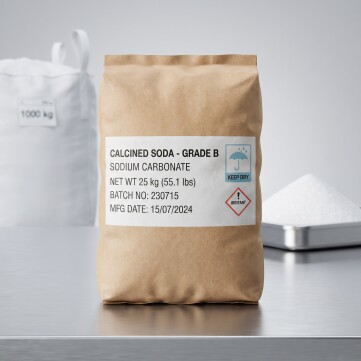
Compared with calcined soda, sodium hydroxide provides significantly higher alkalinity and neutralizing capacity per unit mass, but is more aggressive and hazardous to handle. Compared with potassium hydroxide, sodium hydroxide is cheaper and more available in large-tonnage batches, although it is inferior in some technological parameters, such as solubility of soaps in special applications. Compared with lime, sodium hydroxide gives soluble reaction products and a higher neutralization rate, but requires more complex packaging and safety measures.
In the pulp and paper industry, sodium hydroxide competes with sulfite and sulfate cooking methods, but remains the preferred reagent for soda cooking and pH control. In water treatment, sodium hydroxide can be replaced by lime or soda, but this changes the sludge composition and requires process adjustment.
Supplier Selection Criteria and Specification Development
The specification for caustic soda must include the commercial form (solid product or solution), grade (TR, TD, RR, RH, RD), sort, NaOH mass fraction, limit values for sodium carbonate, chlorides and iron, as well as packaging requirements (bags, drums, big bags, tank cars) and transport conditions.
The supplier confirms batch-to-batch quality consistency, a valid safety data sheet under GOST 30333-2022, readiness to provide packaging that protects against moisture and is compatible with the product (polypropylene, polyethylene, coated steel), and to organize loading in compliance with safety measures. For imported batches, it is important to verify that labeling and actual parameters match, since grade designations may differ.
Typical Processing, Storage and Logistics Errors
- Use of aluminum or zinc packaging. Sodium hydroxide reacts with these metals to release hydrogen, potentially causing loss of containment and an explosive gas concentration.
- Use of paper or cardboard packaging. These materials are porous, hygroscopic and combustible; they do not protect against moisture and can degrade under the action of alkali.
- Violation of sealing of solid product packaging. Sodium hydroxide absorbs moisture and carbon dioxide from air, converting to carbonate and losing activity.
- Freezing or supercooling of solutions. Sodium hydroxide solutions tend to crystallize at low temperatures, potentially causing pipeline blockage and tank rupture.
- Neglecting personal protective equipment. Caustic soda causes severe chemical burns to skin and eyes, up to irreversible damage; work is performed with alkali-resistant gloves, protective goggles or shields, protective clothing and, if necessary, a respirator.
- Co-storage with acids. A violent exothermic neutralization reaction with splashing and heat release is possible; co-storage is not permitted.
- Use of product beyond its shelf life. For the solid product, the shelf life in original packaging is up to 5 years; after this period, incoming inspection is required.
Quality Control and Laboratory Methods
Incoming inspection of caustic soda includes determination of the NaOH mass fraction by titration, sodium carbonate, sodium chloride, iron calculated as Fe2O3, and for solutions also density and insoluble matter content. For solid grades, appearance (color, presence of coloration) and granulometric composition are additionally controlled. Sampling is performed in alkali-resistant containers with observance of safety measures; the combined sample is analyzed in the plant laboratory.
When changing supplier or batch, a control run of the target product is recommended to confirm compatibility with the process.
Storage and Transportation Conditions
Caustic soda is classified as a class 8 dangerous good (corrosive substances), UN numbers 1823 (solid product) and 1824 (solutions). Storage of the solid product is carried out in closed warehouses protected from moisture, in sealed packaging. Solutions are stored in closed tanks made of materials resistant to caustic alkalis, with heating in winter to prevent crystallization.
Transportation of the solid product is carried out in covered vehicles in bags, drums and big bags. Solutions are transported in bulk in specially designated rail and road tank cars, as well as in welded steel drums. Dangerous goods transport rules are observed, including requirements for labeling and packaging compatibility.
Finding Analogues and Interchangeability
There is no direct analogue of sodium hydroxide as a strong alkali in large-tonnage processes. In some applications, such as certain neutralization processes, sodium hydroxide can be replaced by calcined soda or potassium hydroxide, but this changes the alkalinity of the medium, the composition of reaction products and requires process revision. In the pulp and paper industry, replacement of sodium hydroxide with other alkaline reagents is limited by fiber quality requirements.
When changing supplier, a product of the same grade and sort with similar main substance and impurity parameters is selected. The replacement decision is based on laboratory testing and, for critical processes, pilot-scale verification.
Supply Routes: Russia, China and Other Regions
Domestic supply is provided by chemical complexes with caustic soda production capacity. Products are supplied to the domestic market and for export. Shipment is by rail in tank cars for solutions, by road in tank cars and drums, and the solid product in bags and big bags.
Chinese producers have large sodium hydroxide capacities. Supplies are delivered by sea with subsequent transfer to rail or road transport, in compliance with dangerous goods requirements. Other global producers are located in the Middle East, Southeast Asia and Europe. Suppliers from these regions are engaged when required, taking into account logistical and regulatory factors.
Risk Factors and Safety Measures
The main risks are associated with chemical burns to skin and eyes, damage to the respiratory tract on inhalation of solution aerosol, and the release of explosive hydrogen on contact with aluminum, zinc and certain other metals. Sodium hydroxide belongs to hazard class 2 (highly hazardous substance) per GOST 12.1.007-76.
Work is performed in ventilated rooms with alkali-resistant gloves, protective goggles or shields, protective clothing and, if necessary, filtering respirators. Emergency showers and eyewash fountains must be provided near workplaces. In case of skin or eye contact, the affected area must be immediately flushed with plenty of water for at least 15 minutes and medical attention sought. In case of a spill, solutions are neutralized with dilute acids, then collected and disposed of. Discharge of concentrated alkali solutions into sewers and water bodies without prior neutralization is not permitted.
FAQ: Common Questions from Procurement and Process Specialists
How does grade TR differ from grade TD under GOST 2263-79
Grade TR (solid mercury) is produced as flakes and contains at least 98.5 percent NaOH with minimal sodium chloride content (not more than 0.05 percent). Grade TD (solid diaphragm) is produced as fused mass and contains at least 94.0 percent NaOH; higher chloride content is permitted (up to 3.5 percent). Grade TR is preferred for demanding applications where product purity is important.
Which packaging is suitable for solid caustic soda storage
Polypropylene bags with a polyethylene insert (25 kg), airtight polyethylene FFS bags, steel drums, and specialized big bags made of polypropylene fabric with a capacity of up to 1000 kg are used for the solid product. Aluminum, zinc, paper and cardboard packaging are unsuitable.
Can caustic soda solutions be stored in ordinary steel tanks
Yes, but taking into account concentration and temperature. For concentrated solutions at moderate temperatures, carbon steel is often used; however, at elevated temperatures and concentrations, stainless steel or polymer coatings are required. Aluminum and zinc are not permitted. Tanks must be equipped with heating to prevent crystallization in winter.
What hazard labels must be on caustic soda packaging
Hazard label 8 (corrosive) is mandatory. For the solid product, the Keep Dry handling symbol may additionally be indicated. Transport marking is applied in accordance with dangerous goods transport rules.
What documents are required for caustic soda import
Import requires a contract, invoice, packing list, safety data sheet under GOST 30333-2022 in Russian, manufacturer certificate of quality, transport documents and a declaration of conformity. For dangerous goods, transport permits and compliance with carriage rules are additionally confirmed.
Conclusion
Caustic soda remains an indispensable large-tonnage inorganic product, enabling the pulp and paper industry, aluminum production, synthetic detergents, viscose fibers and equipment cleaning. GOST 2263-79 establishes solid grades TR and TD and solutions RR, RH and RD, differing in concentration and impurity content. For procurement teams, the practical task reduces to correct selection of commercial form and grade, confirmation of batch conformity to the standard, and organization of supplies in compliance with requirements for alkali-resistant packaging, moisture protection and safety measures when handling a class 8 hazardous good.
Contact Us
For procurement inquiries and supply chain organization, contact the portal team at info@apptrade.ru.