














Calcined Soda
What Calcined Soda Is and Why It Remains a Base Product of Inorganic Chemistry
Calcined soda, or sodium carbonate (Na2CO3), is a white crystalline powder or granules without odor, readily soluble in water. Industrially, it is produced by the ammonia-soda process (Solvay process) from sodium chloride, ammonia and carbon dioxide, as well as from nepheline raw materials and natural soda. Global calcined soda production exceeds 50 million tonnes per year, placing it among the largest-volume inorganic chemical products.
For procurement teams, calcined soda matters primarily as a raw material for the glass industry, which accounts for about half of global consumption, as well as a reagent for synthetic detergents, cellulose, aluminum, chemical fibers and various sodium salts. GOST 5100-85 establishes requirements for technical soda of grades A and B, enabling selection of the product for a specific process and handling conditions.
The key feature of calcined soda that determines the entire supply chain is its hygroscopicity and tendency to cake when moistened, as well as the alkaline reaction of its solutions, which requires protection of skin and eyes. The material is classified as a moderately hazardous substance of the third class, but during transport it may be classified as a non-hazardous cargo, simplifying logistics compared to acids and alkalis.
Chemical Identification and Procurement Data
- Chemical name: sodium carbonate, disodium carbonate, carbonic acid sodium salt.
- Chemical formula: Na2CO3.
- Molar mass: 105.99 g/mol.
- CAS number: 497-19-8.
- HS code: 2836200000.
- Hazard class: 3 (moderately hazardous substance) per GOST 12.1.007-76; during transport it may be classified as a non-hazardous cargo.
- Commercial form: white granules (grade A) or white powder (grade B).
In the Russian regulatory system, the primary document for technical calcined soda is GOST 5100-85, which covers product intended for the chemical, glass, electronic, pulp and paper and other industries, as well as for export. The standard provides for grades A and B, each divided into premium, first and second grade. The supplier confirms batch conformity to GOST 5100-85 and provides a certificate of quality with actual values for each parameter.
Physical and Chemical Properties Relevant to Processing and Logistics
- Sodium carbonate (Na2CO3) mass fraction: at least 99.4 percent for grade A premium; at least 99.0 percent for grade A first and grade B premium; at least 98.5 percent for grade A second and 99.0 percent for grade B first.
- Na2CO3 mass fraction calculated on a non-calcined basis: at least 98.7 percent for grade A premium; at least 98.2 percent for grade A first; at least 97.0 percent for grade A second; at least 98.9 percent for grade B premium; at least 98.2 percent for grade B first; at least 97.5 percent for grade B second.
- Loss on ignition at 270-300 degrees Celsius: not more than 0.7 percent for grade A premium; not more than 0.8 percent for first grade; not more than 1.5 percent for second grade.
- Chloride mass fraction calculated as NaCl: not more than 0.2 percent for grade A premium; not more than 0.5 percent for first grade; not more than 0.8 percent for second grade.
- Iron mass fraction calculated as Fe2O3: not more than 0.003 percent for premium grades A and B; not more than 0.005 percent for grade A first; not more than 0.008 percent for second grade.
- Water-insoluble matter mass fraction: not more than 0.04 percent for premium and first grade; not more than 0.08 percent for second grade.
- Bulk density: 0.5-1.2 g/cm3 depending on granulometric composition.
For the processor and logistics specialist, the critical factors are the hygroscopicity of soda, its tendency to cake during storage in humid environments, and dust generation during loading. Soda solutions have an alkaline reaction, requiring protection of skin and eyes during work.
Technical Grades and Supply Forms
Grade A
Intended for the production of electrovacuum glass and other purposes requiring high product purity. Produced as white granules. Na2CO3 content is at least 99.4 percent for premium, 99.0 percent for first and 98.5 percent for second grade.
Grade B
Used in the chemical, glass and other industries. Produced as white powder. Na2CO3 content is at least 99.4 percent for premium, 99.0 percent for first and 99.0 percent for second grade (with somewhat wider tolerances for certain impurities).
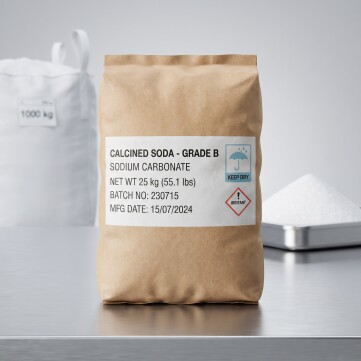
Supply is in four-ply paper sacks per GOST 2226 grade PM, in flexible specialized containers (big bags) of up to 1000 kg capacity, as well as in bulk in covered hopper cars or specialized containers. Grade A is supplied mainly in MKR 1.0 type containers of up to 1000 kg capacity.
Regulatory Framework for Incoming Inspection
- GOST 5100-85 - technical calcined soda. Specifications.
- GOST 10689-75 - technical calcined soda from nepheline raw materials. Specifications (for nepheline-derived product).
- GOST 2226 - paper sacks. Specifications.
- GOST 14192 - cargo marking.
- GOST 19433 - classification and labeling of dangerous goods; group code 923 applies to soda.
- GOST 12.1.007-76 - classification of hazardous substances; soda belongs to hazard class 3.
For imported batches, the specification is based on manufacturer standards and harmonized ISO methods. The batch specification is confirmed by the manufacturer certificate of quality and the results of incoming laboratory control by the recipient.
Mechanism of Action and Functional Role
Calcined soda is a source of sodium oxide (Na2O) in glass batches: on heating it reacts with silica, lowering the melting point and viscosity of the glass melt. In synthetic detergent production, soda provides the alkaline environment necessary for saponification of fats and neutralization of acidic contaminants. In the pulp and paper industry, it is used for cellulose cooking and pH control.
In metallurgy, soda is used for metal refining, removal of sulfur and phosphorus, and for aluminum production from bauxite. In chemical synthesis, it serves as a raw material for glass, sodium silicates, phosphates, dyes and other compounds. In water treatment, soda is used for neutralization of acidic effluents and water softening.
Applications by Industry
Glass Industry
The largest consumption direction. Soda is used for the production of flat, container, automotive, optical, medical and electrovacuum glass, as well as crystal and glass blocks. This segment accounts for about half of global soda consumption.
Chemical Industry
Production of synthetic detergents, soap, dyes, sodium silicates, phosphates and other chemical compounds. Soda is also used for acid neutralization and pH control.
Pulp and Paper Industry
Cellulose cooking, pH control, paper and cardboard production. Soda promotes wood delignification and improves fiber quality.
Metallurgy
Refining of non-ferrous metals, removal of sulfur and phosphorus from steel, aluminum production from bauxite, as well as metal surface treatment before coating.
Other Industries
Water treatment and effluent neutralization, production of building materials, textile and leather industries, food industry (as an acidity regulator).
Comparison with Alternative Alkaline Reagents
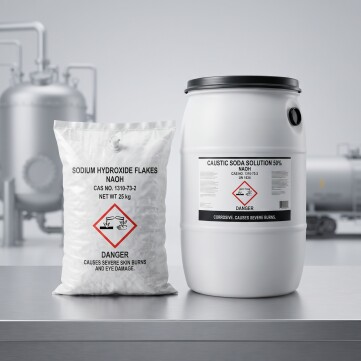
Compared with sodium hydroxide, calcined soda provides a milder alkaline environment and is safer to handle, but is inferior in neutralizing capacity per unit mass. Compared with sodium bicarbonate (baking soda), calcined soda is a stronger alkali and is used in industrial processes requiring high alkalinity. Compared with potassium hydroxide, soda is cheaper and more available in large-tonnage batches.
In the glass industry, soda competes with sodium sulfate and potash, but remains the preferred source of Na2O due to its optimal balance of cost and technological properties. In water treatment, soda can be replaced by lime, but this changes the sludge composition and requires process adjustment.
Supplier Selection Criteria and Specification Development
The specification for calcined soda must include the grade (A or B), sort (premium, first, second), Na2CO3 mass fraction, limit values for chlorides, iron and insoluble matter, as well as packaging requirements (sacks, big bags, bulk) and transport conditions.
The supplier confirms batch-to-batch quality consistency, a valid safety data sheet under GOST 30333-2022, readiness to provide packaging that protects against moisture and to organize shipment in compliance with safety measures. For imported batches, it is important to verify that labeling and actual parameters match.
Typical Processing, Storage and Logistics Errors
- Violation of storage conditions. Soda is hygroscopic; storage in humid areas leads to caking and loss of flowability. The product should be stored in closed warehouses protected from moisture ingress.
- Use of damaged packaging. Damage to paper sacks or big bags leads to moistening and contamination of the product.
- Neglecting personal protective equipment. Soda dust irritates the respiratory tract and mucous membranes, and solutions cause skin irritation; work is performed with a respirator, protective goggles and gloves.
- Co-storage with acids. A violent neutralization reaction with carbon dioxide release is possible; co-storage is not permitted.
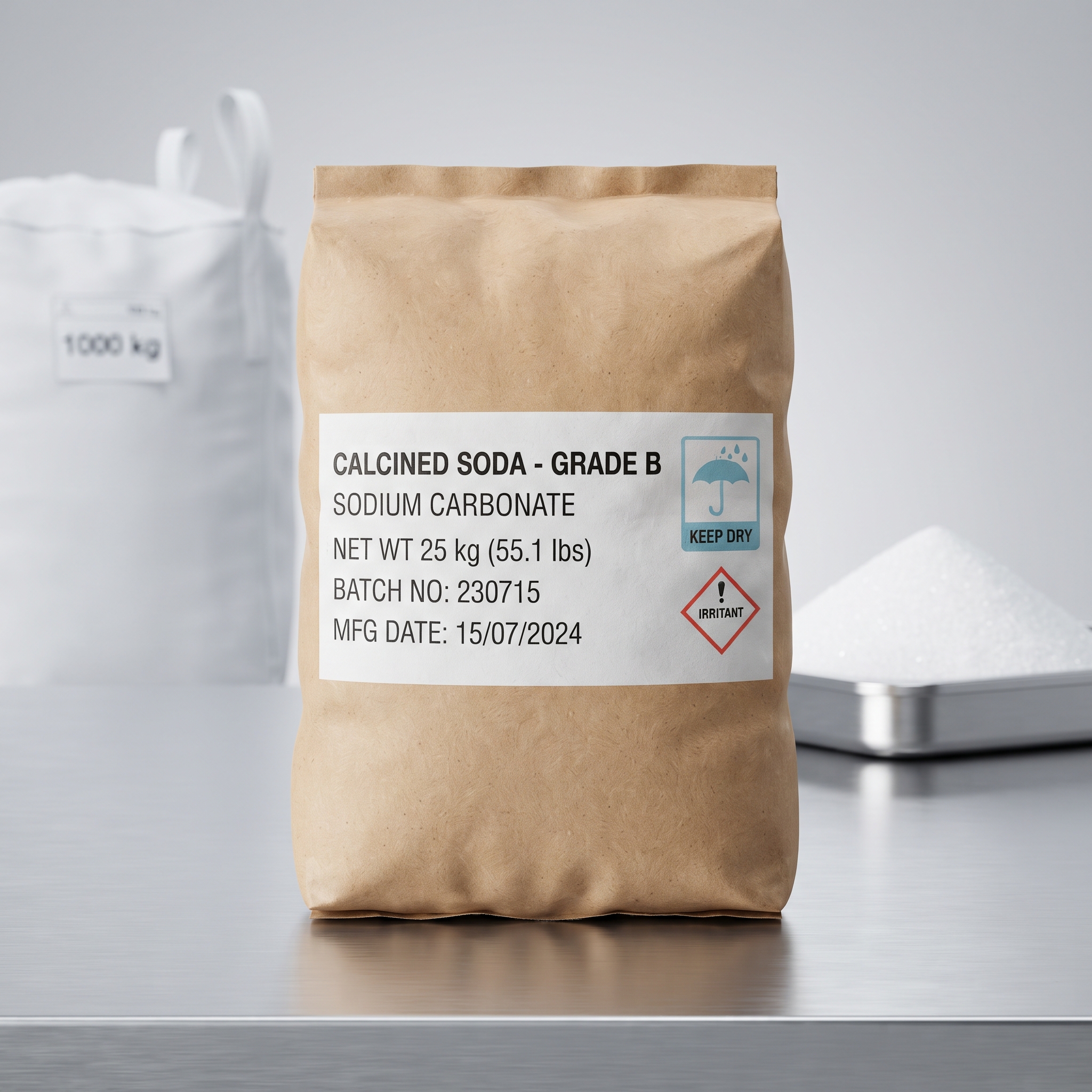
- Errors in dangerous goods documentation. During transport, soda may be classified as a non-hazardous cargo, but marking must include the keep dry handling symbol.
- Use of soda beyond its shelf life. The shelf life is 3 months from the date of manufacture; after this period, incoming inspection is required.
Quality Control and Laboratory Methods
Incoming inspection of calcined soda includes determination of the Na2CO3 mass fraction by titration, loss on ignition, chloride, iron and water-insoluble matter content. For grade A, granulometric composition is additionally controlled. Sampling is performed by standardized methods; the combined sample is analyzed in the plant laboratory.
When changing supplier or batch, a control run of the target product is recommended to confirm compatibility with the process.
Storage and Transportation Conditions
Calcined soda is stored in closed warehouses protected from moisture ingress. Specialized flexible containers may be stored on open platforms. The shelf life is 3 months from the date of manufacture.
Transportation is by rail, road and river transport. Packaged soda is carried in covered rail cars; soda in specialized or flexible MKR containers is carried on open rolling stock. Bulk soda is transported in covered hopper cars or specialized containers.
Finding Analogues and Interchangeability
When replacing calcined soda, a product of the same grade and sort with similar main substance and impurity parameters is selected. Replacing grade A with grade B is possible in processes not requiring high product purity, but requires confirmation of final product properties. Replacing soda with sodium hydroxide or sodium bicarbonate is possible only with revision of the formulation and technology.
The replacement decision is based on laboratory testing and, for critical processes, pilot-scale verification.
Supply Routes: Russia, China and Other Regions
Domestic supply is provided by chemical complexes with calcined soda production capacity. Products are supplied to the domestic market and for export. Shipment is by rail in covered cars and hoppers, and by road in sacks and big bags.
Chinese producers have large calcined soda capacities. Supplies are delivered by sea with subsequent transfer to rail or road transport. Other global producers are located in the Middle East, Southeast Asia and Europe. Suppliers from these regions are engaged when required, taking into account logistical and regulatory factors.
Risk Factors and Safety Measures
The main risks are associated with irritation of skin and mucous membranes on contact with soda dust or solution, as well as the risk of environmental contamination. Soda belongs to moderately hazardous substances of the third class, with a maximum permissible dust concentration in the working area air of 2 mg/m3.
Work is performed in ventilated rooms with respirators, protective goggles and gloves. In case of a spill, soda is collected mechanically and residues are washed off with plenty of water. Discharge of concentrated soda solutions into water bodies without prior neutralization is not permitted.
FAQ: Common Questions from Procurement and Process Specialists
How does grade A differ from grade B under GOST 5100-85
Grade A is intended for the production of electrovacuum glass and other purposes requiring high purity; it is produced as granules. Grade B is used in the chemical, glass and other industries; it is produced as powder. Grade A has stricter limits for chlorides and iron.
Which packaging is suitable for calcined soda storage
Four-ply paper sacks per GOST 2226 grade PM, flexible specialized containers (big bags) of up to 1000 kg capacity, and specialized MKR containers are used for packaging. Bulk soda is stored in covered hopper cars or special containers.
Is calcined soda a hazardous cargo
During transport, soda may be classified as a non-hazardous cargo, but it belongs to moderately hazardous substances of the third class by health impact. Marking includes the keep dry handling symbol.
What is the shelf life of calcined soda
The shelf life is 3 months from the date of manufacture under proper transport and storage conditions. After this period, incoming inspection is required.
What documents are required for calcined soda import
Import requires a contract, invoice, packing list, safety data sheet under GOST 30333-2022 in Russian, manufacturer certificate of quality and transport documents. The portal organizes the preparation of the document set and interaction with the customs broker.
Conclusion
Calcined soda remains an indispensable large-tonnage inorganic product, enabling the glass, chemical, pulp and paper and metallurgical industries. GOST 5100-85 establishes grades A and B with sort divisions, enabling selection of the product for a specific process. For procurement teams, the practical task reduces to correct selection of grade and sort, confirmation of batch conformity to the standard, and organization of supplies with storage conditions that exclude moistening and caking of the product.
Contact Us
For procurement inquiries and supply chain organization, contact the portal team at info@apptrade.ru.