Diammonium Phosphate (DAP)
Diammonium Phosphate: Technical Overview for Agro-Industrial Applications
Diammonium phosphate (DAP, diammonium hydrogen phosphate) is a high-analysis granular nitrogen-phosphorus fertilizer produced by neutralizing phosphoric acid with ammonia, followed by crystallization and granulation. In the agro-industrial complex, DAP occupies a leading position among phosphorus-containing fertilizers due to its high nutrient content and good physical properties. Its primary function is to supply plants with available phosphorus and ammonium nitrogen, which is especially important on acidic soils where phosphate mobility is limited. DAP is also widely used in industry for impregnating wood and fabrics to impart fire resistance, as well as in the food and pharmaceutical industries.
Chemical Identification
Diammonium phosphate is identified by CAS 7783-28-0, empirical formula (NH4)2HPO4, relative molecular mass 132.06. Synonyms include diammonium phosphate, DAP, diammonium hydrogen phosphate, and ammonium phosphate dibasic. In international trade, it is classified under HS heading 3105 30 000 0 as diammonium hydrogenorthophosphate (diammonium phosphate). DAP is not classified as dangerous goods for transport: according to international codes, it has no special hazardous properties and is a non-flammable or poorly flammable cargo. The substance is hygroscopic and may harden under humid conditions, which must be considered during storage and transportation.
Physicochemical Properties
Diammonium phosphate consists of white crystals or granules, depending on the grade, with a yellowish or gray tint. The phosphorus oxide (V) content is 50-52 percent, and ammonia content is 23-23.5 percent. In the fertilizer grade, the nitrogen mass fraction is about 18 percent, total phosphates about 46 percent, and moisture not more than 1.8 percent. The pH of a one-molar solution ranges from 7.6 to 8.2, indicating a slightly alkaline reaction. Water solubility is high: at 20 degrees Celsius, about 71 g dissolves in 100 g of water. Bulk density of the granular product is approximately 890 to 1040 kg/m3. The granulometric composition of the fertilizer grade is typically in the range of 1 to 4 mm. DAP has low hygroscopicity compared with some other fertilizers; however, under high humidity it tends to cake.
Technical Grades and Supply Forms
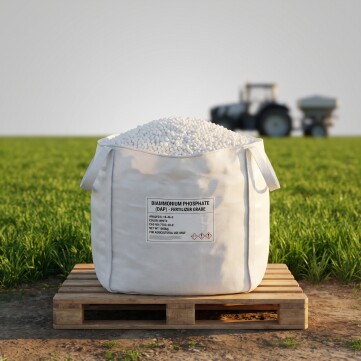
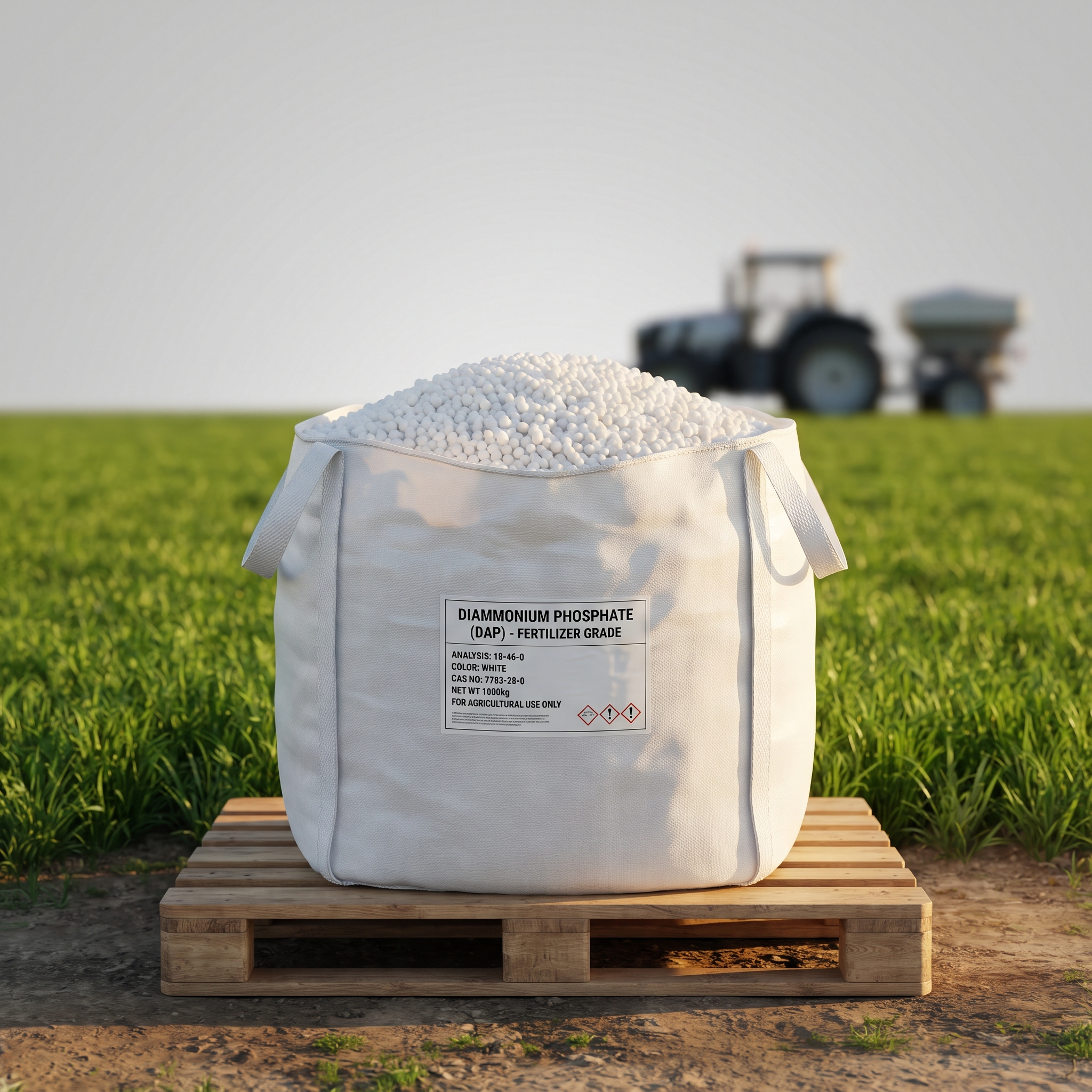
Diammonium phosphate is produced under GOST 8515-75, which covers the product obtained by neutralizing thermal or extraction phosphoric acid with ammonia. The standard provides for several grades, including those for industrial purposes (wood and fabric impregnation, food and pharmaceutical industry) and for agriculture as a fertilizer. A separate standard exists for feed-grade DAP. Fertilizer-grade DAP is supplied in bulk in rail cars and road transport, in polypropylene bags, and in big bags. Typical agricultural bulk shipments start from one tonne; for large agroholdings and traders, from 20 tonnes and more.
Regulatory Framework
In the EAEU region, quality of diammonium phosphate is governed by GOST 8515-75 Diammonium Phosphate. Specifications. The standard sets requirements for physicochemical indicators, packaging, marking, transportation, and storage. Products intended for agriculture, as mineral fertilizers, are subject to conformity declaration under the EAEU technical regulation on requirements for mineral fertilizers, which sets radiation and chemical safety norms. For customs purposes, the explanatory notes to HS heading 3105 30 000 0 apply.
Mechanism of Action and Functional Role
When applied to soil, diammonium phosphate dissociates to release ammonium and phosphate ions. The ammonium ion is absorbed by the soil complex and gradually nitrified by microorganisms, providing prolonged nitrogen nutrition. Phosphate ions, depending on the soil solution reaction, convert into forms available to plants. Due to its slightly alkaline reaction, DAP is particularly effective on acidic soils, where it not only supplies plants with phosphorus but also helps to somewhat reduce acidity in the local application zone. Phosphorus plays a key role in energy metabolism, root system development, and the formation of reproductive organs, while nitrogen is essential for protein and chlorophyll synthesis.
Applications by Industry
Agriculture is the largest consumer of diammonium phosphate. The product is used as a basal fertilizer for all agricultural crops on various soil types, especially acidic ones. DAP is also used for starter (banded) application and for preparing fertilizer blends. Its high phosphorus concentration makes it particularly valuable for crops with increased demand for this element in early development stages. In industry, diammonium phosphate is used for impregnating wood and fabrics to impart fire resistance, in match production, in the food industry as an emulsifier and acidity regulator, and in pharmaceuticals.
Comparison with Alternative Materials
Compared with monoammonium phosphate (MAP, ammophos), diammonium phosphate contains more nitrogen and less phosphorus, and its solution has a slightly alkaline reaction, whereas MAP solution is slightly acidic. This makes DAP preferable on acidic soils. Compared with simple superphosphate, DAP provides a significantly higher phosphorus concentration and additionally contains nitrogen, reducing logistics costs per unit of active ingredient. Compared with complex fertilizers such as NPK blends, DAP is simpler in composition and allows flexible nutrition adjustment by mixing with other components.
Typical Processing Errors
- Storing DAP under high humidity without protection from atmospheric precipitation, leading to caking and loss of flowability.
- Mixing diammonium phosphate with fertilizers containing free lime or calcium without considering compatibility, which may reduce phosphorus availability.
- Surface application without incorporation into the soil, especially on acidic soils, reducing phosphorus nutrition efficiency.
- Using DAP with impaired granulometric composition (elevated dust fraction) in fertilizer blends, leading to component segregation.
- Neglecting moisture content control when receiving product delivered during the rainy season or with damaged packaging.
Quality Control and Laboratory Methods
Incoming inspection of diammonium phosphate includes determination of appearance and granule color, total nitrogen mass fraction, available phosphate mass fraction calculated as phosphorus oxide, water mass fraction, granulometric composition, and pH of the solution. Nitrogen content is determined by ammonia distillation after sample decomposition. Phosphorus content is determined by photometric or titrimetric method. Test methods are governed by GOST 8515-75 and relevant standards for mineral fertilizer analysis.
Storage and Transportation Conditions
Diammonium phosphate is stored in closed, dry warehouses excluding atmospheric precipitation and groundwater ingress. Product packaged in big bags or sacks may be stored on pallets. When storing in bulk, mixing with other fertilizers should be avoided. DAP is not classified as dangerous goods for transport; however, it is a hygroscopic cargo, and during bulk sea shipments the risk of hardening under high humidity must be considered. Transportation is carried out by all modes of transport in accordance with cargo transport rules. In bulk, DAP is transported in dedicated self-unloading rail cars, closed deck ships, and road vehicles equipped with a tarpaulin.
Finding Analogues and Interchangeability
When selecting an analogue for diammonium phosphate, the key criteria are available phosphorus content, nitrogen content, solution pH, and granulometric composition. For acidic soils, DAP is preferable due to its slightly alkaline reaction. For starter application on neutral soils, replacement with monoammonium phosphate is possible with nitrogen dosage adjustment. For fertilizer blend preparation, DAP can be partially replaced by other phosphorus-containing components while maintaining the calculated nutrient content. Direct substitution without consideration of soil agrochemical parameters is not recommended.
Supply Scheme
For agricultural producers and industrial buyers, diammonium phosphate is available worldwide through the apptrade.ru platform. Shipments can be organized from producing regions across different continents, with logistics and customs support adapted to the destination market. International sourcing allows buyers to balance cost and lead time depending on batch size and logistical distance, especially for bulk sea shipments.
Logistics and Customs Clearance
DAP is transported by sea, rail, and road. For large batches, bulk transport in sea vessels or dedicated rail cars is economically viable; for medium and small volumes, big bags and sacks are used. When imported into the EAEU, products are classified under HS heading 3105 30 000 0. As DAP is not dangerous goods, special dangerous goods packaging and marking requirements do not apply; however, phytosanitary and sanitary norms must be observed, and the hygroscopic nature of the cargo must be considered during sea transport. The portal customs broker prepares declarations, confirms classification codes, and manages non-tariff regulation procedures.
FAQ
What is the difference between diammonium phosphate (DAP) and monoammonium phosphate (MAP)?
DAP contains about 18 percent nitrogen and 46 percent phosphates, and its solution has a slightly alkaline reaction (pH 7.6-8.2). MAP contains less nitrogen (10-12 percent) and more phosphorus (44-52 percent), and its solution is slightly acidic. DAP is preferable on acidic soils, while MAP is preferable on neutral and alkaline soils.
Can DAP be used for all crops?
Yes, diammonium phosphate is a universal fertilizer for all agricultural crops on various soil types, especially acidic ones. It is effective as a basal fertilizer and for starter application.
Is diammonium phosphate classified as dangerous goods for transport?
No, DAP is not classified as dangerous goods. According to international codes, it has no special hazardous properties and is a non-flammable or poorly flammable cargo. However, it is hygroscopic and may harden under humid conditions.
What is the phosphorus content in diammonium phosphate?
The phosphorus oxide (V) content is 50-52 percent. In the fertilizer grade, the total phosphate mass fraction is about 46 percent.
What is the shelf life of diammonium phosphate?
The guaranteed shelf life of DAP under proper storage in closed dry warehouses is typically several months; specific periods should be confirmed with the manufacturer. After expiry, the product must undergo laboratory testing before use.
Can DAP be mixed with other fertilizers?
DAP can be mixed with most fertilizers; however, mixing with materials containing free lime or calcium should be avoided to prevent loss of phosphorus availability. Compatibility testing is recommended before preparing fertilizer blends.
Conclusion
Diammonium phosphate (DAP) remains one of the most in-demand phosphorus-containing fertilizers due to its high phosphorus content, nitrogen presence, and particularly effective action on acidic soils. For agro-industrial buyers, critical factors include batch-to-batch consistency, especially phosphate content and moisture, correct customs classification, and compliance with storage conditions to prevent caking. The apptrade.ru portal organizes the full supply cycle, from grade selection for a specific crop and soil condition to customs clearance and delivery to the manufacturing site.
Contact Us
For procurement inquiries, technical documentation, and logistics coordination, contact the apptrade.ru team at info@apptrade.ru.