Industrial and Transmission Oils
What Industrial and Transmission Oils Are and Why They Form Two Lubricant Classes
Industrial oils are refined distillate and residual petroleum oils or their blends used to lubricate friction units of industrial equipment, hydraulic systems, guideways, and lightly and moderately loaded gears. According to GOST 20799-88, they belong to subgroup A and contain no additives, making them suitable for conditions that do not impose special requirements on oxidation and corrosion resistance. Transmission oils per GOST 23652-79 are intended for lubricating vehicle transmission units, road construction machines and industrial gearboxes, and contain functional additives providing extreme-pressure, antioxidant and anticorrosion properties.
For procurement teams, it is important to distinguish these classes by purpose and composition. Industrial oils of the I series are used in machine tools, presses, hydraulics and as base oils for further compounding. Transmission oils of the TM series are used in manual gearboxes, drive axles, transfer cases and gearboxes where high contact loads act and extreme-pressure properties are required. Modern classification by ISO VG viscosity (ISO 3448) and by API GL-4 and GL-5 performance categories allows Russian grades to be correlated with international standards and an analogue to be selected for a specific unit.
The key feature of the group that determines logistics is combustibility and sensitivity to contamination. Oils have high flash points but remain combustible liquids, and ingress of water and mechanical impurities sharply reduces their performance. This requires sealed packaging, protection from moisture and cleanliness during storage and transfer.
Chemical Identification and Procurement Data
- Chemical name: industrial oil, transmission oil, petroleum-based lubricating oil.
- Main components: mixture of hydrocarbons (paraffinic, naphthenic, aromatic); transmission oils additionally contain extreme-pressure, antioxidant, anticorrosion and pour-point depressant additives.
- CAS number: various numbers apply to base oils depending on fractional composition; finished oils are identified by the normative document.
- HS code: 2710198200 to 2710198800 for industrial and transmission oils depending on petroleum content.
- UN number: generally not assigned; oils are not classified as dangerous goods under normal conditions if the flash point is above 60 degrees Celsius.
- Commercial form: clear liquid from light yellow to brown.
In the Russian regulatory system, industrial oils are governed by GOST 20799-88, which establishes grades I-5A, I-8A, I-12A, I-20A, I-30A, I-40A and I-50A and requirements for their physical and chemical parameters. Classification and designation of industrial oils are established by GOST 17479.4-87, which is harmonized with ISO 3448 for viscosity classes. Transmission oils are governed by GOST 23652-79, which establishes grades TEp-15, TSp-10, TSp-15K, TAp-15V, TSp-14gip and TAD-17i. The supplier confirms batch conformity to the applicable standard and provides a certificate of quality with actual values for each parameter.
Quality Parameters Relevant to Processing
For industrial oils per GOST 20799-88, the key parameters are kinematic viscosity at 40 degrees Celsius, acid number, ash content, sulphur content, water and mechanical impurity content, flash point and pour point. For grade I-20A, kinematic viscosity at 40 degrees Celsius is 29-35 mm2/s (ISO VG 32 class), flash point not lower than 190 degrees Celsius, pour point not higher than minus 15 degrees Celsius. For grade I-40A, viscosity is 61-75 mm2/s (ISO VG 68 class), flash point not lower than 210 degrees Celsius.
For transmission oils per GOST 23652-79, kinematic viscosity at 100 and 50 degrees Celsius, dynamic viscosity at sub-zero temperatures, flash point, viscosity index, pour point, mechanical impurity and water content, corrosiveness to metals and active element content of additives are standardized. For grade TAD-17i, kinematic viscosity at 100 degrees Celsius is about 17.5 mm2/s, flash point not lower than 200 degrees Celsius, pour point not higher than minus 25 degrees Celsius, viscosity index not less than 100.
For the processor, viscosity stability and additive content are critical. For industrial oils, cleanliness and absence of water are important because they contain no corrosion inhibitors. For transmission oils, extreme-pressure properties and compatibility with non-ferrous metal synchronizers are critical, especially for GL-4 category oils.
Technical Grades and Supply Forms
Industrial Oils (GOST 20799-88)
Grades I-5A, I-8A and I-12A are light oils used for high-speed mechanisms and hydraulics. I-20A, I-30A, I-40A and I-50A are medium and heavy oils used in machine tool hydraulic systems, presses, sliding and rolling guideways, and for lubricating lightly and moderately loaded gears. I-20A oil is widely used in hydraulic systems of industrial equipment and road construction machines operating outdoors at temperatures from minus 5 to plus 70 degrees Celsius.
Transmission Oils (GOST 23652-79)
Grade TEp-15 is used in cylindrical, bevel and worm gears. TSp-10 is used in truck gearboxes. TSp-15K is intended for transmissions of KamAZ, UralAZ, UAZ, KrAZ and MAZ vehicles. TAp-15V is used in gearboxes with cylindrical, bevel and worm gears, as well as in transmissions of road construction machines. TSp-14gip belongs to the TM-4 group (API GL-4) and is used in hypoid gears of trucks. TAD-17i belongs to the TM-5 group (API GL-5) and is a universal oil for heavily loaded cylindrical, spiral-bevel and hypoid gears of trucks and passenger cars.
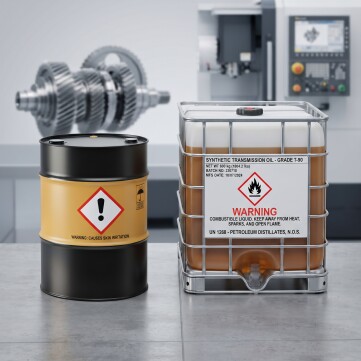
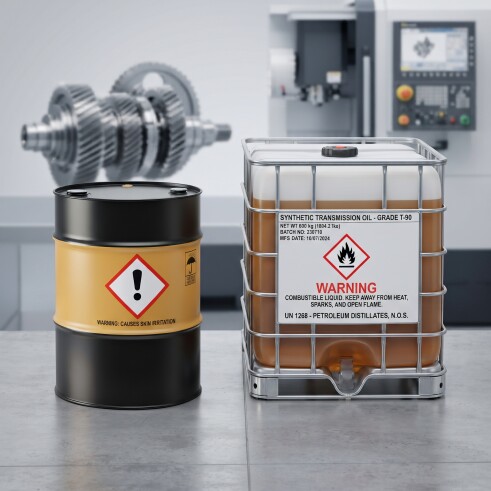
Supply is in 216 L steel drums, 1000 L IBCs, 20 L canisters, and in bulk in rail and road tank cars.
Packaging, Containers and Labeling
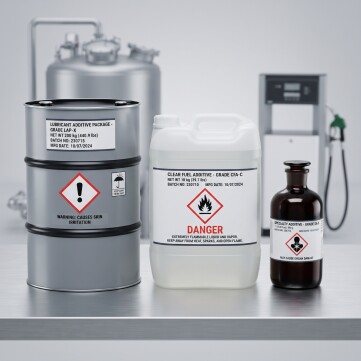
Oils are packed in steel drums, polyethylene canisters, IBCs and metal containers. Packaging must be clean, sealed and intended for lubricants. Bulk oils are transported in specialized tank cars.
Transport Marking
Transport marking is applied per GOST 14192 indicating the product name, grade, batch number and date of manufacture. Oils with a flash point above 60 degrees Celsius are not classified as dangerous goods, and class 3 hazard labels are not applied to ordinary packaging. Under GHS, oils may be labelled with GHS07 as skin irritants, and with GHS08 if they contain high levels of aromatic hydrocarbons. For transmission oils with extreme-pressure additives, additional information on sulphur and phosphorus content may be indicated.
Storage Conditions
Oils are stored in closed warehouses or under a canopy at temperatures from minus 20 to plus 30 degrees Celsius. Storage under direct sunlight, near heat sources and together with oxidizers is not permitted. The shelf life is typically 5 years from the date of manufacture.
Regulatory Framework for Incoming Inspection
- GOST 20799-88 - industrial oils. Specifications.
- GOST 17479.4-87 - industrial oils. Classification and designation.
- GOST 23652-79 - transmission oils. Specifications.
- GOST 33-2016 - petroleum products. Method for determining kinematic viscosity.
- GOST 4333-2014 - petroleum products. Methods for determining flash and ignition points in an open cup.
- GOST 20287-91 - petroleum products. Methods for determining pour point and freezing point.
- GOST 19433-88 - classification and labeling of dangerous goods.
Mechanism of Action and Functional Role
Industrial oils perform the function of a lubricant separating friction surfaces and reducing the coefficient of friction. In hydraulic systems they transmit pressure and simultaneously lubricate moving parts. Because industrial oils contain no additives, their effectiveness depends on viscosity and cleanliness: too low viscosity leads to increased wear, too high viscosity to higher energy consumption and overheating.
Transmission oils operate under harsher conditions. Extreme-pressure additives containing sulphur, phosphorus or chlorine form a thin chemically modified film on the metal surface that prevents scoring and seizure under high contact loads in gear meshing. Antioxidant additives slow oil aging, and pour-point depressants ensure fluidity at low temperatures.
Applications by Industry
Metalworking and Machine Tool Building
Industrial oils I-20A, I-30A and I-40A are used in hydraulic systems of machine tools, automatic lines and presses, in sliding and rolling guideways, and for lubricating spindle units and lightly loaded gears.
Automotive Transport and Road Construction Machines
Transmission oils TSp-15K, TAp-15V, TSp-14gip and TAD-17i are used in gearboxes, drive axles, transfer cases and gearboxes of trucks, passenger cars, buses and road construction equipment.
Industrial Gearboxes and Drives
Transmission oils are used in cylindrical, bevel, worm and hypoid gearboxes of industrial equipment, conveyors, pumps and compressors.
Hydraulic Systems
Industrial oils I-20A and I-30A serve as working fluids in hydraulic systems of industrial equipment, construction and road machines.
Comparison of Industrial and Transmission Oils
Industrial oils contain no additives and are intended for conditions that do not require high load-carrying capacity and extreme-pressure properties. Transmission oils contain functional additives and withstand high contact loads but may be incompatible with certain non-ferrous metals, especially GL-5 oils when used in synchronized gearboxes where GL-4 oils are preferred.
In viscosity, industrial oils of the I series correspond to ISO VG classes from 5 to 100, while transmission oils are classified by SAE (for example, 80W-90, 85W-90) and by API GL-4 or GL-5. For a specific unit, the choice is determined by the manufacturer recommendations, gear type and operating temperature range.
Supplier Selection Criteria and Specification Development
The specification must include the oil type (industrial or transmission), grade, ISO VG or SAE viscosity class, API performance category (for transmission), kinematic viscosity at 40 or 100 degrees Celsius, flash point and pour point, as well as the supply form (drums, IBCs, bulk). For transmission oils, the active element content of additives and compatibility with synchronizers are additionally specified.
The supplier confirms quality consistency, availability of a safety data sheet and batch conformity to the standard or technical specification.
Typical Processing, Storage and Logistics Errors
- Using GL-5 oil in a gearbox requiring GL-4. Leads to accelerated wear of non-ferrous metal synchronizers.
- Mixing oils of different grades and manufacturers without confirmed compatibility. May cause sediment formation and loss of properties.
- Water ingress into oil. Reduces lubricity and causes corrosion.
- Overheating oil during storage. Accelerates oxidation and aging.
- Use of contaminated packaging. Mechanical impurities cause abrasive wear of friction units.
Quality Control and Laboratory Methods
Incoming inspection includes determination of kinematic viscosity, flash point, pour point, acid number, water and mechanical impurity content. For transmission oils, viscosity index, corrosiveness to metals and active element content of additives are additionally controlled. Sampling is performed by standardized methods.
Storage and Transportation Conditions
Oils are stored in closed warehouses or under a canopy at temperatures from minus 20 to plus 30 degrees Celsius, protected from moisture and contamination. Transportation is carried out in drums, IBCs, canisters and in bulk in tank cars.
Finding Analogues and Interchangeability
When replacing industrial oil, a product with similar ISO VG viscosity and no additives is selected. When replacing transmission oil, the API category must be taken into account: replacing GL-4 with GL-5 is permissible only in non-synchronized gearboxes, while the reverse replacement is not recommended. The decision is based on laboratory testing and equipment manufacturer recommendations.
Supply Routes: Russia, China and Other Regions
Russia has large refineries producing industrial and transmission oils. Supplies are delivered throughout the country and for export.
Chinese producers supply oils of various grades, including analogues of Russian and international specifications. Other global producers are located in the Middle East, Europe and Asia. Suppliers from these regions are engaged when required, taking into account logistical and regulatory factors.
Logistics and Customs Clearance
Customs clearance includes HS code classification, preparation of a safety data sheet and conformity declaration. The portal provides customs broker services.
Risk Factors and Safety Measures
The main risks are associated with combustibility and skin irritation. Work is performed with gloves and protective goggles. In case of skin contact, wash with water and soap. Used oils must be sent for recycling.
FAQ: Common Questions from Procurement and Process Specialists
How does industrial oil differ from transmission oil
Industrial oil contains no additives and is used for lubrication and hydraulics under moderate loads. Transmission oil contains extreme-pressure and other additives and is intended for gear transmissions under high contact loads.
Which industrial oil grade is suitable for a machine tool hydraulic system
I-20A or I-30A oil is typically used for machine tool hydraulic systems depending on the viscosity required by the equipment manufacturer.
Can TAD-17i be used in a front-wheel-drive gearbox
TAD-17i belongs to API GL-5 and is not recommended for synchronized gearboxes where API GL-4 oil is preferred. Using GL-5 may accelerate wear of non-ferrous metal synchronizers.
What documents are required for oil import
Contract, invoice, packing list, safety data sheet, certificate of quality and transport documents.
Conclusion
Industrial and transmission oils remain key lubricants for industrial equipment and transport machinery. GOST 20799-88 and GOST 23652-79 establish requirements for grades and parameters, and ISO VG and API classification allows correlation with international standards. For procurement teams, the practical task reduces to correct type and grade selection, confirmation of batch conformity to the standard, and organization of supplies with cleanliness and moisture protection.
Contact Us
For procurement inquiries and supply chain organization, contact the portal team at info@apptrade.ru.