Technical Methanol
What Methanol Is and Why It Remains a Base Product of Organic Synthesis
Methanol, or methyl alcohol, is the simplest monohydric alcohol with the chemical formula CH3OH. Under normal conditions it is a colorless transparent liquid with a mild characteristic alcoholic odor, miscible with water in all proportions. Industrially, methanol is produced by catalytic synthesis from carbon oxides and hydrogen, as well as from natural gas via synthesis gas.
Methanol occupies a unique position in the chemical industry: it is simultaneously a large-tonnage intermediate and a versatile feedstock for a wide range of derivatives. More than half of global methanol consumption is directed to formaldehyde production, with significant volumes used for acetic acid, methyl tert-butyl ether, dimethyl ether and dimethyl terephthalate. In recent years, the importance of methanol as a feedstock for olefin production in China and as a component of fuel blends has been growing.
For procurement teams, methanol is interesting as a product with steady demand and a wide supply geography. However, its toxicity and flammability impose elevated requirements on packaging, storage and transport: methanol is classified as a class 3 hazardous good with an additional toxicity risk, making correct logistics organization no less important than product quality itself.
Chemical Identification and Procurement Data
- Chemical name: methanol, methyl alcohol, carbinol.
- Chemical formula: CH3OH, CH4O.
- Molar mass: 32.04 g/mol.
- CAS number: 67-56-1.
- UN number: 1230.
- HS code: 2905110000 for methanol (methyl alcohol).
- Commercial form: colorless transparent liquid without insoluble impurities.
In the Russian regulatory system, the primary document for technical methanol is GOST 2222-95, which covers product obtained by catalytic synthesis and intended for the chemical, wood-chemical, pharmaceutical, oil, gas and other industries. The standard provides for two grades, A and B, differing in intended use and impurity limits. The supplier confirms batch conformity to GOST 2222-95 and provides a certificate of quality with actual values for each parameter.
Physical and Chemical Properties Relevant to Processing and Logistics
- Density at 20 degrees Celsius: 0.791-0.792 g/cm3.
- Boiling point: 64.0-65.5 degrees Celsius; 99 percent of the product distills within not more than 0.8 degrees Celsius for grade A.
- Melting point: minus 98 degrees Celsius.
- Flash point: about 10 degrees Celsius in a closed cup; the substance is classified as a flammable liquid.
- Auto-ignition temperature: 455 degrees Celsius.
- Explosive limits in air: 5.5 to 44 volume percent.
- Vapor pressure: about 128 hPa at 20 degrees Celsius.
- Solubility: miscible with water, alcohols, ethers and most organic solvents.
For the processor and logistics specialist, the low flash point, wide explosive range and water miscibility of methanol are critical, requiring special measures for spills. Methanol is hygroscopic, so contact with atmospheric moisture must be excluded during storage, and its toxicity requires sealed systems and effective ventilation.
Technical Grades and Supply Forms
Grade A
Intended for the most demanding chemical productions, including formaldehyde, acetic acid and other products with strict purity requirements. Methanol mass fraction is at least 99.85 percent, water mass fraction not more than 0.05 percent, permanganate test not less than 60 minutes. Iron, chlorine, sulfur and ammonia contents are standardized at the level of ten-thousandths and hundred-thousandths of a percent.
Grade B
Used in productions where somewhat wider impurity limits are acceptable, in particular in the wood-chemical and some petrochemical processes. Water mass fraction not more than 0.08 percent, permanganate test not less than 30 minutes, iron and chlorine contents higher than for grade A.
Methanol is supplied in bulk in rail tank cars, specialized tank containers and road tankers. Steel drums and IBCs are used for small batches. Packaging must be sealed, made of materials compatible with methanol and labeled in accordance with hazardous goods requirements.
Regulatory Framework for Incoming Inspection
- GOST 2222-95 - technical methanol. Specifications. Establishes requirements for grades A and B, analytical methods and acceptance rules.
- GOST 25742.1 to GOST 25742.8 - methods for determining methanol parameters (density, water, acids, aldehydes, iron, chlorides, sulfur, non-volatile residue).
- GOST 19433 - classification and labeling of dangerous goods.
- GOST 30333-2022 - safety data sheet for chemical products.
- ISO 1387 - methanol for industrial use. Methods of analysis (harmonized with GOST 2222-95).
- ASTM D1152 - standard test methods for methanol.
For imported batches, the specification is based on manufacturer standards and harmonized ISO and ASTM methods. The batch specification is confirmed by the manufacturer certificate of quality and the results of incoming laboratory control by the recipient.
Mechanism of Action and Functional Role
Methanol is a key building block for organic synthesis. In formaldehyde production, methanol is oxidized over a silver or iron-molybdenum catalyst to form formaldehyde, which is then used to produce urea-formaldehyde, phenol-formaldehyde and melamine-formaldehyde resins. In acetic acid synthesis, methanol is carbonylated with carbon monoxide in the presence of a rhodium or iridium catalyst.
In methyl tert-butyl ether production, methanol reacts with isobutylene in the presence of an acid catalyst to form a high-octane gasoline component. Dimethyl ether is produced by methanol dehydration over aluminum oxide; it is used as a propellant and as a feedstock for olefin production. Methanol also serves as a solvent, antifreeze and denaturing additive.
For the B2B buyer, it is important to understand that methanol quality directly affects the yield and selectivity of target products. Impurities of water, iron and carboxylic acids can deactivate catalysts and reduce equipment service life, so control under GOST 2222-95 is a mandatory incoming inspection step.
Applications by Industry and Process Stage
Formaldehyde and Resin Production
The largest consumption direction. Formaldehyde is used to produce urea-formaldehyde, phenol-formaldehyde and melamine-formaldehyde resins used in woodworking, particleboard, plywood and laminates.
Acetic Acid and MTBE Synthesis
Methanol is carbonylated to acetic acid, which then goes into PET, solvents and pharmaceuticals. Reaction with isobutylene yields MTBE, a high-octane gasoline additive.
DMT and Polyester Chains
Dimethyl terephthalate (DMT) is produced by esterification of terephthalic acid with methanol; DMT is used in polyethylene terephthalate and other polyesters.
Fuel Applications and Energy
Methanol is considered a promising fuel for marine engines and a feedstock for dimethyl ether and synthetic liquid fuels. China has large methanol-to-olefins (MTO/MTP) capacities.
Solvents, Antifreezes and Specialty Applications
Methanol is used as a solvent in paints and coatings, a component of antifreezes and windshield washer fluids, and a reagent in pharmaceutical synthesis and biodiesel production.
Comparison with Alternative Alcohols and Feedstocks
Compared with ethanol, methanol provides higher oxygen content and lower cost per unit of synthetic value but is inferior in energy density and toxicological profile. Compared with synthesis gas, methanol is a more convenient and transportable chemical intermediate that can be processed into target products at remote sites.
In fuel applications, methanol competes with ethanol and dimethyl ether. Ethanol has higher calorific value and is less toxic but is more expensive and requires biomass fermentation. Dimethyl ether provides better ignition characteristics in diesel engines but requires methanol as an intermediate.
For chemical production, methanol remains the most economical and available source of the methyl group, reinforcing its position as a base product of organic synthesis.
Supplier Selection Criteria and Specification Development
The specification for methanol must include the grade (A or B), mass fraction of methanol, water, acids, aldehydes and iron, as well as packaging and transport requirements. For export batches, color on the platinum-cobalt scale and specific electrical conductivity are additionally specified.
The supplier confirms batch-to-batch quality consistency, a valid safety data sheet under GOST 30333-2022, readiness to provide transport authorized for dangerous goods and to organize loading in compliance with safety measures. When importing from China, it is important to verify that marking and actual parameters match, since grade designations may differ.
Typical Processing, Storage and Logistics Errors
- Use of non-specialized packaging. Methanol requires sealed containers of compatible materials; ordinary steel drums without appropriate coating can contaminate the product.
- Violation of storage temperature. Methanol should be stored at temperatures not above 25 degrees Celsius in closed ventilated premises, protected from direct sunlight and heat sources.
- Neglecting sealing. Methanol is hygroscopic and volatile; contact with atmospheric moisture reduces product purity, and evaporation creates an explosive concentration indoors.
- Co-storage with oxidizers and acids. Exothermic reactions and toxic vapor release are possible; co-storage is not permitted.
- Errors in dangerous goods documentation. Incorrect classification or labeling leads to customs delays and penalties.
- Ignoring toxicity during sampling. Methanol is toxic by inhalation, ingestion and skin contact; sampling must be performed with personal protective equipment.
Quality Control and Laboratory Methods
Incoming inspection of methanol includes determination of the main substance mass fraction (gas chromatography), water (Karl Fischer or chromatography), free acids calculated as formic acid, aldehydes and ketones calculated as acetone, volatile iron, chlorine and sulfur. For grade A, the permanganate test (not less than 60 minutes) and color on the platinum-cobalt scale are additionally controlled.
Sampling is performed in sealed samplers with observance of safety measures; the combined sample is analyzed in the plant laboratory. When changing supplier or batch, a control run of the target product is recommended to confirm catalytic compatibility.
Storage and Transportation Conditions
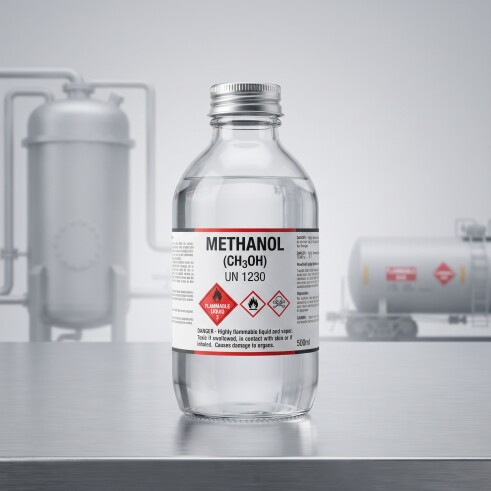
Methanol is classified as a class 3 dangerous good (flammable liquids) with an additional toxicity risk (subclass 6.1), UN number 1230, packing group II. Storage is carried out in above-ground or underground steel tanks compatible with methanol, with a nitrogen blanket to prevent contact with air and moisture. Tanks are equipped with breather valves, level and temperature control systems and firefighting equipment.
Transportation is carried out in rail tank cars, specialized tank containers and road tankers authorized for dangerous goods. Loading and unloading use closed systems, grounding and protection against static electricity. Sea transport is performed in tank containers or on specialized vessels in compliance with IMDG requirements.
Finding Analogues and Interchangeability
There is no direct analogue of methanol as a source of the methyl group in large-tonnage organic synthesis. In some processes, methanol can be replaced by dimethyl ether or synthesis gas, but such substitution requires process changes and is often economically impractical. When changing supplier, a product of the same grade (A or B) with similar water, acid and iron parameters is selected.
For fuel applications, methanol can compete with ethanol, but their interchangeability is limited by engine and infrastructure requirements. The replacement decision is based on laboratory testing and, for catalytic processes, pilot-scale verification.
Supply Routes: Russia, China and Other Regions
Domestic supply is provided by large gas chemical complexes with methanol production capacity. Products are supplied to the domestic market and for export, primarily to China. Shipment is carried out by rail, through ports and land border crossings.
China is the world largest consumer and importer of methanol. Russian methanol holds a notable share of Chinese imports, with supplies moving through land crossings (Zabaikalsk, Grodekovo) and Far East ports. Chinese producers also export methanol, but domestic demand limits export volumes. Other global producers are located in the Middle East, Trinidad and Tobago, the USA, Malaysia and other regions. Suppliers from these regions are engaged when required, taking into account logistical and regulatory factors and the availability of specialized transport for dangerous goods.
Logistics and Customs Clearance
Bulk transport of methanol is carried out in specialized rail tank cars, tank containers and road tankers. Customs clearance includes classification under HS code 2905110000, preparation of a safety data sheet under GOST 30333-2022, conformity declaration and compliance with dangerous goods labeling requirements. For imported batches, permits and compliance of packaging with international requirements are additionally verified. The portal provides customs broker services and supports all clearance stages.
Risk Factors and Safety Measures
The main risks are associated with methanol toxicity, flammability and the ability to form explosive mixtures with air. Methanol is toxic by ingestion, inhalation of vapors and skin contact; effects may be delayed, so medical attention should be sought immediately if exposure is suspected. Work is performed in ventilated rooms with filtering respirators, acid-resistant gloves and protective goggles.
In case of a spill, the area is cordoned off, ignition sources are eliminated, the spill is localized with inert materials and vapors are suppressed with a water curtain. Discharge of methanol into sewers and water bodies is not permitted. Process regulations provide level and temperature interlocks, emergency relief to a flare or safe vessel, and periodic control of oxygen content in the gas phase.
FAQ: Common Questions from Procurement and Process Specialists
How does grade A differ from grade B under GOST 2222-95
Grade A is intended for the most demanding chemical productions and has stricter limits for water (not more than 0.05 percent), iron and permanganate decolorization time (not less than 60 minutes). Grade B allows wider limits for these parameters and is used in less demanding processes.
Which methanol is suitable for formaldehyde synthesis
Grade A methanol is typically used for formaldehyde synthesis because iron and acid impurities deactivate the catalyst and reduce target product yield. Specific requirements are agreed with the process regulations.
What documents are required for methanol import
Import requires a contract, invoice, packing list, safety data sheet under GOST 30333-2022 in Russian, manufacturer certificate of quality, transport documents and a declaration of conformity. For dangerous goods, transport permits and compliance with carriage rules are additionally confirmed.
What is the shelf life of methanol
Under sealed packaging and proper temperature conditions, methanol retains its properties for an extended period. The shelf life established by the manufacturer is typically 6 months from the date of manufacture; after this period, incoming inspection is required.
Can methanol be stored in ordinary steel tanks
Storage is permitted in steel tanks made of materials compatible with methanol, with a mandatory nitrogen blanket and sealing. Ordinary tanks without appropriate preparation can contaminate the product and do not provide the required safety.
Conclusion
Methanol remains an indispensable base product of organic synthesis, enabling the production of formaldehyde, acetic acid, MTBE, DMT and a wide range of other chemical products. Its toxicity and flammability require professional handling: specialized packaging, sealed systems, temperature control and strict quality compliance with GOST 2222-95. For procurement teams, the practical task reduces to correct grade selection (A or B), confirmation of batch conformity to the standard and organization of supplies in compliance with dangerous goods transport rules.
Contact Us
For procurement inquiries and supply chain organization, contact the portal team at info@apptrade.ru.