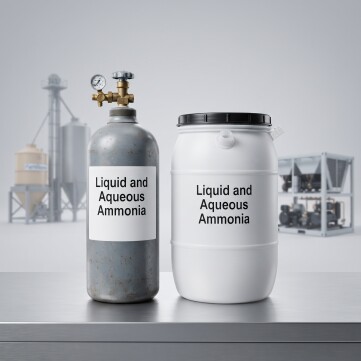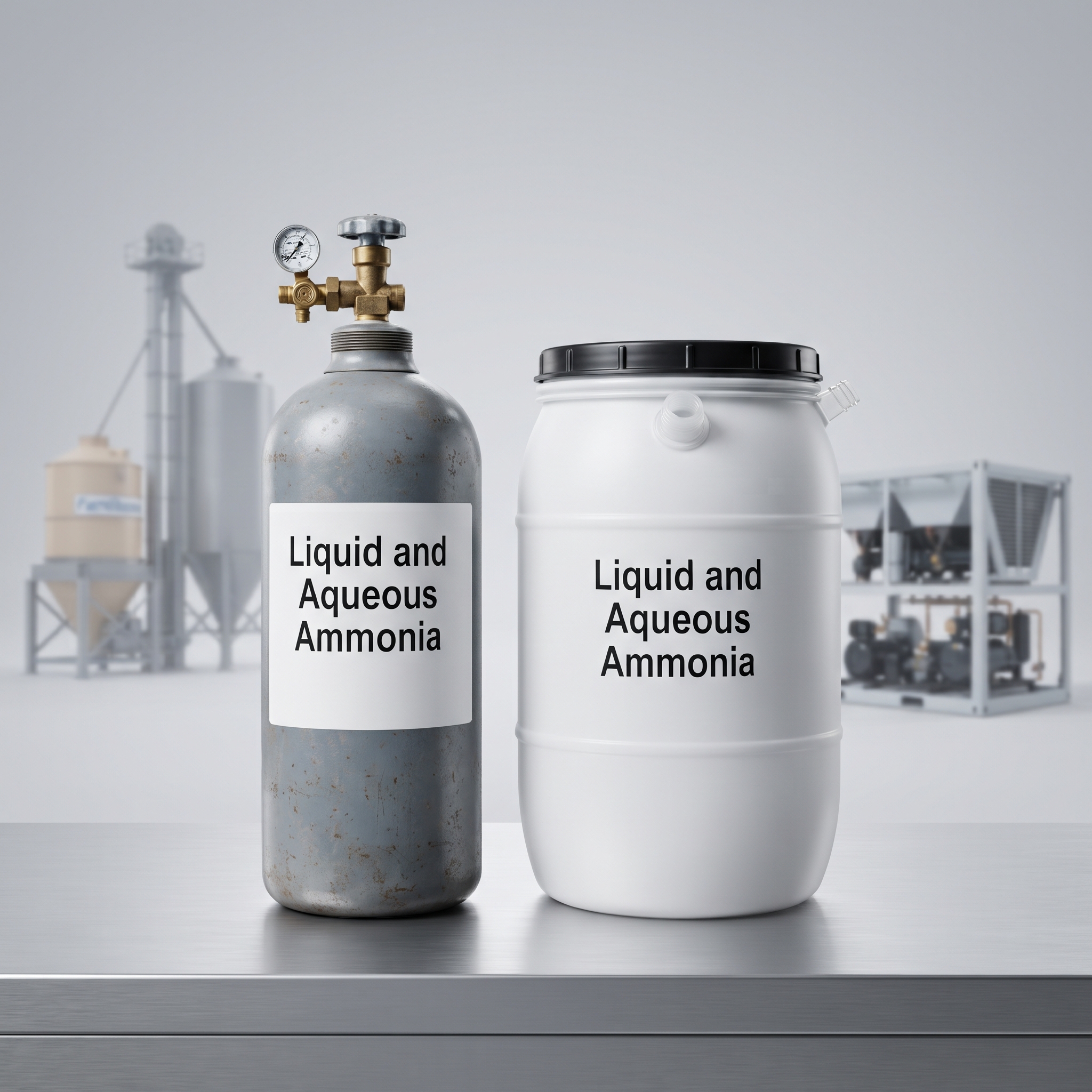
Liquid and Aqueous Ammonia
What Ammonia Is and Why It Remains a Large-Tonnage Inorganic Product
Ammonia (nitrogen trihydride, NH3) is a colorless gas with a pungent suffocating odor that liquefies at room temperature under a pressure of about 8-10 atmospheres. Industrially, ammonia is produced by catalytic synthesis from nitrogen and hydrogen via the Haber-Bosch process, as well as as a by-product of coal and oil processing. Global ammonia production exceeds 150 million tonnes per year, placing it among the largest-volume chemical products.
For procurement teams, ammonia matters in two main commercial forms. Anhydrous liquid ammonia contains at least 99.6 percent of the main substance and is supplied under pressure in specialized tank cars and cylinders. Aqueous ammonia is a solution of the gas in water with a mass fraction of 25 percent and is used where milder handling conditions are required and high concentration is not needed. Both forms find application in agriculture, chemical synthesis, metallurgy and refrigeration.
The key feature of ammonia that determines the entire handling chain is the combination of toxicity, corrosiveness and the ability to form explosive mixtures with air. Anhydrous liquid ammonia is classified as a class 2 hazardous good (liquefied gases), while aqueous ammonia belongs to class 8 (corrosive substances). This requires specialized packaging, trained personnel and strict compliance with transport regulations.
Chemical Identification and Procurement Data
- Chemical name: ammonia, nitrogen trihydride; aqueous solution - ammonium hydroxide (NH4OH).
- Chemical formula: NH3; aqueous solution - NH3·H2O.
- Molar mass: 17.03 g/mol.
- CAS number: 7664-41-7 for anhydrous ammonia; 1336-21-6 for aqueous solution.
- UN number: 1005 for anhydrous liquefied ammonia; 2672 for aqueous solution with 10-35 percent concentration; 3318 for solutions above 50 percent.
- HS code: 2814100000 for anhydrous ammonia; 2814200000 for aqueous ammonia solution.
- Commercial form: anhydrous liquid ammonia - clear colorless liquid under pressure; aqueous ammonia - clear colorless or yellowish liquid.
In the Russian regulatory system, GOST 6221-90 applies to anhydrous liquid ammonia, covering technical liquefied anhydrous ammonia used in various industries and agriculture. The standard provides for grades A, Ak and B. For technical aqueous ammonia, GOST 9-92 applies, establishing two grades: A for industry and B for agriculture as a nitrogen fertilizer. The supplier confirms batch conformity to the applicable standard and provides a certificate of quality with actual values for each parameter.
Physical and Chemical Properties Relevant to Processing and Logistics
- State: gas under normal conditions; liquefies under a pressure of about 8-10 atmospheres or by cooling to minus 33 degrees Celsius.
- Boiling point (anhydrous): minus 33.3 degrees Celsius.
- Melting point (anhydrous): minus 77.7 degrees Celsius.
- Liquid density at minus 33 degrees Celsius: about 0.68-0.69 g/cm3; at 20 degrees Celsius in the liquid phase under pressure - about 0.61 g/cm3.
- Vapor density relative to air: 0.59 (vapors are lighter than air).
- Water solubility: very high; at 20 degrees Celsius about 52-53 grams of ammonia dissolve in 100 ml of water.
- Auto-ignition temperature: about 650 degrees Celsius.
- Explosive limits in air: 15-28 volume percent for anhydrous ammonia.
- Density of 25 percent aqueous solution: about 0.90-0.91 g/cm3 at 20 degrees Celsius.
- Boiling point of 25 percent aqueous solution: about 37-38 degrees Celsius.
- pH of aqueous solution: strongly alkaline, typically above 11.
For the processor and logistics specialist, the critical factors are vapor toxicity, corrosive attack on copper and zinc, and the ability of liquid ammonia to cause frostbite on skin contact. Aqueous ammonia is less volatile but retains high alkalinity and requires protection from acid contact. Both forms are hygroscopic and require sealed packaging.
Technical Grades and Supply Forms
Anhydrous Liquid Ammonia (GOST 6221-90)
Grade A is intended for nitric acid production, nitriding, use as a refrigerant and for creating protective atmospheres. Grade Ak is oriented toward export supplies and pipeline transport. Grade B is used for fertilizer processing and in agriculture as a nitrogen fertilizer. The ammonia mass fraction for grade Ak is at least 99.6 percent, nitrogen mass fraction at least 82 percent. Supplied in bulk in rail tank cars, road tankers and tank containers, as well as in steel cylinders for small batches.
Technical Aqueous Ammonia (GOST 9-92)
Grade A is used in various industries, including pulp and paper and hydrolysis production. Ammonia mass fraction is at least 25 percent, non-volatile residue concentration not more than 0.07 g/dm3. Grade B is intended for agriculture as a nitrogen fertilizer; ammonia mass fraction at least 25 percent, calculated as nitrogen at least 20.5 percent, a yellowish tint is permitted. Supplied in rail and road tank cars, as well as in IBCs and drums. The shelf life of aqueous ammonia is typically 3 months from the date of manufacture.
Regulatory Framework for Incoming Inspection
- GOST 6221-90 - technical liquid ammonia (anhydrous liquefied). Specifications.
- GOST 9-92 - technical aqueous ammonia. Specifications.
- GOST 19433 - classification and labeling of dangerous goods; aqueous ammonia is assigned to class 8, subclass 8.2.
- GOST 30333-2022 - safety data sheet for chemical products.
- GOST 14192 - cargo marking.
- ISO 7103, ASTM D1426 - methods for determining ammonia in aqueous solutions for harmonization with international practice.
For imported batches, the specification is based on manufacturer standards and harmonized methods. The batch specification is confirmed by the manufacturer certificate of quality and the results of incoming laboratory control by the recipient.
Mechanism of Action and Functional Role
Ammonia is the key source of fixed nitrogen in industry. In nitrogen fertilizer production, it reacts with acids to form salts: with nitric acid it gives ammonium nitrate, with sulfuric acid ammonium sulfate, with phosphoric acid ammonium phosphates. Reaction with carbon dioxide yields urea, which is also used as a fertilizer and feedstock for resins.
In chemical synthesis, ammonia serves as a feedstock for nitric acid (catalytic oxidation), caprolactam (via cyclohexanone oxime), acrylonitrile and amines. In metallurgy, ammonia is used for steel surface nitriding and for creating protective atmospheres during heat treatment. In refrigeration, liquid ammonia (R717) remains one of the most efficient and environmentally safe refrigerants, although it requires strict safety measures due to toxicity.
Aqueous ammonia acts as a mild neutralizing agent and a source of ammonium nitrogen for plants. In the pulp and paper industry it is used for pH control and in cooking processes. In construction and oil production, aqueous ammonia is used as a component of drilling fluids and a well treatment reagent.
Applications by Industry
Agriculture and Fertilizer Production
Dominant consumption direction: about 80-90 percent of global ammonia goes to nitrogen fertilizer production (urea, ammonium nitrate, ammonium sulfate, ammonium phosphates). Anhydrous ammonia is used for direct soil injection, aqueous ammonia grade B as a liquid fertilizer.
Chemical Industry
Production of nitric acid, caprolactam, acrylonitrile, amines, urotropine and various nitrogen-containing compounds. Ammonia is also used as a solvent in some processes.
Refrigeration and Air Conditioning
Liquid ammonia (R717) is used in industrial refrigeration units, ice arenas and the food industry due to high cooling capacity and zero ozone depletion potential.
Metallurgy and Mechanical Engineering
Steel nitriding, creation of protective atmospheres during annealing and brazing, and surface treatment before painting.
Pulp and Paper and Mining Industry
Aqueous ammonia grade A is used for pH control in paper production and as a component of reagents in ore flotation.
Comparison with Alternative Nitrogen Sources and Refrigerants
Compared with urea and ammonium nitrate, anhydrous ammonia provides a higher nitrogen concentration (82 percent versus 46 and 34.5 percent respectively), reducing logistics costs per unit of active substance but requiring specialized storage and application infrastructure. Compared with aqueous ammonia, anhydrous ammonia is more concentrated but requires pressure vessels and stricter safety measures.
In refrigeration, ammonia competes with freons (HFC/HFO) and carbon dioxide. Ammonia surpasses them in energy efficiency and environmental performance (zero GWP and ODP) but is inferior in toxicity and requires trained personnel. Carbon dioxide is safer but operates at significantly higher pressures, increasing equipment cost.
For chemical synthesis, ammonia remains an irreplaceable nitrogen source in large-tonnage processes; replacement with hydrazine or amines is economically impractical and technologically limited.
Supplier Selection Criteria and Specification Development
The specification for ammonia must include the commercial form (anhydrous liquid or aqueous solution), grade (A, Ak, B for anhydrous; A or B for aqueous), ammonia mass fraction (or nitrogen for aqueous grade B), packaging requirements and transport conditions. For anhydrous ammonia, moisture and oil limits are additionally specified; for aqueous ammonia, non-volatile residue and carbon dioxide concentrations.
The supplier confirms batch-to-batch quality consistency, a valid safety data sheet under GOST 30333-2022, readiness to provide transport authorized for the relevant class of dangerous goods and to organize loading in compliance with safety measures. For imported batches, it is important to verify that marking and actual parameters match.
Typical Processing, Storage and Logistics Errors
- Use of non-specialized packaging. Ammonia corrodes copper, zinc and their alloys; steel tanks compatible with ammonia are used for storage and transport.
- Neglecting sealing. Ammonia is volatile and toxic; a leak creates a hazardous concentration indoors and requires immediate evacuation.
- Overheating of packaging. When heated, pressure in anhydrous ammonia vessels rises, potentially causing rupture; protection from sunlight and heat sources is required.
- Co-storage with acids and oxidizers. A violent neutralization reaction with heat and vapor release is possible; co-storage is not permitted.
- Use of aqueous ammonia beyond its shelf life. The shelf life of aqueous ammonia is typically 3 months; expired product requires incoming inspection.
- Neglecting personal protective equipment. Ammonia causes chemical burns to skin and eyes, and liquid ammonia causes frostbite; work is performed with filtering respirators, protective goggles and acid-resistant gloves.
Quality Control and Laboratory Methods
Incoming inspection of anhydrous liquid ammonia includes determination of ammonia mass fraction (titration or gas chromatography), nitrogen mass fraction, moisture, oil and non-volatile residue content. For aqueous ammonia, ammonia mass fraction (titration), non-volatile residue and carbon dioxide concentrations, density and pH are determined. Sampling is performed in sealed samplers with observance of safety measures; the combined sample is analyzed in the plant laboratory.
When changing supplier or batch, a control run of the target product is recommended to confirm compatibility with the process.
Storage and Transportation Conditions
Anhydrous liquid ammonia is classified as a class 2 dangerous good (liquefied gases), UN number 1005, and requires specialized steel tank cars and cylinders rated for the working pressure. Storage is carried out in above-ground or underground isothermal tanks with measures to prevent overheating and leaks. Transportation is by rail and road tank cars, tank containers and cylinders in accordance with dangerous goods transport rules.
Aqueous ammonia is classified as a class 8 dangerous good (corrosive substances), subclass 8.2, and is transported in rail and road tank cars, as well as in IBCs and drums. Storage is carried out in sealed packaging in closed premises or specially designated tanks. For both forms, contact with acids, oxidizers and food products must be excluded.
Finding Analogues and Interchangeability
There is no direct analogue of ammonia as a nitrogen source in large-tonnage processes. In some applications, for example certain neutralization processes, aqueous ammonia can be replaced by sodium hydroxide or soda ash, but this changes the reaction product composition and requires process revision. Anhydrous ammonia and aqueous solution are not always interchangeable: processes requiring high concentration and minimal water content use only anhydrous ammonia; for soil fertilization and mild neutralization, aqueous solution may be used.
When changing supplier, a product of the same grade with similar main substance and impurity parameters is selected. The replacement decision is based on laboratory testing and, for critical processes, pilot-scale verification.
Supply Routes: Russia, China and Other Regions
Domestic supply is provided by large chemical and gas chemical complexes with ammonia production capacity. Products are supplied to the domestic market and for export, including China. Shipment is carried out by rail, through ports and pipeline systems.
China is the largest producer and consumer of ammonia. Russian ammonia holds a notable share of Chinese imports, with supplies moving through land crossings and Far East ports. Chinese producers also export ammonia, but domestic demand limits export volumes. Other global producers are located in the Middle East, Trinidad and Tobago, the USA, India and other regions. Suppliers from these regions are engaged when required, taking into account logistical and regulatory factors and the availability of specialized transport for dangerous goods.
Logistics and Customs Clearance
Bulk transport of liquid ammonia is carried out in specialized rail tank cars, tank containers and road tankers. Customs clearance includes classification under HS code 2814100000 for anhydrous ammonia or 2814200000 for aqueous ammonia, preparation of a safety data sheet under GOST 30333-2022, conformity declaration and compliance with dangerous goods labeling requirements. For imported batches, permits and compliance of packaging with international requirements are additionally verified. The portal provides customs broker services and supports all clearance stages.
Risk Factors and Safety Measures
The main risks are associated with ammonia toxicity, its ability to cause chemical burns and frostbite, and flammability at high airborne concentrations. Ammonia is toxic by inhalation and causes damage to the respiratory tract and mucous membranes; contact with liquid ammonia can cause frostbite and burns with blistering. Work is performed in ventilated rooms with filtering respirators, protective goggles, acid-resistant gloves and protective clothing.
In case of a leak, the area is cordoned off, ignition sources are eliminated, and vapors are suppressed with a water curtain. Discharge of ammonia into sewers and water bodies is not permitted. Process regulations provide pressure and temperature interlocks, emergency relief to a safe vessel or flare, and periodic monitoring of ammonia concentration in the working area air.
FAQ: Common Questions from Procurement and Process Specialists
How does anhydrous liquid ammonia differ from aqueous ammonia
Anhydrous liquid ammonia contains at least 99.6 percent NH3 and is supplied under pressure in specialized vessels. Aqueous ammonia is a 25 percent NH3 solution in water, less volatile and does not require high-pressure vessels, but contains significant water and has a lower active substance concentration.
Which ammonia grade is suitable for refrigeration
Anhydrous liquid ammonia of grade A or Ak with an ammonia mass fraction of at least 99.6 percent is used for refrigeration units. Moisture and oil content must be minimal to avoid corrosion and system clogging.
What documents are required for ammonia import
Import requires a contract, invoice, packing list, safety data sheet under GOST 30333-2022 in Russian, manufacturer certificate of quality, transport documents and a declaration of conformity. For dangerous goods, transport permits and compliance with carriage rules are additionally confirmed.
What is the shelf life of aqueous ammonia
The shelf life of aqueous ammonia is typically 3 months from the date of manufacture under sealed packaging and proper temperature conditions. After this period, incoming inspection is required.
Can ammonia be stored in copper or zinc vessels
No, ammonia corrodes copper, zinc and their alloys. Steel vessels compatible with ammonia are used for storage and transport, with or without appropriate coating depending on concentration and conditions.
Conclusion
Ammonia remains an indispensable large-tonnage inorganic product, enabling fertilizer, nitric acid, caprolactam and a wide range of other chemical products, as well as use in refrigeration and metallurgy. Anhydrous liquid and aqueous ammonia differ in concentration, hazard class and packaging requirements, which determines logistics and storage conditions. For procurement teams, the practical task reduces to correct selection of commercial form and grade, confirmation of batch conformity to GOST 6221-90 or GOST 9-92, and organization of supplies in compliance with dangerous goods transport rules and safety measures.
Contact Us
For procurement inquiries and supply chain organization, contact the portal team at info@apptrade.ru.