Technical Potassium Chloride
What Technical Potassium Chloride Is and Why It Remains a Critical Potash Feedstock
Potassium chloride, or potassium chloride (KCl), is a colorless or white crystalline solid, often with a grayish or pinkish tint, odorless, readily soluble in water. Industrially, it is produced by processing potash ores using the halurgical or flotation method. Its molar mass is 74.55 g/mol, density about 1.98 g/cm3, melting point 770 degrees Celsius, and solubility in water at 20 degrees Celsius is about 34 grams per 100 ml, increasing noticeably with temperature.
For procurement teams, technical potassium chloride matters primarily as a feedstock for chemical synthesis rather than as a fertilizer. Grades A and B per TU 2152-013-00203944-2011 are intended for use in industry as raw materials for chemical products. The product is also demanded in the oil and gas industry as an inhibiting component of drilling fluids, in metallurgy for producing heat-resistant and corrosion-resistant alloys, in powder metallurgy, brazing and catalytic systems, as well as in the production of dyes, synthetic rubber and artificial leather.
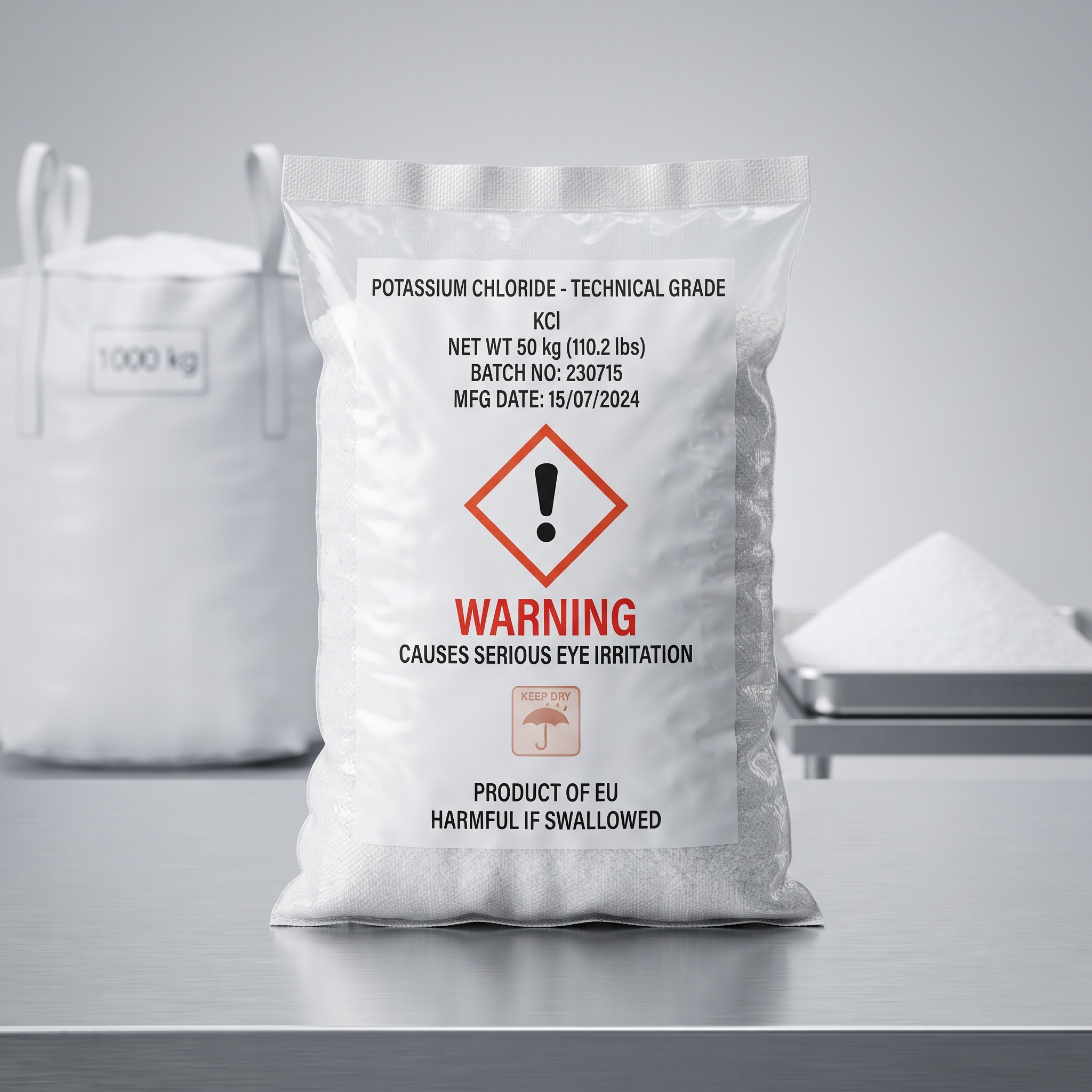
The key feature of technical potassium chloride that determines the entire supply chain is its hygroscopicity and tendency to cake when moistened, as well as its ability to irritate mucous membranes. The product is not classified as a dangerous good for transport, and no UN number is assigned, which simplifies logistics. However, under GHS it may be labeled with the GHS07 exclamation mark pictogram and the signal word Warning.
Chemical Identification and Procurement Data
- Chemical name: potassium chloride, potassium salt of hydrochloric acid.
- Chemical formula: KCl.
- Molar mass: 74.55 g/mol.
- CAS number: 7447-40-7.
- UN number: not assigned; the product is not classified as a dangerous good for transport.
- HS code: 3104200000 for potassium chloride with a K2O content of not more than 62 percent calculated on a dry anhydrous basis.
- Commercial form: free-flowing crystalline product of white color with a grayish or pinkish tint (grades A and B per TU 2152-013-00203944-2011); granular and fine-crystalline forms are possible for grades per GOST 4568-95.
In the Russian regulatory system, TU 2152-013-00203944-2011 apply to technical potassium chloride, establishing grades A and B with KCl content of at least 98.2 percent and K2O of at least 62.0 percent. For product intended for agriculture and industry, GOST 4568-95 applies, covering potassium chloride produced by halurgical and flotation methods and providing for Fine and Granular grades. The supplier confirms batch conformity to the applicable normative document and provides a certificate of quality with actual values for each parameter.
Quality Parameters Relevant to Processing
- Potassium chloride (KCl) mass fraction: at least 98.2 percent for grades A and B per TU 2152-013-00203944-2011.
- Potassium mass fraction calculated as K2O: at least 62.0 percent for grades A and B per TU; at least 60.0-60.5 percent for grades per GOST 4568-95.
- Sodium chloride (NaCl) mass fraction: not more than 1.3 percent for grade A; not more than 1.6 percent for grade B per TU.
- Water mass fraction: not more than 0.5 percent for grades A and B per TU; not more than 0.2-0.5 percent for grades per GOST 4568-95 depending on sort.
- Total impurities mass fraction (water-insoluble residue, CaSO4, MgCl2*6H2O): not more than 0.2 percent for grades A and B per TU.
- Amines mass fraction: not more than 0.02 percent for grade A; not standardized for grade B.
- Granulometric composition (for granular grade per GOST 4568-95): mass fraction of 1-4 mm fraction at least 95 percent, less than 1 mm not more than 5 percent, more than 6 mm absent.
- Dynamic granule strength (for granular grade): at least 80 percent.
- Flowability: 100 percent for grades per GOST 4568-95.
For the processor, water and sodium chloride content are critical. Increased moisture leads to caking and loss of flowability during storage and pneumatic transport, while increased NaCl content affects the purity of target products in chemical synthesis and the properties of drilling fluids.
Technical Grades and Supply Forms
Grade A per TU 2152-013-00203944-2011
White crystals with a grayish tint. Contains at least 98.2 percent KCl and at least 62.0 percent K2O. Sodium chloride mass fraction is not more than 1.3 percent, water not more than 0.5 percent. Amine content is limited to 0.02 percent. Used as a feedstock in chemical synthesis requiring increased purity for sodium and amines.
Grade B per TU 2152-013-00203944-2011
White crystals with a pinkish tint. Contains at least 98.2 percent KCl and at least 62.0 percent K2O. Allows a higher sodium chloride content (up to 1.6 percent); amine content is not standardized. Used in the same industries where somewhat wider impurity limits are acceptable.
Grades per GOST 4568-95
The standard covers potassium chloride produced by halurgical and flotation methods and provides for Fine and Granular grades. The Fine grade contains at least 60.0-60.5 percent K2O and is characterized by small grains of various reddish-brown shades. The Granular grade contains at least 60.0 percent K2O and is used for NPK fertilizer blends and direct soil application. For technical purposes, GOST 4568-95 also provides for corresponding sorts.
Supply of technical potassium chloride is in bulk, in polypropylene bags of 50 kg, as well as in flexible specialized containers (big bags) of 500, 800, 900 or 1000 kg capacity depending on grade and manufacturer.
Packaging, Containers and Labeling
Technical potassium chloride is not a dangerous good, so packaging must primarily provide moisture protection and mechanical strength. Polypropylene bags with a polyethylene liner and big bags made of polypropylene fabric are used. Special packaging is provided for product intended for the production of dyes, synthetic rubber and baker yeast.
Transport Marking
Transport marking is applied per GOST 14192 with the Keep Dry handling symbol. Since the product is not classified as a dangerous good, transport hazard diamonds (class 5.1, 8 and others) are not applied. Under GHS, the product may be labeled with the GHS07 exclamation mark pictogram and the signal word Warning because dust causes irritation of skin, eyes and respiratory tract. Product marking must contain the manufacturer name, product name, grade and sort, batch number and date of manufacture, standard or technical specification designation and guaranteed K2O content.
Storage Conditions
The product is stored in closed warehouses excluding contamination and ingress of atmospheric and groundwater. Storage in containers on hard-surfaced areas equipped with canopies is permitted. The shelf life for grades per GOST 4568-95 is 6 months from the date of manufacture; for technical grades per TU it is established by the manufacturer.
Regulatory Framework for Incoming Inspection
- TU 2152-013-00203944-2011 - technical potassium chloride. Specifications. Establishes grades A and B, their parameters and scope of application.
- GOST 4568-95 - potassium chloride. Specifications. Covers product for agriculture and industry, provides for Fine and Granular grades.
- GOST 4234-77 - reagents. Potassium chloride. Specifications (for reagent grade).
- GOST 12.1.007-76 - classification of hazardous substances. Potassium chloride belongs to moderately hazardous substances; dust irritates mucous membranes.
- GOST 14192 - cargo marking.
- GOST 30333-2022 - safety data sheet for chemical products.
For imported batches, the specification is based on manufacturer standards and harmonized methods. The batch specification is confirmed by the manufacturer certificate of quality and the results of incoming laboratory control by the recipient.
Mechanism of Action and Functional Role
In chemical synthesis, potassium chloride serves as a source of potassium and chloride ions. It is used to produce potassium hydroxide, potassium carbonate, various potassium salts, and as a catalyst and component of reaction mixtures. In the production of dyes, synthetic rubber and artificial leather, potassium ions influence reaction rates and the properties of target products.
In the oil and gas industry, potassium chloride stabilizes clay and shale formations in drilling fluids, preventing their swelling and disintegration. This strengthens the wellbore walls and reduces the risk of complications during drilling. In metallurgy, potassium chloride is used in the production of heat-resistant and corrosion-resistant alloys, in powder metallurgy, brazing and chemical deposition, as well as in catalytic systems.
In agriculture, potassium chloride acts as a potassium fertilizer: potassium participates in regulating plant water balance, activates enzymes and increases resistance to diseases. However, for technical grades this is not the main purpose.
Applications by Industry
Chemical Industry
The largest consumption direction for technical potassium chloride. Used for the production of potassium hydroxide, potassium carbonate, other potassium salts, dyes, synthetic rubber and artificial leather.
Oil and Gas Industry
Used as an inhibiting component of drilling fluids to stabilize clay and shale formations and strengthen wellbore walls.
Metallurgy
Used in the production of heat-resistant and corrosion-resistant alloys, in powder metallurgy, brazing, chemical deposition and catalytic systems.
Agriculture
Grades per GOST 4568-95 are used as potassium fertilizer for direct soil application and production of NPK fertilizer blends. Technical grades are generally not used for this purpose.
Other Industries
Used in the production of baker yeast, in electroplating, for preparing electrolytes and in laboratory practice (reagent grade per GOST 4234-77).
Comparison with Alternative Potassium Products
Compared with potassium sulfate, potassium chloride contains less potassium calculated as K2O (62 percent versus 50-52 percent) and is inferior in potassium content, but has an advantage in cost and availability. Potassium sulfate is preferred for chloride-sensitive crops, while potassium chloride is used mainly in industry and for chloride-tolerant crops.
Compared with potassium nitrate, potassium chloride contains no nitrogen and does not provide additional nutrition, but it is a cheaper and more concentrated source of potassium. In chemical synthesis, potassium chloride competes with potassium hydroxide and potassium carbonate but has an advantage as the most available and economical feedstock for producing these products.
Supplier Selection Criteria and Specification Development
The specification for technical potassium chloride must include the grade (A or B per TU 2152-013-00203944-2011; or grade and sort per GOST 4568-95), KCl and K2O mass fractions, sodium chloride, water and amine content (for grade A), as well as the supply form (bulk, bags, big bags) and transport conditions.
The supplier confirms batch-to-batch quality consistency, a valid safety data sheet under GOST 30333-2022, readiness to provide packaging that protects against moisture and to organize transport in compliance with cargo transport rules. For imported batches, it is important to verify labeling and actual parameters, as well as storage conditions at the warehouse before shipment.
Typical Processing, Storage and Logistics Errors
- Violation of storage conditions. Potassium chloride is hygroscopic; storage in humid areas or in the open leads to caking and loss of flowability. The product is stored in closed warehouses protected from atmospheric precipitation and groundwater.
- Co-storage with acids and oxidizers. Although potassium chloride is not an oxidizer, contact with strong acids can lead to the release of hydrogen chloride. Co-storage with acids is not recommended.
- Use of contaminated packaging. Residues of other products can contaminate potassium chloride, especially for chemical synthesis where purity for sodium and amines is important.
- Neglecting dust protection. Potassium chloride dust irritates mucous membranes and the respiratory tract; a respirator, protective goggles and gloves are required when working with the product.
- Use of technical grade for food or agricultural purposes without confirmation. Technical grades per TU are not standardized for parameters important for food use or for sensitive crops and must not be used for these purposes without additional confirmation.
- Labeling errors. Applying transport hazard labels that do not correspond to the product, or omitting the GHS07 label when irritant action is present, can mislead the consumer.
Quality Control and Laboratory Methods
Incoming inspection of technical potassium chloride includes determination of the KCl mass fraction (argentometric titration or ionometry), potassium mass fraction calculated as K2O (calculation method or per GOST 20851.3), water mass fraction (drying), sodium chloride (flame photometry or titration) and amines (photometric) for grade A. Sampling is performed by standardized methods; the combined sample is analyzed in the plant laboratory.
When changing supplier or batch for chemical synthesis, a control run of the target product is recommended to confirm compatibility with the process.