Hydrogen Peroxide
What Hydrogen Peroxide Is and Why It Remains a Critical Oxidizer
Hydrogen peroxide (H2O2) is a colorless transparent odorless liquid miscible with water in all proportions. Industrially, it is produced mainly by the anthraquinone process based on liquid-phase oxidation of isopropyl alcohol, as well as by the electrochemical process via peroxysulfuric acid. Global hydrogen peroxide production exceeds 5 million tonnes per year calculated as 100 percent, with a significant share directed to environmentally oriented chlorine-free bleaching processes.
For procurement teams, hydrogen peroxide matters primarily as an oxidizer with a unique safety profile: on decomposition it forms only water and oxygen, leaving no toxic residues. This makes it the preferred reagent for pulp and paper, textile, mining and medical industries. GOST 177-88 establishes requirements for medical and technical peroxide of grades A and B, differing in production method, concentration and impurity content.
The key feature of hydrogen peroxide that determines the entire supply chain is its tendency to decompose under the action of light, heat and heavy metal impurities. The product is classified as a class 5.1 hazardous good (oxidizers) with a subsidiary hazard 8 (corrosive substances), UN numbers 2014 for solutions of 20-60 percent and 2015 for solutions above 60 percent. This requires passivated or polymer packaging, protection from light and observance of the temperature regime.
Chemical Identification and Procurement Data
- Chemical name: hydrogen peroxide, hydroperoxide.
- Chemical formula: H2O2.
- Molar mass: 34.02 g/mol.
- CAS number: 7722-84-1.
- UN number: 2014 for aqueous solutions containing 20 to 60 percent; 2015 for solutions containing more than 60 percent.
- HS code: 2847000000.
- Commercial form: colorless transparent liquid without mechanical impurities.
In the Russian regulatory system, the primary document for hydrogen peroxide is GOST 177-88, which covers aqueous solutions produced by the electrochemical process via peroxysulfuric acid and by the organic method based on liquid-phase oxidation of isopropyl alcohol. The standard provides for medical peroxide and technical peroxide of grades A and B, and establishes requirements for physical and chemical parameters, packaging, labeling and analytical methods. The supplier confirms batch conformity to the applicable standard and provides a certificate of quality with actual values for each parameter.
Physical and Chemical Properties Relevant to Processing and Logistics
- Density at 20 degrees Celsius: about 1.11-1.13 g/cm3 for 30-40 percent solutions; about 1.20 g/cm3 for a 50 percent solution.
- Freezing point: about minus 26 degrees Celsius for a 30 percent solution; about minus 52 degrees Celsius for a 50 percent solution.
- Boiling point: about 106 degrees Celsius for a 30 percent solution; increases with concentration.
- Hydrogen peroxide mass fraction: 30-40 percent for medical and technical grade A; 35-40 percent for technical grade B premium; 30-40 percent for technical grade B first. Production of grade A and medical peroxide with a mass fraction of 27-40 percent is permitted by agreement with the consumer.
- Non-volatile residue mass fraction: not more than 0.003-0.006 percent depending on grade and sort.
- Sulfuric acid mass fraction calculated as SO4: standardized for technical grades.
- Stability: standardized as the loss of hydrogen peroxide mass fraction after holding at elevated temperature.
- Hydrogen index: weakly acidic medium, typically in the range of 2-5 depending on the stabilizer.
For the processor and logistics specialist, the critical factors are the decomposition rate of hydrogen peroxide during storage, sensitivity to transition metal ions and ultraviolet radiation, and the oxidizing ability that creates a fire hazard on contact with organic materials. Solutions with a concentration above 60 percent require particularly strict temperature and packaging cleanliness control.
Technical Grades and Supply Forms
Medical Hydrogen Peroxide
Produced by the electrochemical process via peroxysulfuric acid and contains 30-40 percent H2O2. Used for medical purposes as an antiseptic and disinfectant, as well as for treatment of premises and equipment. Stabilized with additives permitted for medical use.
Technical Grade A
Also produced by the electrochemical process and contains 35-40 percent H2O2 (27-40 percent permitted by agreement with the consumer). Used in the chemical, pulp and paper, textile and other industries requiring high product purity.
Technical Grade B
Produced by the organic method based on liquid-phase oxidation of isopropyl alcohol. Available in two grades: premium contains 35-40 percent H2O2, first grade 30-40 percent. Used in bleaching, oxidation and other large-tonnage processes where somewhat wider impurity limits are acceptable.
Supply is in glass carboys of 20 dm3 capacity, polyethylene drums of 20-60 dm3, polyethylene canisters, as well as passivated aluminum vessels and containers of up to 1.6 m3 capacity. Bulk supply in specialized tank cars is possible for large-tonnage consumers.
Packaging, Containers and Labeling
The choice of packaging for hydrogen peroxide is determined by its oxidizing properties and tendency to decompose. Aluminum after passivation is resistant to peroxide, so passivated aluminum vessels and containers are widely used for the technical product. Medical peroxide is not supplied in aluminum packaging.
Small and Medium Packaging
Glass carboys of 20 dm3 capacity made of dark glass or light glass with a light-protective coating, sealed with glass stoppers or polyethylene caps allowing free gas escape. Carboys are placed in wooden crates lined with non-combustible cushioning material. Polyethylene drums of 20-60 dm3 capacity made of high or low density polyethylene, closed with caps having gas escape holes.
Large Packaging
Passivated aluminum vessels and containers of up to 1.6 m3 capacity, as well as specialized tank cars. The filling coefficient of the packaging is not more than 0.92 to leave space for oxygen release during decomposition.
Hazard Labeling
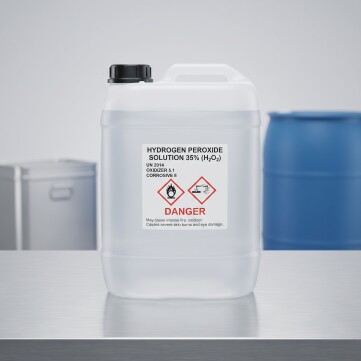
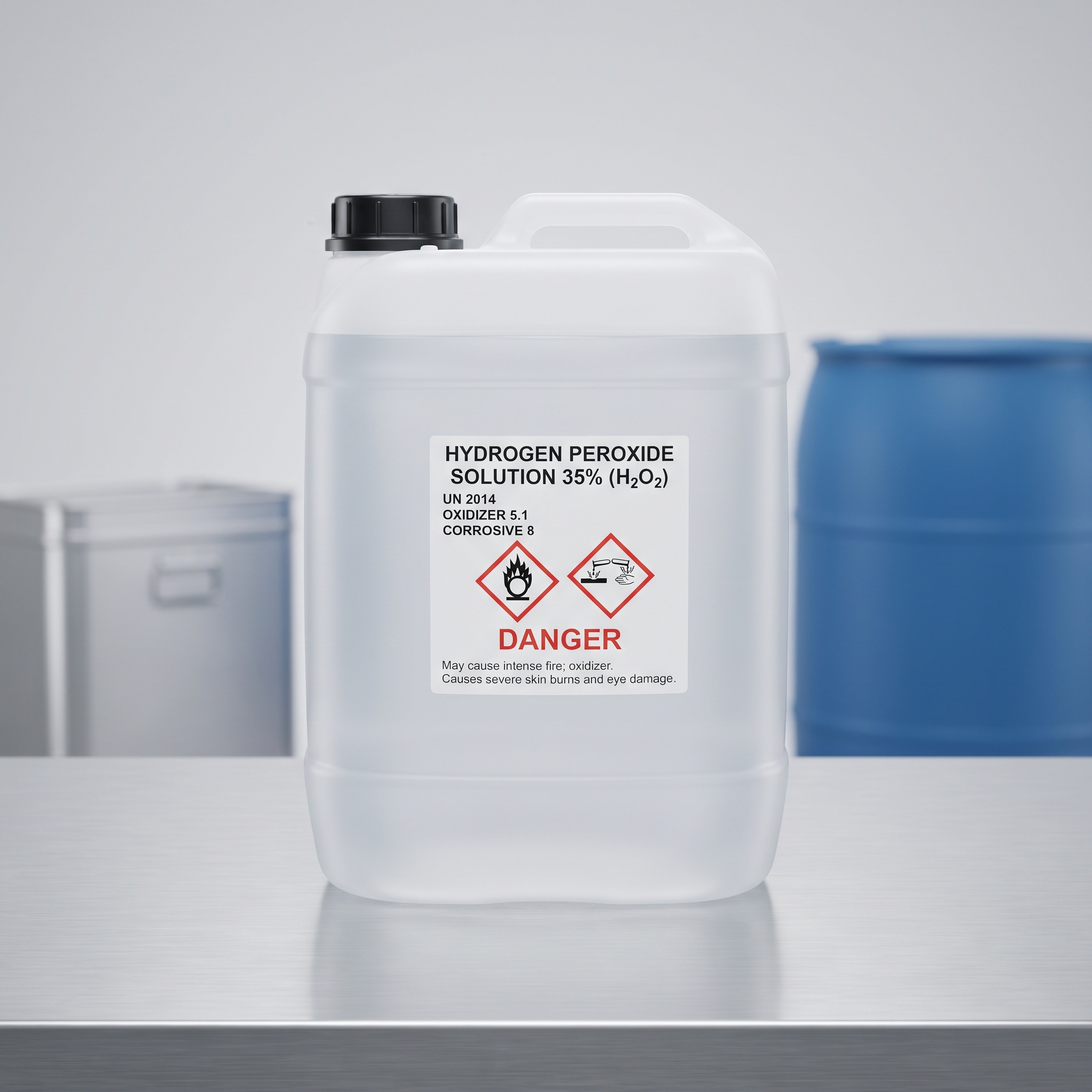
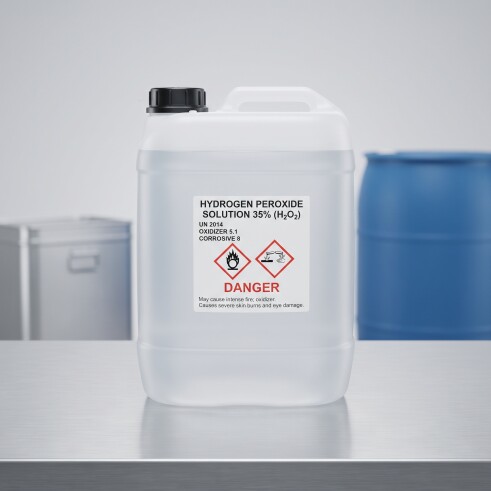
The packaging bears hazard label 5.1 (oxidizer) with a subsidiary label 8 (corrosive) for solutions with a concentration above 20 percent. Transport marking includes warning inscriptions and handling signs, including Keep Away From Sunlight and Keep Away From Heat. For export batches, labeling is performed per GOST 14192 and the order of the foreign trade organization.
Regulatory Framework for Incoming Inspection
- GOST 177-88 - hydrogen peroxide. Specifications. Establishes requirements for medical and technical peroxide of grades A and B, analytical methods and acceptance rules.
- GOST 12.1.007-76 - classification of hazardous substances. Hydrogen peroxide belongs to hazard class 2 substances.
- GOST 19433 - classification and labeling of dangerous goods.
- GOST 30333-2022 - safety data sheet for chemical products.
- GOST 14192 - cargo marking.
- GOST 26319 - packaging for export batches.
- ISO 13730 - methods for determination of hydrogen peroxide stability.
For imported batches, the specification is based on manufacturer standards and international dangerous goods transport rules. The batch specification is confirmed by the manufacturer certificate of quality and the results of incoming laboratory control by the recipient.
Mechanism of Action and Functional Role
Hydrogen peroxide is a strong oxidizer that releases active oxygen on decomposition. In bleaching processes, active oxygen oxidizes the chromophore groups of lignin, cellulose and other colored compounds, providing lightening of the material without the formation of chlorinated organic by-products. This is why hydrogen peroxide is considered an environmentally preferred alternative to chlorine-containing bleaches in the pulp and paper and textile industries.
In disinfection and medicine, hydrogen peroxide oxidizes cell membranes and intracellular components of microorganisms, providing antiseptic and bactericidal action. In chemical synthesis, it is used as an oxidizer for producing epoxides, hydroxylamine, organic peroxides and other compounds. In mining, peroxide is used for oxidation of cyanides and other toxic compounds in wastewater, as well as in leaching processes.
For the B2B buyer, it is important to understand that hydrogen peroxide stability and impurity content directly affect bleaching and oxidation efficiency. Iron, copper and other transition metal impurities catalyze the decomposition of active oxygen, so control under GOST 177-88 and correct packaging selection are mandatory incoming inspection steps.
Applications by Industry
Pulp and Paper Industry
The largest consumption direction. Hydrogen peroxide is used for bleaching high-yield pulp, mechanical pulp and recycled paper, as well as for paper refining. Environmentally oriented totally chlorine-free (TCF) and elemental chlorine-free (ECF) bleaching processes are based on hydrogen peroxide.
Textile Industry
Bleaching of cotton, linen and viscose fabrics, preparation of fibers before dyeing, as well as disinfection of textiles in medical institutions and the food industry.
Chemical Synthesis
Oxidation of organic compounds, production of epoxides, hydroxylamine, organic peroxides, as well as neutralization of cyanides and other toxic substances in wastewater.
Medicine and Sanitation
Antiseptic treatment of wounds and mucous membranes, disinfection of premises, equipment and instruments, sterilization in low-temperature plasma.
Mining and Metallurgy
Oxidation of sulfide ores, neutralization of cyanides in gold recovery plant effluents, as well as metal surface treatment before coating.
Other Industries
Water treatment and wastewater purification, production of food additives and packaging, electronics for wafer cleaning, as well as household chemicals and cosmetics.
Comparison with Alternative Oxidizers and Bleaching Agents
Compared with chlorine and sodium hypochlorite, hydrogen peroxide does not form chlorinated organic compounds and trihalomethanes, making it preferable for processes where toxic by-products must be minimized. Compared with ozone, peroxide is easier to dose and does not require on-site generation, although it is inferior to ozone in oxidizing power in some processes.
Compared with potassium permanganate and dichromate, hydrogen peroxide gives clean decomposition products and does not contaminate effluents with heavy metal ions. Compared with peroxysulfuric acid, peroxide is more stable and safer to handle. For pulp bleaching, hydrogen peroxide competes with chlorine-containing reagents but has an advantage in environmental and sanitary requirements.
Supplier Selection Criteria and Specification Development
The specification for hydrogen peroxide must include the grade (medical, technical A or B), sort for grade B, H2O2 mass fraction, stability parameters, non-volatile residue and sulfate content, as well as packaging and transport conditions. For medical peroxide, sterility requirements and permitted stabilizers are additionally specified.
The supplier confirms batch-to-batch quality consistency, a valid safety data sheet under GOST 30333-2022, readiness to provide passivated or polymer packaging and to organize delivery with observance of the temperature regime. For imported batches, it is important to verify the remaining shelf life and transport conditions, since hydrogen peroxide is sensitive to heat and contamination.
Typical Processing, Storage and Logistics Errors
- Use of non-passivated aluminum or ordinary steel packaging. Metal ions catalyze peroxide decomposition, potentially causing a rapid concentration drop and oxygen release under pressure.
- Storage under direct sunlight and at elevated temperature. Ultraviolet radiation and heating accelerate product decomposition.
- Co-storage with organic materials, reducing agents and combustible substances. Hydrogen peroxide is a strong oxidizer and can cause spontaneous ignition or explosion on contact with incompatible substances.
- Use of contaminated packaging. Residues of other chemicals, especially metal salts, cause peroxide decomposition.
- Overfilling of packaging. The filling coefficient must not exceed 0.92 to leave space for oxygen release.
- Neglecting personal protective equipment. Concentrated solutions cause chemical burns to skin and eyes; work is performed with protective goggles, rubber gloves and protective clothing.
- Use of product beyond its shelf life without control. Hydrogen peroxide gradually loses activity; the actual concentration must be determined before use.
Quality Control and Laboratory Methods
Incoming inspection of hydrogen peroxide includes determination of the H2O2 mass fraction by permanganometric titration, the stability index, non-volatile residue and sulfate mass fractions, as well as the hydrogen index. For medical peroxide, sterility requirements and permitted stabilizers are additionally controlled. Sampling is performed in clean glass or polyethylene containers with observance of safety measures; the combined sample is analyzed in the plant laboratory.
When changing supplier or batch, it is recommended to verify stability and efficiency in the target process, since even minor differences in stabilizer and impurity content can affect bleaching or oxidation results.
Storage and Transportation Conditions
Hydrogen peroxide is classified as a class 5.1 dangerous good with a subsidiary hazard 8, UN numbers 2014 and 2015. Storage is carried out in closed packaging in a cool, light-protected and well-ventilated area at a temperature not above 25 degrees Celsius. Storage under direct sunlight, near heat sources and in contact with organic materials, reducing agents and metal salts is not permitted.
Transportation is carried out in glass carboys, polyethylene drums and canisters, passivated aluminum vessels and specialized tank cars in accordance with dangerous goods transport rules. Sea transport uses specialized tank containers and vessels complying with IMDG requirements.
Finding Analogues and Interchangeability
When replacing hydrogen peroxide, a product of the same grade and concentration is selected. Replacing medical peroxide with technical peroxide is not permitted due to differences in purity and stabilizer requirements. Replacing technical grade A with grade B is possible in processes where somewhat wider impurity limits are acceptable, with confirmation of efficiency in the target process.
Replacing hydrogen peroxide with sodium hypochlorite or chlorine-containing bleaches is possible but changes the environmental profile of the process and may lead to the formation of chlorinated by-products. Replacement with ozone or peroxysulfuric acid requires changes in technology and equipment. The decision is based on laboratory and pilot-scale testing.
Supply Routes: Russia, China and Other Regions
Domestic supply is provided by chemical complexes with hydrogen peroxide production capacity. Products are supplied to the domestic market and for export. Shipment is by road and rail in polyethylene and passivated aluminum packaging.
Chinese producers have large hydrogen peroxide capacities. Supplies are delivered by sea with subsequent transfer to rail or road transport in compliance with dangerous goods requirements. At the same time, Russian consumers have recently reduced purchases of Chinese product in favor of suppliers from Korea and India. Other global producers are located in Korea, India, the Middle East and Europe. Suppliers from these regions are engaged when required, taking into account logistical and regulatory factors, as well as delivery times that are critical for a product with a limited shelf life.
Logistics and Customs Clearance
Transportation is carried out in glass carboys, polyethylene drums, canisters, passivated aluminum vessels and tank cars. Customs clearance includes classification under HS code 2847000000, preparation of a safety data sheet under GOST 30333-2022, conformity declaration and compliance with dangerous goods labeling requirements. The portal provides customs broker services and supports all clearance stages.
Risk Factors and Safety Measures
The main risks are associated with the oxidizing ability of hydrogen peroxide, its ability to cause chemical burns to skin and eyes, and the danger of decomposition with oxygen release and pressure build-up in packaging. Concentrated solutions can ignite organic materials. Hydrogen peroxide belongs to hazard class 2 substances per GOST 12.1.007-76.
Work is performed in ventilated rooms with protective goggles or shields, rubber gloves and protective clothing. In case of contact with skin or eyes, the affected area must be immediately flushed with plenty of water and medical attention sought. In case of a spill, the solution is diluted with plenty of water and collected with inert material; contact with combustible substances and reducing agents is not permitted. Discharge of concentrated solutions into water bodies without prior dilution and neutralization is not permitted.
FAQ: Common Questions from Procurement and Process Specialists
How does medical hydrogen peroxide differ from technical peroxide
Medical peroxide contains 30-40 percent H2O2, is produced by the electrochemical process and is stabilized with additives permitted for medical use. Technical peroxide of grades A and B also contains 30-40 percent H2O2 but allows wider impurity limits and is used in industrial processes. Replacing medical peroxide with technical peroxide is not permitted.
Which packaging is suitable for hydrogen peroxide storage
Dark glass carboys, polyethylene drums and canisters, and passivated aluminum vessels and containers for the technical product are used. Ordinary steel and non-passivated aluminum are unsuitable because metal ions catalyze decomposition. Medical peroxide is not supplied in aluminum packaging.
Why is packaging for peroxide not filled completely
The filling coefficient of the packaging must not exceed 0.92 to leave space for oxygen release during peroxide decomposition. Overfilling can lead to pressure build-up and loss of containment.
What is the shelf life of hydrogen peroxide
The shelf life depends on concentration, stabilizer and storage conditions. Under proper temperature conditions and protection from light, peroxide retains activity for several months; the specific shelf life is established by the manufacturer. Before use, determination of the actual concentration is recommended.
What documents are required for hydrogen peroxide import
Import requires a contract, invoice, packing list, safety data sheet under GOST 30333-2022 in Russian, manufacturer certificate of quality, transport documents and a declaration of conformity. For dangerous goods, transport permits and compliance with carriage rules are additionally confirmed.
Conclusion
Hydrogen peroxide remains a demanded oxidizer and environmentally preferred bleaching agent for the pulp and paper, textile, mining and medical industries. GOST 177-88 establishes medical and technical peroxide of grades A and B, differing in production method and impurity content. For procurement teams, the practical task reduces to correct selection of grade and concentration, confirmation of batch conformity to the standard, and organization of supplies in compliance with requirements for passivated or polymer packaging, protection from light and heat, and safety measures when handling a class 5.1 hazardous good.
Contact Us
For procurement inquiries and supply chain organization, contact the portal team at info@apptrade.ru.