













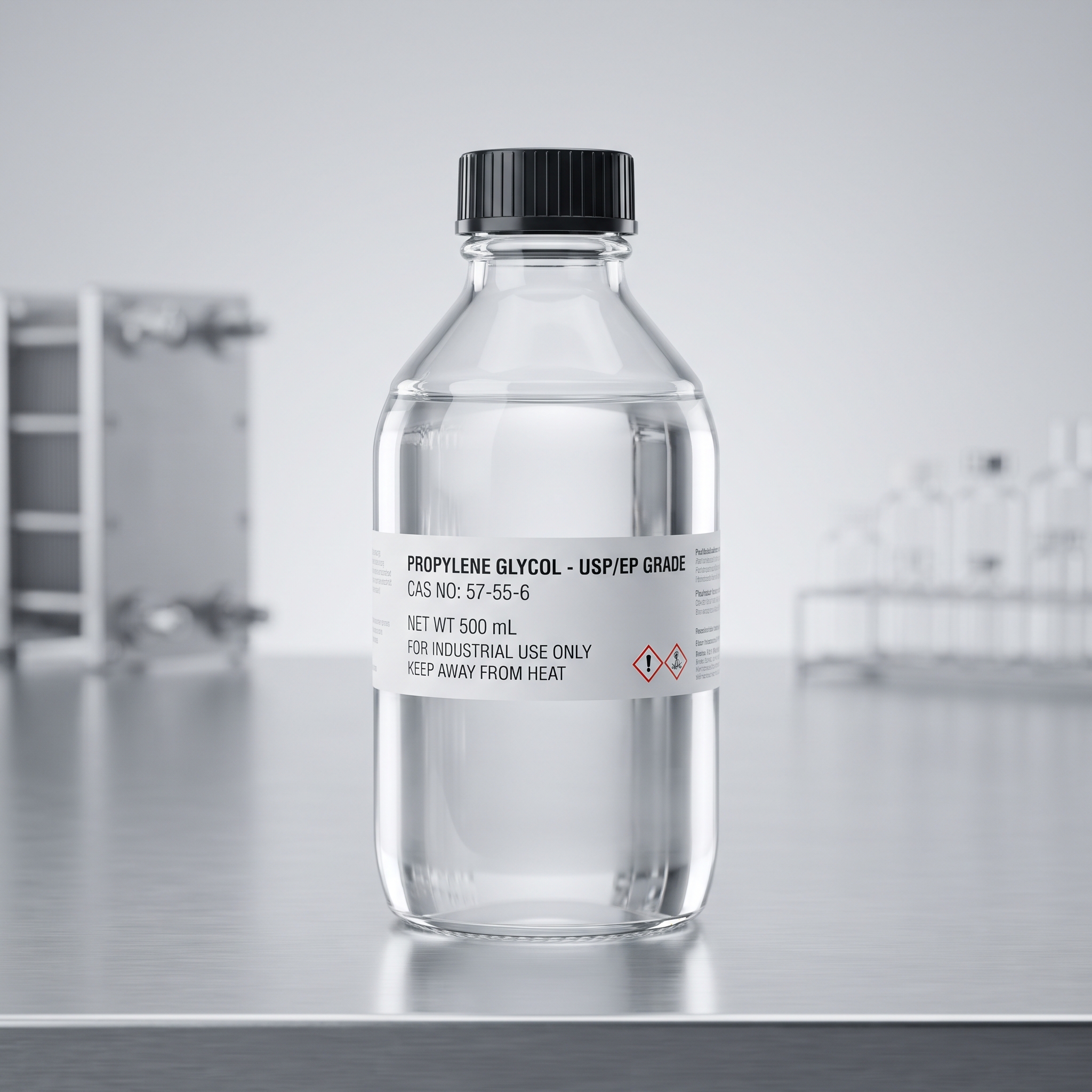
Propylene Glycol
Propylene Glycol: Technical Overview for Industrial Applications
Propylene glycol (1,2-propanediol, monopropylene glycol, MPG) is a dihydric alcohol produced by liquid-phase hydration of propylene oxide. In industrial practice, propylene glycol occupies a stable niche as a less toxic alternative to ethylene glycol in heat transfer fluids and antifreezes, and as a multifunctional additive in food, pharmaceutical, and cosmetic products. Its primary function is to lower the freezing point of aqueous solutions, ensure stable heat removal, and provide humectant and solvent properties without altering the target characteristics of the final product.
Chemical Identification
Propylene glycol is identified by CAS 57-55-6, empirical formula C3H8O2, structural formula CH3CHOHCH2OH, relative molecular mass 76.1. In international trade, it is classified under HS heading 2905 32 000 0 as propylene glycol (propane-1,2-diol). Synonyms include 1,2-propanediol, monopropylene glycol, methyl ethylene glycol, and MPG. The substance is assigned to hazard class 4 for health effects as a low-hazard substance.
Physicochemical Properties
Propylene glycol is a colorless transparent viscous hygroscopic liquid with no odor. Density at 20 degrees Celsius is 1.035-1.038 g/cm3. Boiling point is 187-188 degrees Celsius, pour point minus 59 degrees Celsius, flash point 99-101 degrees Celsius in a closed cup, autoignition temperature 420 degrees Celsius. Refractive index at 20 degrees Celsius is 1.431-1.433. Propylene glycol is miscible with water, alcohols, acetone, and many organic compounds; it does not dissolve rubber or heavy petroleum oils. It has low volatility and high hygroscopicity.
Technical Grades and Supply Forms
Propylene glycol is produced under GOST 32744-2014. The standard provides for grade A in highest, first, and second grades, differing in main substance mass fraction (at least 99.7, 99.5, and 99.0 percent respectively). Highest grade is used in the electronics industry, first grade in the pharmaceutical industry, and second grade for technical purposes and antifreeze preparation. Outside the EAEU, USP and EP pharmacopoeial grades are common, as well as food grade designated E1520. The product is supplied in steel drums, intermediate bulk containers, rail and road tank cars, and tank containers. Typical bulk shipments start from one tonne.
Regulatory Framework
In the EAEU region, quality is governed by GOST 32744-2014 Propylene Glycol. Specifications. For pharmaceutical and food applications, products may be accompanied by certificates of conformity to USP or EP pharmacopoeial monographs, as well as declarations of conformity with food safety requirements. As a lubricating material or special fluid, propylene glycol may be subject to declaration under TR CU 030/2012 depending on the intended use of the batch. For customs purposes, the explanatory notes to HS heading 2905 32 000 0 apply.
Mechanism of Action and Functional Role
In heat transfer fluids and antifreezes, propylene glycol lowers the crystallization temperature of water by disrupting the ice crystal lattice and raises the boiling point of the solution, ensuring stable heat removal over a wide temperature range. In food and cosmetic products, propylene glycol acts as a humectant, binding free water and preventing product drying, and as a solvent for flavors and colors. In pharmaceuticals, it is used as a solvent and base for soft dosage forms. In industrial formulations, it performs a wetting and dispersing function.
Applications by Industry
The food industry uses propylene glycol as a humectant, solvent, and stabilizer in confectionery, flavors, and food additives. Pharmaceuticals use it as a solvent and base for syrups, ointments, and injectable solutions. The cosmetics industry uses propylene glycol as a humectant, solvent, and component of creams, shampoos, and toothpastes. In heating and cooling systems, propylene glycol is used as a safe heat transfer fluid in residential and food facilities. In the oil and gas sector, it is used as a component of drilling fluids and dehydrating agents. In polymer production, it serves as feedstock for unsaturated polyester resins and polyurethanes.
Comparison with Alternative Materials
Compared with ethylene glycol, propylene glycol has lower toxicity (hazard class 4 versus class 3) and is permitted for use in food and pharmaceutical circuits, but it is inferior to ethylene glycol in thermophysical characteristics at low temperatures and has a higher cost. In polyester resin production, propylene glycol imparts greater flexibility and hydrolysis resistance to the polymer compared with ethylene glycol. Compared with butylene glycol, propylene glycol has lower viscosity and higher hygroscopicity.
Typical Processing Errors
- Using technical grade propylene glycol in food or pharmaceutical applications without confirming compliance with pharmacopoeial requirements.
- Applying propylene glycol in systems requiring a lower freezing point than it provides, without adjusting concentration or switching to ethylene glycol.
- Storing in non-sealed containers, leading to moisture absorption from air and concentration changes.
- Mixing with strong oxidizers or alkalis without control, which may cause an exothermic reaction.
- Neglecting color and iron content control in supplies for the electronics and pharmaceutical industries.
- Violating storage temperature conditions above plus 40 degrees Celsius near ignition sources.
Quality Control and Laboratory Methods
Incoming inspection of propylene glycol includes determination of appearance and color on the platinum-cobalt scale, density at 20 degrees Celsius, refractive index, main substance content by gas chromatography, water content by the Karl Fischer method, acid content calculated as acetic acid, chloride content, and residue after ignition. For pharmaceutical and food applications, heavy metal content and microbiological indicators are additionally controlled.
Storage and Transportation Conditions
Propylene glycol is stored in sealed containers at temperatures up to plus 40 degrees Celsius, away from ignition sources and strong oxidizers. The guaranteed shelf life is typically 24 to 60 months depending on grade and packaging conditions. Propylene glycol is not classified as dangerous goods for transport, simplifying logistics. Transportation is carried out by all modes of transport in accordance with cargo transport rules applicable to the respective mode.
Finding Analogues and Interchangeability
When selecting an analogue for propylene glycol, the key criteria are grade (technical, pharmacopoeial, food), main substance content, water content, and color. For heat transfer fluids, replacing propylene glycol with ethylene glycol is possible only in the absence of low-toxicity requirements, as this changes the hazard class and permissible application conditions. For food and pharmaceutical applications, replacement with other glycols is unacceptable without safety confirmation. Direct substitution without preliminary testing is not recommended.
Supply Scheme
For industrial buyers, propylene glycol is available worldwide through the apptrade.ru platform. Shipments can be organized from producing regions across different continents, with logistics and customs support adapted to the destination market. International sourcing allows buyers to balance cost and lead time depending on batch size and logistical distance.
Logistics and Customs Clearance
Propylene glycol is transported by sea, rail, and road. For large batches, sea tank containers or dedicated tankers are economically viable; for medium and small volumes, drums and intermediate bulk containers are used. When imported into the EAEU, products are classified under HS heading 2905 32 000 0. The portal customs broker prepares declarations, confirms classification codes, and manages non-tariff regulation procedures where applicable to a specific shipment.
FAQ
What is the difference between propylene glycol and ethylene glycol?
Propylene glycol (C3H8O2) is less toxic (hazard class 4 versus class 3 for ethylene glycol) and is permitted for use in food and pharmaceutical circuits. Ethylene glycol (C2H6O2) provides lower freezing points for solutions and is less expensive but is toxic when ingested.
Can propylene glycol be used as a heat transfer fluid in a residential building?
Yes, propylene glycol is widely used as a safe heat transfer fluid in residential heating systems and food production facilities due to its low toxicity. However, its higher viscosity compared to ethylene glycol must be considered, and pumping equipment should be selected accordingly.
What hazard class is assigned to propylene glycol?
Propylene glycol is hazard class 4 for health effects as a low-hazard substance. For transport, it is not classified as dangerous goods.
How long can propylene glycol be stored?
The guaranteed shelf life of propylene glycol is typically 24 to 60 months depending on grade and packaging conditions at temperatures up to plus 40 degrees Celsius in sealed containers. After expiry, the product must undergo laboratory testing before use.
Is special packaging required for propylene glycol transportation?
Hermetic packaging is used for propylene glycol: tank cars, tank containers, steel drums, and intermediate bulk containers. Special dangerous goods packaging requirements do not apply because propylene glycol is not dangerous goods.
What is the difference between propylene glycol grades under GOST 32744-2014?
Grade A highest grade contains at least 99.7 percent main substance and is used in the electronics industry. First grade contains at least 99.5 percent and is used in pharmaceuticals. Second grade contains at least 99.0 percent and is used for technical purposes and antifreeze preparation.
Conclusion
Propylene glycol remains a sought-after petrochemical product and a key component for food, pharmaceutical, and cosmetic industries, as well as a safe heat transfer fluid for residential and food facilities. For industrial buyers, critical factors include batch-to-batch consistency, especially color and iron content, correct customs classification, and compliance with storage conditions. The apptrade.ru portal organizes the full supply cycle, from grade selection for a specific process to customs clearance and delivery to the manufacturing site.
Contact Us
For procurement inquiries, technical documentation, and logistics coordination, contact the apptrade.ru team at info@apptrade.ru.