















Caprolactam
What Caprolactam Is and Why It Remains the Monomer for Polyamide-6
Caprolactam (lactam of epsilon-aminocaproic acid, C6H11NO) is a colorless crystalline solid or a colorless oily liquid in the molten state. Industrially, it is produced synthetically from benzene, aniline, phenol and toluene via hydrogenation, oximation and Beckmann rearrangement. Its molar mass is 113.16 g/mol, melting point 68-70 degrees Celsius, boiling point 267-270 degrees Celsius, and density about 1.01-1.02 g/cm3.
For procurement teams, caprolactam matters primarily as the sole large-tonnage monomer for polyamide-6 (nylon-6). Almost all global caprolactam consumption is directed to polymerization to produce polyamide fibers (textile and technical, including tire cord), engineering plastics for automotive and electrical applications, and films for food packaging. Unlike many monomers, caprolactam is supplied both in crystalline (flaked) and liquid molten form, which determines differences in packaging and logistics.
The key feature of caprolactam that determines the supply chain is its hygroscopicity and susceptibility to hydrolysis, as well as the fact that the crystalline product is not classified as a dangerous good for transport. This simplifies logistics compared to most monomers but requires moisture protection and, for the liquid form, strict temperature control to prevent solidification in tank cars.
Chemical Identification and Procurement Data
- Chemical name: caprolactam, epsilon-caprolactam, lactam of epsilon-aminocaproic acid, hexahydro-2H-azepin-2-one.
- Chemical formula: C6H11NO.
- Molar mass: 113.16 g/mol.
- CAS number: 105-60-2.
- UN number: not assigned for crystalline caprolactam; the product is not classified as a dangerous good. For liquid melt above 100 degrees Celsius, UN 3257 may apply; above 125 degrees Celsius, UN 3256.
- HS code: 2933710000 for 6-hexanelactam (epsilon-caprolactam).
- Commercial form: crystalline (flaked) as white flakes or crystals; liquid as melt at about 80-90 degrees Celsius.
In the Russian regulatory system, the primary document for caprolactam is GOST 7850-2013, which covers product obtained synthetically from benzene, aniline, phenol and toluene and establishes requirements for caprolactam manufactured for domestic needs and export. The standard provides for premium, first and second grades and standardizes parameters for both crystalline and liquid product. The supplier confirms batch conformity to GOST 7850-2013 and provides a certificate of quality with actual values for each parameter.
Quality Parameters Relevant to Processing
For caprolactam per GOST 7850-2013, the key parameters are the main substance mass fraction (not less than 99.9 percent for premium), volatile bases mass fraction (not more than 0.5-0.6 millimoles per 100 grams), permanganate index (not less than 5-10 minutes depending on grade), water mass fraction (not more than 0.1-0.2 percent), melt color and iron content. For the liquid product, the crystallization temperature is additionally standardized.
For the processor, volatile bases content and permanganate index are critical. Elevated volatile bases indicate impurities that can disrupt polymerization and degrade polyamide quality. A low permanganate index indicates the presence of reducing agents capable of causing polymer degradation. Moisture and iron also affect polymerization stability and final product color.
Technical Grades and Supply Forms
Crystalline (Flaked) Caprolactam
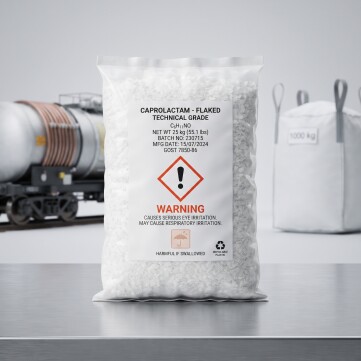
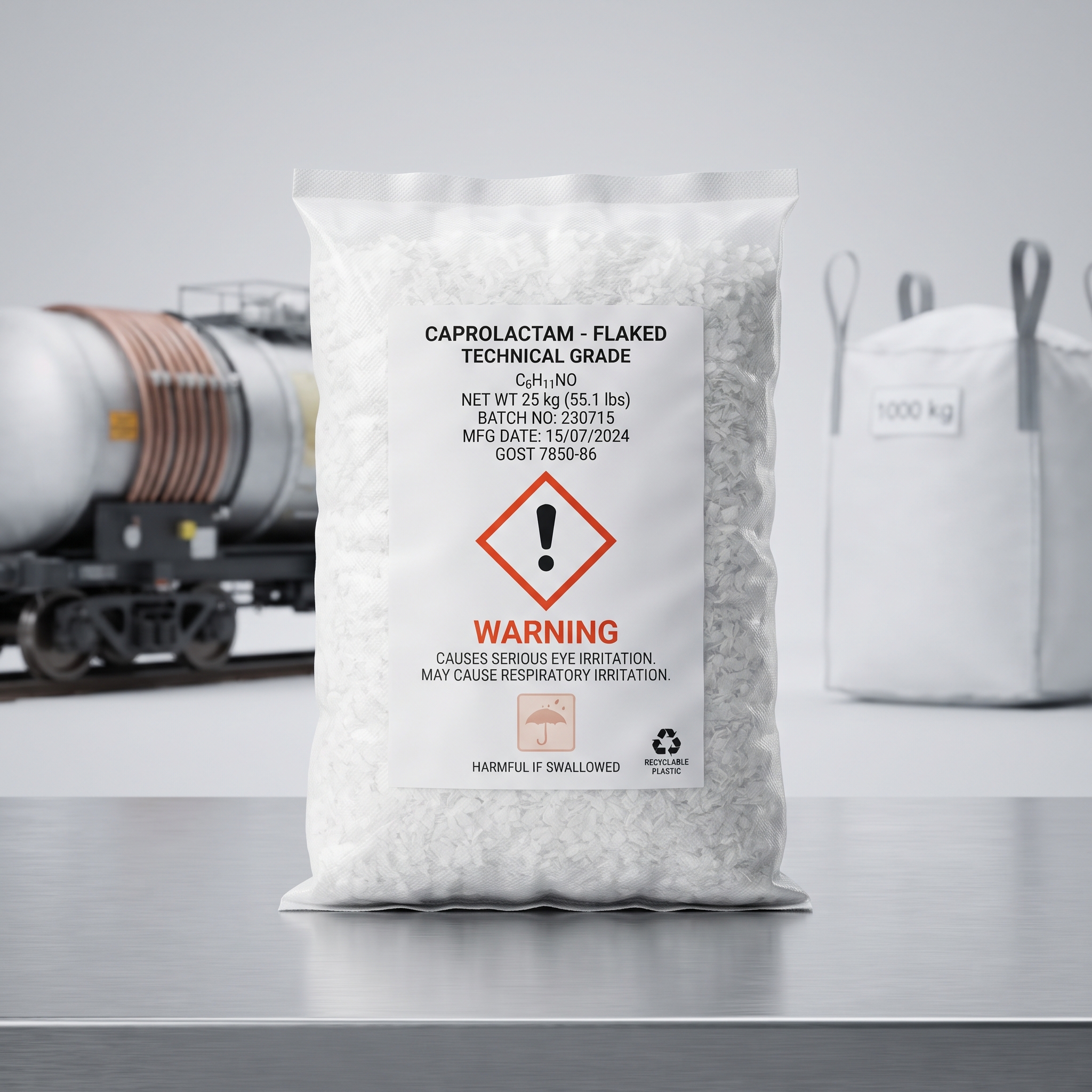
The main commercial format for export and most consumers. Produced in premium, first and second grades. Packed in 25 kg polyethylene bags subsequently palletized, as well as in five-ply paper bags with polyethylene liners. Crystalline caprolactam has a long shelf life of up to 6 months from the date of manufacture under proper conditions.
Liquid Caprolactam
Supplied in specialized rail and road tank cars, as well as in tank containers. Transported and stored in the molten state at about 80-90 degrees Celsius. The shelf life of liquid caprolactam is limited to about 15 days from the date of manufacture, requiring precise synchronization of supplies with the consumer production schedule.
Packaging, Containers and Labeling
Crystalline caprolactam is packed in 25 kg polyethylene bags or five-ply paper bags with a polyethylene liner. Bags are formed into transport packages on pallets. Liquid caprolactam is filled into specialized heated tank cars and tank containers.
Transport Marking
Transport marking is applied per GOST 14192 with the mandatory Keep Dry handling symbol. Since crystalline caprolactam is not classified as a dangerous good, transport hazard labels of class 4.1, 6.1 and others are not applied to the packaging. Under GHS, the product may be labeled with the GHS07 exclamation mark pictogram and the signal word Warning because dust irritates skin, eyes and respiratory tract and is harmful if swallowed. Marking must contain the product name and grade, country and manufacturer, batch number and date of manufacture, net mass, shelf life and standard designation.
Storage Conditions
Crystalline caprolactam is stored in closed dry warehouses in sealed packaging, protected from moisture. Liquid caprolactam is stored in heated tanks under a nitrogen blanket to prevent oxidation and moisture absorption.
Regulatory Framework for Incoming Inspection
- GOST 7850-2013 - caprolactam. Specifications. Establishes requirements for grades, analytical methods and acceptance rules.
- GOST 19433-88 - classification and labeling of dangerous goods; crystalline caprolactam is not classified as a dangerous good.
- GOST 12.1.007-76 - classification of hazardous substances; caprolactam belongs to hazard class 3.
- GOST 12.1.005-88 - maximum permissible concentration of caprolactam vapors in the working area air is 5 mg/m3.
- GOST 14192 - cargo marking.
- GOST 30333-2022 - safety data sheet for chemical products.
For imported batches, the specification is based on manufacturer standards and international transport rules IMDG, RID and ADR taking into account the temperature regime for the liquid product. The batch specification is confirmed by the manufacturer certificate of quality and the results of incoming laboratory control by the recipient.
Mechanism of Action and Functional Role
Caprolactam is a cyclic amide that, on heating in the presence of water or catalysts, opens the lactam ring and polymerizes to form linear polyamide-6. Polymerization can proceed via hydrolytic, anionic or cationic mechanisms. Hydrolytic polymerization is the most common in industry, where caprolactam is heated to 250-270 degrees Celsius in the presence of small amounts of water that initiate ring opening.
The resulting polyamide-6 combines high strength, elasticity, wear resistance, heat resistance and chemical resistance. These properties make it in demand for fiber and engineering plastic production. Caprolactam purity directly affects the molecular weight and properties of the polymer: impurities can terminate chains or cause degradation.
Applications by Industry
Polyamide Fibers
The largest consumption direction. Caprolactam is polymerized into polyamide-6, from which textile and technical yarns are formed, including high-tenacity cord yarns for tires, as well as carpet fibers. This segment accounts for the bulk of global caprolactam consumption.
Engineering Plastics
Polyamide-6 is used to produce structural parts in automotive (intake manifolds, engine covers, fuel system components), electrical engineering (connectors, tool housings), household appliances and mechanical engineering. Polyamide-6 is also used for food packaging films.
Films and Packaging
Polyamide-6 based films offer high strength, heat resistance and barrier properties, making them suitable for food packaging, including vacuum packaging and microwave-safe packaging.
Other Applications
Polyamide-6 is used in fishing nets, ropes and cables, as well as in medicine and for various technical articles.
Comparison with Alternative Monomers
Compared with adipic acid and hexamethylenediamine, monomers for polyamide-66, caprolactam enables a simpler single-stage polymerization process and greater production flexibility. Polyamide-6 is inferior to polyamide-66 in melting point and stiffness but superior in impact toughness and elasticity. Compared with other lactams, for example laurolactam for polyamide-12, caprolactam is significantly cheaper and more available in large-tonnage volumes, although inferior in hydrophobicity and moisture resistance.
In fiber production, caprolactam competes with polyester monomers, terephthalic acid and ethylene glycol, but has an advantage in applications requiring high strength, wear resistance and heat resistance.
Supplier Selection Criteria and Specification Development
The specification for caprolactam must include the form (crystalline or liquid), grade (premium, first, second), main substance mass fraction, volatile bases content, permanganate index, water and iron content, as well as packaging (bags, tank cars) and transport conditions. For the liquid product, crystallization temperature and transport temperature regime are additionally specified.
The supplier confirms batch-to-batch quality consistency, a valid safety data sheet under GOST 30333-2022, readiness to provide sealed packaging and to organize transport in compliance with the temperature regime for the liquid form. For imported batches, it is important to verify remaining shelf life and transport conditions.
Typical Processing, Storage and Logistics Errors
- Violation of packaging sealing. Caprolactam is hygroscopic; moisture absorption from air leads to hydrolysis and reduced product quality, as well as caking of flakes.
- Solidification of liquid caprolactam in tank cars. Below 68-70 degrees Celsius the melt crystallizes, potentially blocking pipelines and damaging equipment. A temperature of at least 80 degrees Celsius must be maintained.
- Co-storage with strong oxidizers. Caprolactam reacts with oxidizers with heat and toxic gas release; co-storage is not permitted.
- Neglecting dust protection. Caprolactam dust irritates mucous membranes and the respiratory tract; a respirator, protective goggles and gloves are required when handling flakes and powder.
- Use of product beyond its shelf life without control. Crystalline caprolactam is stored for up to 6 months, liquid for up to 15 days; after this period, incoming inspection is required.
- Incorrect labeling. Applying class 4.1 or 6.1 hazard labels to crystalline caprolactam packaging is misleading because the product is not classified as a dangerous good.
Quality Control and Laboratory Methods
Incoming inspection of caprolactam includes determination of the main substance mass fraction by gas chromatography, volatile bases content by titration, permanganate index by titration, water mass fraction by the Fischer method, melt color by photometry and iron content by spectrophotometry. For the liquid product, crystallization temperature is additionally controlled. Sampling is performed by standardized methods; the combined sample is analyzed in the plant laboratory.
When changing supplier or batch for polyamide production, a control polymerization run is recommended to confirm compatibility with the process and final polymer properties.
Storage and Transportation Conditions
Crystalline caprolactam is stored in closed dry warehouses in sealed packaging at ambient temperature, protected from moisture. The shelf life is 6 months from the date of manufacture. Liquid caprolactam is stored in heated tanks under a nitrogen blanket at 80-90 degrees Celsius; the shelf life is 15 days from the date of manufacture.
Transportation of crystalline caprolactam is by rail and road in covered cars and containers in bags on pallets. Liquid caprolactam is transported in specially equipped heated rail and road tank cars, as well as in tank containers. When transporting liquid melt above 100 degrees Celsius, UN 3257 requirements may apply; above 125 degrees Celsius, UN 3256.
Finding Analogues and Interchangeability
When replacing caprolactam, a product of the same grade with similar main substance, volatile bases and permanganate index parameters is selected. Replacing premium grade with first or second grade is possible only in processes where impurities do not affect polyamide quality, with confirmation of final product properties. Replacing caprolactam with other monomers, adipic acid and hexamethylenediamine for polyamide-66, requires a complete revision of the polymerization technology and is often economically impractical.
In fiber production, caprolactam has no direct analogues among large-tonnage monomers because polyamide-6 offers a unique combination of properties. The replacement decision is based on laboratory testing and, for critical processes, pilot-scale verification.
Supply Routes: Russia, China and Other Regions
Domestic supply is provided by petrochemical complexes with caprolactam production capacity. A significant share of Russian product is exported, primarily to China and India. Shipment is by rail in covered cars and tank cars, and by sea through ports.
China is the largest producer and consumer of caprolactam. Supplies are delivered by sea with subsequent transfer to rail or road transport. Other global producers are located in Southeast Asia and Europe. Suppliers from these regions are engaged when required, taking into account logistical and regulatory factors.
Logistics and Customs Clearance
Transportation of crystalline caprolactam is carried out in bags on pallets in covered vehicles. Liquid caprolactam is transported in heated tank cars and tank containers. Customs clearance includes classification under HS code 2933710000, preparation of a safety data sheet under GOST 30333-2022 and conformity declaration. The portal provides customs broker services and supports all clearance stages.
Risk Factors and Safety Measures
Caprolactam belongs to hazard class 3 per GOST 12.1.007-76; the maximum permissible concentration of vapors in the working area air is 5 mg/m3. Dust and vapors irritate the mucous membranes of the eyes, nose and respiratory tract, and prolonged contact may cause dermatitis. On heating above the melting point, caprolactam decomposes with the release of toxic vapors containing nitrogen oxides and ammonia.
Work is performed in ventilated rooms with filtering respirators, protective goggles and gloves. In case of a liquid caprolactam spill, it is collected mechanically after solidification, and residues are washed off with plenty of water. Discharge of concentrated solutions into water bodies without prior neutralization is not permitted.
FAQ: Common Questions from Procurement and Process Specialists
How does crystalline caprolactam differ from liquid
Crystalline caprolactam is flakes or crystals packed in bags with a long shelf life of up to 6 months. Liquid caprolactam is a melt transported and stored at 80-90 degrees Celsius in heated tank cars; its shelf life is limited to 15 days. The liquid form is convenient for large consumers at a short transport distance and avoids the melting stage.
Is caprolactam a dangerous good
Crystalline caprolactam is not classified as a dangerous good and has no UN number, which simplifies transport. However, under GHS the product may be labeled with GHS07 as harmful if swallowed and irritating to skin and eyes. Liquid melt above 100 degrees Celsius may require classification as a dangerous good UN 3257 or UN 3256.
Which packaging is used for caprolactam
Crystalline caprolactam is packed in 25 kg polyethylene bags or five-ply paper bags with a polyethylene liner, which are then palletized. Liquid caprolactam is filled into specialized heated rail and road tank cars, as well as tank containers.
What is the shelf life of caprolactam
Crystalline caprolactam is stored for 6 months from the date of manufacture, liquid for 15 days. After this period, incoming inspection of main substance and volatile bases content is required.
What documents are required for caprolactam import
Import requires a contract, invoice, packing list, safety data sheet under GOST 30333-2022, manufacturer certificate of quality and transport documents. For liquid caprolactam, the temperature regime and transport permit are additionally confirmed. The portal organizes the preparation of the document set and interaction with the customs broker.
Conclusion
Caprolactam remains an indispensable large-tonnage monomer for polyamide-6, enabling the production of fibers, engineering plastics and films. GOST 7850-2013 establishes requirements for crystalline and liquid product differing in main substance and impurity content. For procurement teams, the practical task reduces to correct form and grade selection, confirmation of batch conformity to the standard, and organization of supplies with sealed packaging for the crystalline product and temperature control for the liquid melt.
Contact Us
For procurement inquiries and supply chain organization, contact the portal team at info@apptrade.ru.