

















Conductive Glass for Transparent Heating Systems
Conductive glass for transparent heating assemblies
Conductive FTO glass is offered as a material for developing transparent resistive heating components. The available sheets have a nominal thickness of 2.1 mm and dimensions of 2000 x 1400 mm. This offer is intended for equipment manufacturers, glass processors and developers of heated glazing. The supply covers glass and agreed preparation operations, rather than a complete electrically connected heating product.
Coating composition and terminology
FTO is fluorine doped tin oxide, expressed as SnO2:F. The coating belongs to the transparent conductive oxide family, or TCO. It is a hard coating deposited by chemical vapour deposition, commonly abbreviated as CVD. A constituent CAS number does not identify the complete coated glass article. Customs classification must be established for the actual supplied item and condition.
Electrical and optical selection data
- Nominal glass thickness: 2.1 mm.
- Starting sheet size: 2000 x 1400 mm.
- Reported sheet resistance: approximately 30 ohms per square.
- Reported light transmission: 85 percent from a production measurement.
- Surface function: transparent electrical conduction.
These values support initial selection. Contractual limits, sampling and acceptable variation should be agreed for the application. Sheet resistance is not the resistance of every finished component. Component dimensions and contact arrangement must be considered before deciding whether the available glass fits the electrical design.
Sheets and prepared components
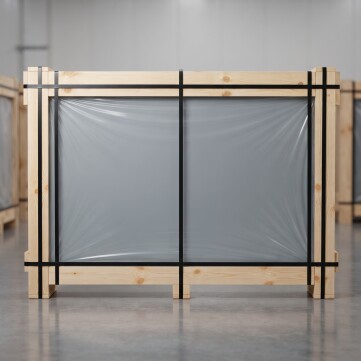
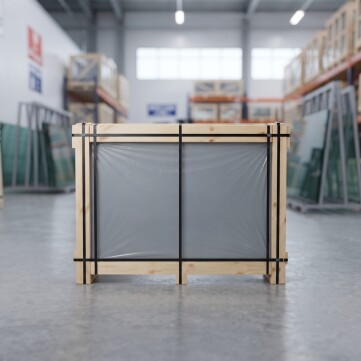
Orders can be discussed for full sheets or blanks prepared to agreed dimensions. Cutting and edge grinding are available by agreement. Wooden transport packaging is used for the sheet material. A dimension schedule should identify finished sizes, quantities and edge requirements. Any request for holes, special shapes or additional processing requires a separate feasibility review rather than being assumed within standard cutting.
Standards and responsibility for the finished system
Product assessment should follow the applicable equipment and destination market requirements. Where relevant, electrical appliance safety may be considered within the IEC 60335 framework, with the appropriate product specific requirements. This does not declare certification of the glass or the completed heater. Responsibility for electrical protection, mechanical safety and approval of the final assembly remains part of the finished product project.
How the heating principle works
When a suitable electrical connection is applied, current passes through the conductive coating and produces resistive heat. For a rectangular uniform coating with full width contacts on opposite edges, resistance depends on sheet resistance and the ratio of contact separation to contact length. Other geometries, interrupted coatings and contact losses require their own assessment. A practical design must account for the complete current path.
Heating output also depends on the applied voltage and the actual component resistance. Surface temperature depends on heat losses, mounting, surrounding air and the adjoining construction. A resistance figure alone therefore cannot define the operating temperature or establish compatibility with a particular power supply. The proposed assembly needs electrical and thermal verification.
Applications for equipment and glazing manufacturers
Potential projects include heated insulating glass units, condensation control in refrigerated displays, equipment viewing windows and transparent heating panels. A refrigeration project should describe the internal and external conditions, humidity and glazing construction. A building glazing project also needs structural and safety assessment. The available 2.1 mm sheet is an input material whose role must be defined within the complete assembly.
Comparison with alternative heating arrangements
A transparent conductive coating offers a different construction approach from visible heating wires, printed tracks or warm air systems. Selection should compare visibility, achievable output, integration work and maintenance requirements. No universal energy saving is declared: consumption depends on the complete system and its control strategy. FTO and other conductive coatings should likewise be compared using actual properties rather than their names alone.
Common design and processing mistakes
- Selecting a supply voltage without checking component resistance and geometry.
- Assuming that every contact arrangement produces uniform heating.
- Ignoring contact resistance and possible local overheating.
- Connecting unprotected accessible conductive surfaces to a power supply.
- Damaging the coating during cutting, cleaning or assembly.
- Using an unverified thermal treatment for the complete order.
Quality control for heating applications
Relevant material checks include dimensions, thickness, coating condition, transmission and sheet resistance. The completed assembly additionally requires verification of contact quality, heating distribution, insulation and protective functions as applicable. A thermal image can help identify uneven heating during development, but it does not replace the complete safety assessment. Batch measurement results are available through the agreed quality documentation.
Storage and handling
Keep the material dry, protected from impact and separated from abrasive contamination. Follow the packaging orientation and support instructions for the consignment. Handling equipment must be suitable for the package weight and dimensions. Inspect the packaging and accessible surfaces at receipt. Contact surfaces should remain suitable for the proposed connection process, with cleaning methods confirmed before production use.
Choosing an equivalent conductive substrate
Replacement selection should compare thickness, dimensions, resistance, transmission, surface condition and compatibility with the contact process. A lower resistance is not automatically better for every heater: the available supply and geometry determine the useful range. Where lamination, sealing or heat treatment is planned, evaluate the material after the intended processing cycle. Similar appearance does not establish equivalent electrical or thermal performance.
Supply planning for worldwide projects
Worldwide enquiries can cover evaluation sheets, prepared blanks and production quantities. Availability and preparation time are confirmed for each request. Forecasts of recurring demand help plan the distinction between prototype work and a larger procurement requirement. The actual supply scope is established through the commercial offer, including any agreed processing. Future quantities and dispatch dates are not assumed from the general product description.
Logistics and customs coordination
Road, rail, sea and multimodal arrangements may be considered where suitable for the consignment. Packaging, lifting access, unloading and insurance responsibilities should be agreed before dispatch. Freight coordination, customs brokerage and financial arrangements are separate services when required. They are not automatically included in a sheet order. Shipment documents must describe the actual supplied glass or prepared components.
Purchasing economics and trial quantities
For production purchasing, compare the cost of a usable blank rather than sheet price alone. Cutting layout, edge work, packaging, transport and acceptance testing influence the total. Evaluation quantities allow the intended contact system and assembly process to be tested before a larger commitment. Full sheets and prepared blanks can be compared to determine which processing operations should be performed by each party.
A useful technical request distinguishes between the glass supplier, the processor and the final equipment manufacturer. Identify which party applies contacts, performs lamination, installs controls and approves the finished product. This avoids comparing a material quotation with a complete heater quotation. Where only glass blanks are required, the offer can remain focused on the agreed dimensions, surface condition and electrical acceptance criteria without implying additional assembly services.
Frequently asked questions
Is the glass supplied as a complete heater?
No. This offer concerns conductive glass and agreed preparation operations. Contacts, electrical protection and the completed assembly require separate definition.
Can the glass operate from any voltage?
No universal voltage is specified. Compatibility depends on resistance, geometry, target output and the protection of the finished product.
Can it help prevent condensation?
Electrical heating can support condensation control when the surface temperature and system design suit the environmental conditions. Performance requires application assessment.
Are cutting and edge grinding available?
Yes, by agreement. Provide a dimension schedule, quantities and edge requirements for a feasibility and preparation review.
Is 30 ohms per square a guaranteed maximum?
The reported selection value is approximately 30 ohms per square. Guaranteed limits and the measurement procedure require separate confirmation.
What information is needed for a proposal?
Provide dimensions, quantity, supply voltage, intended output, environment, glazing construction and the planned contact and processing methods.
Summary for industrial purchasing
The offer combines a defined sheet format, a hard conductive coating and preparation options for transparent heating development. A project based specification connects the material characteristics with the actual electrical and mechanical construction. Prototype verification establishes whether the selected glass and manufacturing route meet the requirements before production purchasing.
Contact Us
info@apptrade.ru