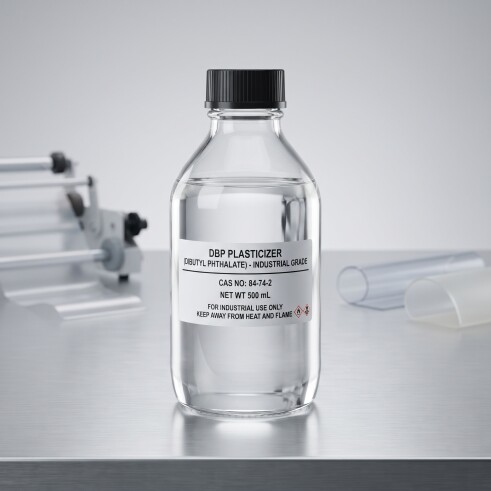
DBP Plasticizer
DBP Plasticizer: Technical Overview for Industrial Applications
DBP plasticizer (dibutyl phthalate, di-n-butyl orthophthalate) is an ester of orthophthalic acid and n-butyl alcohol. In industrial practice, DBP is one of the most widely used plasticizers for polyvinyl chloride and other polar polymers. Its primary function is to lower the glass transition temperature of the polymer, imparting flexibility, elasticity, and low-temperature resistance without altering its chemical nature. DBP is also used as a component of coatings and adhesive compositions.
Chemical Identification
DBP is identified by CAS 84-74-2, empirical formula C16H22O4, relative molecular mass 278.34. Chemical name: dibutyl phthalate, di-n-butyl orthophthalate. In international trade, it is classified under HS heading 2917 34 100 0 as dibutyl orthophthalates. Synonyms include dibutyl phthalate and DBP. The substance is assigned to hazard class 2 for health effects under GOST 12.1.007 as an orthophthalic acid ester.
Physicochemical Properties
DBP is a colorless or slightly yellowish transparent oily liquid with a mild specific odor. Density at 20 degrees Celsius is 1.045-1.050 g/cm3. Boiling point is 340 degrees Celsius at atmospheric pressure. Melting point is minus 35 degrees Celsius. Flash point is 157 degrees Celsius in a closed cup, ignition temperature 202 degrees Celsius, autoignition temperature 402 degrees Celsius. Refractive index at 20 degrees Celsius is 1.492-1.494. Acid number is not more than 0.10 mg KOH/g. Volatile matter content is not more than 0.20 percent. DBP is practically insoluble in water and miscible with most organic solvents, oils, and hydrocarbons.
Technical Grades and Supply Forms
DBP plasticizer is produced under GOST 8728-88 in three grades: highest, first, and second. The grade determines the product application: highest grade is intended for transparent uncolored and light-stable PVC materials, first grade for light-colored polymer materials, and second grade for dark-colored and carbon-black-filled products. The product is supplied in steel drums, intermediate bulk containers, rail and road tank cars, and tank containers. Typical bulk shipments start from one tonne.
Regulatory Framework
In the EAEU region, quality is governed by GOST 8728-88 Plasticizers. Specifications. The standard covers plasticizers - esters of various alcohols and dicarboxylic acids intended for plasticizing vinyl resins and other polymers. Packaging, marking, transportation, and storage are regulated by GOST 1510 and GOST 14192. For customs purposes, the explanatory notes to HS heading 2917 34 100 0 apply.
Mechanism of Action and Functional Role
DBP molecules penetrate between polymer macromolecules such as polyvinyl chloride and weaken intermolecular interactions, leading to a decrease in glass transition temperature and increased segmental mobility. As a result, the material acquires flexibility, elasticity, and elongation capability while maintaining strength. Compared with higher molecular weight plasticizers, DBP has increased volatility, which ensures faster drying and film formation but may limit product durability at elevated temperatures. Compatibility with the polymer is determined by the solubility parameter and polarity.
Applications by Industry
The main volume of DBP is consumed in the production of flexible PVC products: cable compounds, artificial leather, linoleum, polymer films and sheets, and rubber articles. In the coatings industry, DBP is used as a plasticizer for cellulose nitrate, polyvinyl acetate dispersions, and alkyd materials. In adhesives and sealants, DBP provides elasticity and adhesion. DBP is also used in the production of synthetic resins and certain rubber types.
Comparison with Alternative Materials
Compared with dioctyl phthalate, DBP has higher volatility and lower compatibility with polyvinyl chloride, making it less preferable for durable products operated at elevated temperatures. However, DBP ensures faster film formation and is often used in fast-drying coatings and adhesives. Compared with diisononyl phthalate and dioctyl terephthalate, DBP is a less environmentally friendly alternative in terms of regulatory restrictions, yet remains cost-effective in certain applications.
Typical Processing Errors
- Using DBP with elevated acid number or moisture content, leading to PVC degradation and defects in the product.
- Applying DBP in formulations for durable products operated at elevated temperatures without considering its volatility.
- Exceeding the recommended plasticizer dosage, which can reduce mechanical strength and increase brittleness.
- Storing DBP in non-sealed containers or in contact with moisture, promoting ester hydrolysis and an increase in acid number.
- Using DBP in products contacting food or skin without considering regulatory restrictions.
- Working with DBP without personal protective equipment in case of spillage.
Quality Control and Laboratory Methods
Incoming inspection of DBP includes determination of appearance and color on the Hazen scale, density at 20 degrees Celsius, refractive index, acid number by titration, volatile matter content by drying, saponification number, main substance content by gas chromatography or titration, water content by the Karl Fischer method, and flash point in a closed cup. Color on the platinum-cobalt scale after heating is also regulated. For cable compounds, volume electrical resistivity is tested.
Storage and Transportation Conditions
DBP is stored in sealed containers, preferably aluminum or stainless steel, in ventilated warehouses protected from direct sunlight and moisture. The guaranteed shelf life under GOST 8728-88 is one year from the date of manufacture for product packaged in drums or glass bottles, and six months for other packaging. DBP is classified as dangerous goods for transport: UN 3082, class 9, packing group III. Transportation is carried out by all modes of transport in accordance with dangerous goods regulations.
Finding Analogues and Interchangeability
When selecting an analogue for DBP, the key criteria are compatibility with the specific polymer, volatility, pour point, color, and cost-effectiveness. For products requiring enhanced durability and resistance to elevated temperatures, dioctyl phthalate or diisononyl phthalate are preferable. For fast-drying coatings, DBP can be replaced by dimethyl phthalate or diethyl phthalate with dosage adjustment. Direct substitution without preliminary testing is not recommended.
Supply Scheme
For industrial buyers, DBP plasticizer is available worldwide through the apptrade.ru platform. Shipments can be organized from producing regions across different continents, with logistics and customs support adapted to the destination market. International sourcing allows buyers to balance cost and lead time depending on batch size and logistical distance.
Logistics and Customs Clearance
DBP is transported by sea, rail, and road. For large batches, sea tank containers or dedicated tankers are economically viable; for medium and small volumes, intermediate bulk containers and steel drums are used. When imported into the EAEU, products are classified under HS heading 2917 34 100 0. As DBP is class 9 dangerous goods, compliance with packaging, marking, and documentation requirements is mandatory. The portal customs broker prepares declarations, confirms classification codes, and manages non-tariff regulation procedures.
FAQ
What is the difference between DBP and DOP?
DBP has a shorter alkyl chain of four carbon atoms versus eight in DOP. This gives DBP higher volatility and faster film formation but lower durability at elevated temperatures. DOP is preferred for durable PVC products, while DBP is more often used in fast-drying paints, adhesives, and short-life compounds.
Can DBP be used for food packaging?
In most countries, including the EAEU and the European Union, DBP use is restricted for food-contact materials due to potential migration risk and reproductive toxicity. For such applications, alternative plasticizers are recommended after verifying compliance with sanitary norms.
What hazard class is assigned to DBP?
DBP is hazard class 2 for health effects under GOST 12.1.007 as an orthophthalic acid ester. For transport, it is classified as dangerous goods: UN 3082, class 9, packing group III.
How long can DBP be stored?
The guaranteed shelf life of DBP under GOST 8728-88 is one year from the date of manufacture for product in drums or glass bottles, and six months for other packaging. After expiry, the product must undergo laboratory testing before use.
Is special packaging required for DBP transportation?
Yes, because DBP is class 9 dangerous goods. Packaging must comply with ADR requirements for dangerous goods. Sealed aluminum or stainless steel containers are recommended.
What is the difference between DBP grades under GOST 8728-88?
Highest grade is intended for transparent uncolored and light-stable materials, first grade for light-colored materials, and second grade for dark-colored and carbon-black-filled products. Grades differ in color, acid number, and impurity limits.
Which polymers are compatible with DBP?
DBP is well compatible with PVC, vinyl chloride copolymers, cellulose nitrate, polyvinyl acetate, polyacrylates, nitrile rubber, and certain other polar polymers. It has limited compatibility with polyolefins and polyamides due to polarity differences.
Conclusion
DBP plasticizer remains a sought-after plasticizer for PVC and other polymers due to its optimal balance of properties, availability, and established regulatory framework. For industrial buyers, critical factors include batch-to-batch consistency, especially color and acid number, correct customs classification considering its dangerous goods status, and compliance with storage conditions. The apptrade.ru portal organizes the full supply cycle, from grade selection for a formulation to customs clearance and delivery to the manufacturing site.
Contact Us
For procurement inquiries, technical documentation, and logistics coordination, contact the apptrade.ru team at info@apptrade.ru.