Benzene
Petroleum Benzene: Technical Overview for Industrial Applications
Benzene (C6H6) is the simplest aromatic hydrocarbon, produced by catalytic reforming of gasoline fractions, hydrodealkylation of toluene and xylene, or pyrolysis of petroleum feedstock. In industrial practice, benzene occupies a central position as feedstock for large-scale organic synthesis. Its primary role is to provide the feedstock base for styrene, phenol, caprolactam, and aniline production, and to serve as a solvent in specific technological processes.
Chemical Identification
Benzene is identified by CAS 71-43-2, empirical formula C6H6, relative molecular mass 78.11. In international trade, it is classified under HS heading 2902 20 as a cyclic aromatic hydrocarbon. Synonyms include benzol, phenyl hydride, and cyclohexatriene. Benzene is assigned to hazard class 2 for health effects (highly hazardous substance) and is a carcinogen.
Physicochemical Properties
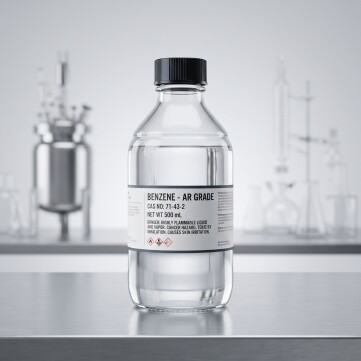
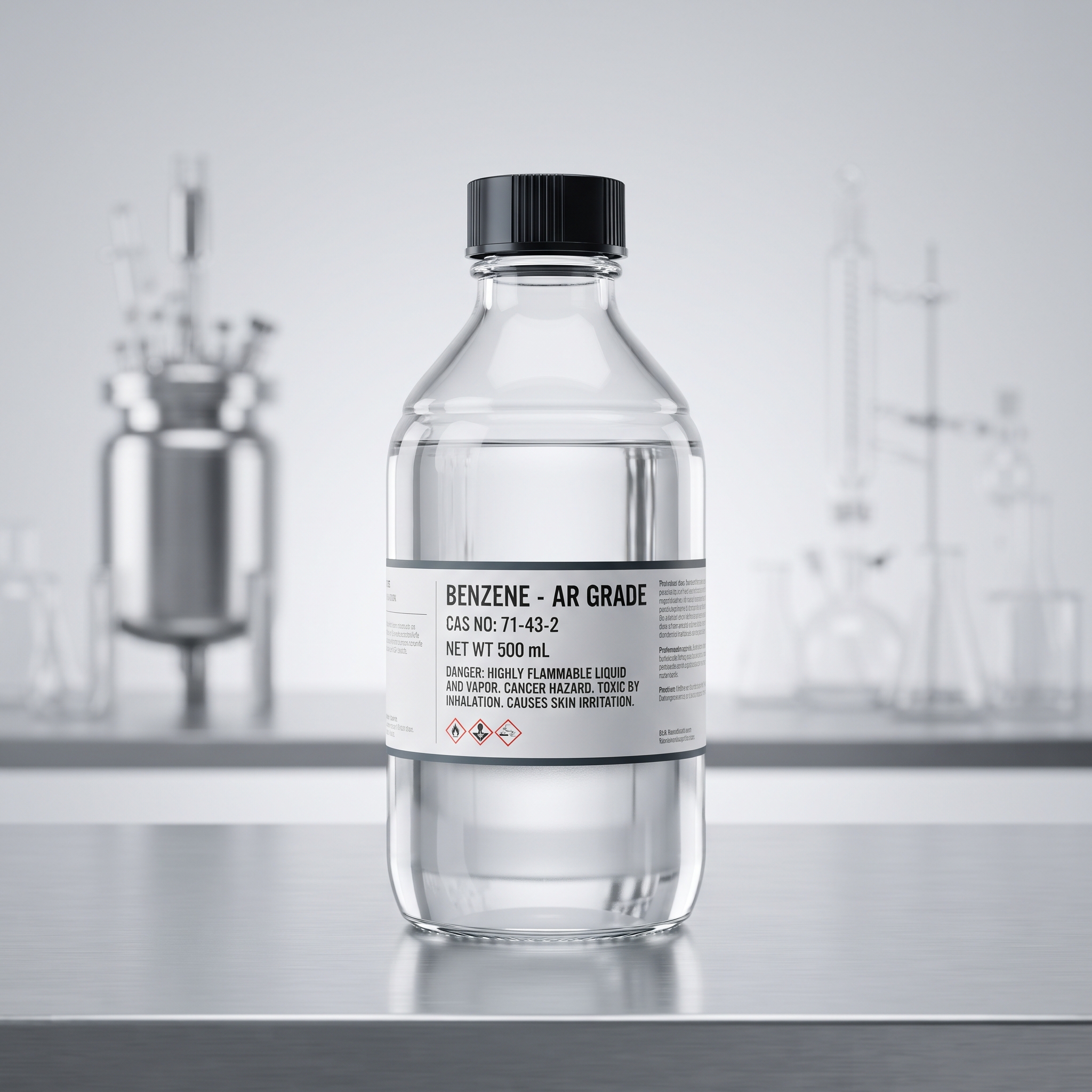
Benzene is a colorless transparent liquid with a characteristic odor. Density at 20 degrees Celsius is 0.878-0.880 g/cm3 depending on grade. Boiling point is 80.1 degrees Celsius, melting point 5.5 degrees Celsius. Flash point in a closed cup is minus 11 degrees Celsius, autoignition temperature 536 degrees Celsius. Explosive limits in air are 1.2 percent (lower) and 8.0 percent (upper) by volume. Solubility in water is very low (0.18 g per 100 g of water at 20 degrees Celsius); benzene is miscible with most organic solvents.
Technical Grades and Supply Forms
Petroleum benzene is produced under GOST 9572-93 in the following grades: highest purity (OKP 24 1411 0120), purified (OKP 24 1411 0130), and for synthesis (OKP 24 1411 0200), as well as highest grade (OKP 24 1411 0220) and first grade (OKP 24 1411 0230). Main substance content ranges from 99.5 to 99.9 percent depending on grade. The product is supplied in rail and road tank cars, steel drums, intermediate bulk containers, and tank containers. Typical B2B shipments start from one tonne.
Regulatory Framework
In the EAEU region, quality is governed by GOST 9572-93. The standard covers benzene intended as feedstock for synthetic fibers and rubbers, plastics, dyes, and other organic synthesis products, as well as for export. Packaging, marking, transportation, and storage are regulated by GOST 1510. For customs purposes, the explanatory notes to HS heading 2902 20 apply.
Mechanism of Action and Functional Role
In chemical synthesis, benzene serves as feedstock for ethylbenzene (styrene), cumene (phenol and acetone), cyclohexane (caprolactam and adipic acid), and aniline. Benzene is also a precursor for nitrobenzene and chlorobenzene. As a solvent, benzene physically dissolves fats, oils, and some resins, but its use in this role is limited due to high toxicity. The key value of benzene for industry lies in its reactivity in electrophilic substitution reactions, enabling a wide range of derivatives.
Applications by Industry
The petrochemical industry consumes the largest share of benzene for styrene (via ethylbenzene), phenol and acetone (via cumene), caprolactam (via cyclohexane), and aniline production. Synthetic rubber production uses benzene as a solvent and feedstock. The coatings industry applies benzene to a limited extent due to toxicity. In dye and pharmaceutical production, benzene serves as a starting compound for intermediate synthesis. Benzene is also used in explosives production (nitrobenzene, trinitrotoluene via toluene).
Comparison with Alternative Materials
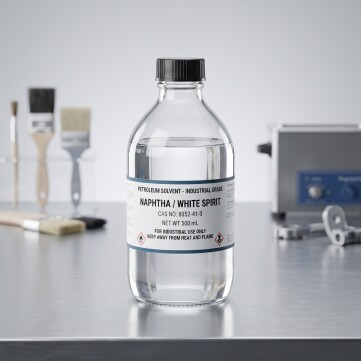
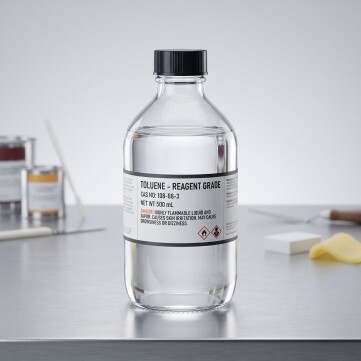
Compared with toluene and xylene, benzene is more toxic (hazard class 2 versus class 3) and is a carcinogen, requiring stricter safety measures. Compared with aliphatic solvents such as naphtha or white spirit, benzene provides higher solvency for certain resins, but its use as a solvent in coatings is declining due to regulatory restrictions. In chemical synthesis, benzene is often irreplaceable as a starting material for styrene and caprolactam.
Typical Processing Errors
- Using benzene in unventilated enclosed spaces without respiratory and skin protection, creating a risk of acute and chronic poisoning.
- Mixing benzene with oxidizers such as nitric acid or peroxides, which may cause an exothermic reaction.
- Storing drums under direct sunlight or near heat sources, leading to pressure buildup and leaks.
- Working with benzene without equipment grounding, creating a risk of static electricity accumulation and ignition.
- Using product past its shelf life without prior laboratory verification of main substance content and impurities.
- Applying benzene to waterborne paints, causing dispersion coagulation.
Quality Control and Laboratory Methods
Incoming inspection of petroleum benzene includes determination of appearance and color (GOST 2706.1-74), density at 20 degrees Celsius (hydrometer or pycnometer under GOST 3900-85), distillation limits (GOST 2706.13-74), crystallization temperature, main substance content and impurities by gas chromatography, sulfuric acid color (GOST 2706.3-74), copper strip test, and total sulfur content. Content of n-heptane, methylcyclohexane, toluene, and other impurities is regulated separately for each grade.
Storage and Transportation Conditions
Benzene is a flammable liquid. The closed-cup flash point is minus 11 degrees Celsius, corresponding to class 3 for transport. Storage is in sealed containers in ventilated warehouses, protected from direct sunlight and kept away from oxidizers and ignition sources. In storage and application areas, open flames and spark-producing tools are prohibited. The guaranteed shelf life of benzene under GOST 9572-93 is six months from the date of manufacture. Transportation is possible by all modes of transport in compliance with dangerous goods regulations: UN 1114, class 3, packing group II.
Finding Analogues and Interchangeability
When selecting an analogue for benzene, the key criteria are product purity, impurity content (n-heptane, toluene, methylcyclohexane), crystallization temperature, and compatibility with process catalysts. For styrene and caprolactam synthesis, replacing benzene with toluene or xylene is impossible without revising the entire technological chain. As a solvent, benzene can be replaced by toluene or xylene, but this alters the toxicological profile and requires revised safety measures. Direct substitution without preliminary testing is not recommended.
Supply Scheme
For industrial buyers, petroleum benzene is available worldwide through the apptrade.ru platform. Shipments can be organized from producing regions across different continents, with logistics and customs support adapted to the destination market. International sourcing allows buyers to balance cost and lead time depending on batch size and logistical distance.
Logistics and Customs Clearance
Benzene is transported by sea, rail, and road. For large batches, sea tank containers or dedicated tankers are economically viable; for medium and small volumes, intermediate bulk containers and steel drums are used. When imported into the EAEU, products are classified under HS heading 2902 20, requiring accurate description of product purity. The portal customs broker prepares declarations, confirms classification codes, and manages non-tariff regulation procedures where applicable.
FAQ
What is the difference between benzene and toluene?
Benzene (C6H6) has no side chain, is more toxic and carcinogenic (hazard class 2), and has a boiling point of 80.1 degrees Celsius. Toluene (C7H8) contains a methyl group, is less toxic (hazard class 3), boils at 110.6 degrees Celsius, and is used primarily as a solvent and synthesis feedstock.
Can benzene be used as a solvent in the coatings industry?
Benzene use in the coatings industry is limited due to its high toxicity and carcinogenic properties. In most formulations, it has been replaced by toluene, xylene, or aliphatic solvents.
What hazard class is assigned to benzene?
Petroleum benzene is hazard class 2 for health effects (highly hazardous substance, carcinogen). For transport, it is class 3 flammable liquid, UN 1114.
How long can benzene be stored?
The guaranteed shelf life of benzene under GOST 9572-93 is six months from the date of manufacture. After expiry, the product must undergo laboratory testing before use.
Is special packaging required for transportation?
Yes. For class 3 dangerous goods, packaging must withstand internal pressure and comply with ADR requirements. Hazard labels are applied in accordance with GOST 19433.
What is the difference between benzene grades under GOST 9572-93?
Highest purity benzene contains at least 99.9 percent main substance, purified at least 99.8 percent, and for synthesis at least 99.7 percent. Highest and first grades differ in main substance content (99.7 and 99.5 percent respectively) and impurity limits.
Conclusion
Petroleum benzene remains irreplaceable feedstock for large-scale organic synthesis despite tightening regulatory requirements. For B2B buyers, critical factors include batch-to-batch consistency, correct customs classification, and strict compliance with dangerous goods transport and occupational safety rules. The apptrade.ru portal organizes the full supply cycle, from grade selection for a specific process to customs clearance and delivery to the manufacturing site.
Contact Us
For procurement inquiries, technical documentation, and logistics coordination, contact the apptrade.ru team at info@apptrade.ru.