Sodium Tripolyphosphate
What Sodium Tripolyphosphate Is and Why It Remains a Critical Polyphosphate Builder
Sodium tripolyphosphate (Na5P3O10), also known as STPP, is a white free-flowing powder produced by processing thermal orthophosphoric acid. Its molecular mass is 367.86, density 2.52 g/cm3, melting point 622 degrees Celsius, and solubility in water at 25 degrees Celsius is about 14.5 grams per 100 ml. Aqueous solutions are weakly alkaline: the pH of a 1 percent solution is 9.7 plus or minus 0.3.
For procurement teams, sodium tripolyphosphate matters primarily as a multifunctional component rather than a narrow-purpose reagent. In detergents it binds calcium and magnesium ions, preventing scale formation and enhancing the effectiveness of surfactants. In ceramics and paints it acts as a dispersant, reducing slurry viscosity and improving pigment paste uniformity. In oil recovery it is used to treat drilling fluids, in textiles for fiber preparation and dyeing, and in food as a moisture-retaining agent and stabilizer.
The key feature of sodium tripolyphosphate that determines the entire supply chain is its low hygroscopicity and the absence of classification as a dangerous good. The product is non-flammable, non-explosive and non-toxic, but dust irritates mucous membranes and the respiratory tract. GOST 13493-86 establishes technical and food grade tripolyphosphate, enabling selection of the grade for a specific industry.
Chemical Identification and Procurement Data
- Chemical name: sodium tripolyphosphate, pentasodium triphosphate.
- Chemical formula: Na5P3O10.
- Molar mass: 367.86 g/mol.
- CAS number: 7758-29-4.
- UN number: not assigned; the product is not classified as a dangerous good for transport.
- HS code: 2835310000.
- Commercial form: free-flowing white powder; granular form is also permitted.
In the Russian regulatory system, the primary document for sodium tripolyphosphate is GOST 13493-86, which covers powder product obtained by processing thermal orthophosphoric acid and intended for domestic needs and export. The standard provides for technical product of premium and first grade, as well as food grade. The supplier confirms batch conformity to GOST 13493-86 and provides a certificate of quality with actual values for each parameter.
Quality Parameters Relevant to Processing
- Total phosphorus pentoxide (P2O5) mass fraction: at least 57.0 percent for food grade and technical premium; at least 56.5 percent for technical first grade. For technical first grade intended for the mining industry, at least 53.5 percent is permitted.
- Sodium tripolyphosphate (Na5P3O10) mass fraction: at least 94 percent for food grade and technical premium; at least 92 percent for technical first grade.
- First form of sodium tripolyphosphate mass fraction: not more than 10 percent for all grades.
- Iron (Fe) mass fraction: not more than 0.01 percent for food grade and technical premium; not more than 0.02 percent for technical first grade.
- Water-insoluble matter mass fraction: not more than 0.10 percent for food grade and technical premium; not more than 0.13 percent for technical first grade.
- pH of 1 percent aqueous solution: 9.7 plus or minus 0.3 for all grades.
- Heavy metals mass fraction calculated as lead: not more than 0.002 percent for food grade; not standardized for technical grades.
- Arsenic (As) mass fraction: not more than 0.004 percent for food grade; not standardized for technical grades. For technical first grade for the mining industry, not more than 0.01 percent is permitted.
- Granulometric composition: residue on a 0.25 mm sieve not more than 3 percent (at least 97 percent passing) for all grades.
For the processor, phosphorus pentoxide content, solution pH and granulometric composition are critical. pH deviation affects compatibility with other components of detergent and ceramic compositions, while coarse particles can slow dissolution and lead to uneven distribution in mixtures.
Technical Grades and Supply Forms
Technical Premium Grade
Contains at least 94 percent Na5P3O10 and at least 57.0 percent P2O5. Used in synthetic detergent production, water softening, ceramics, paints and textiles, as well as oil recovery.
Technical First Grade
Contains at least 92 percent Na5P3O10 and at least 56.5 percent P2O5. Used in the same industries where somewhat wider limits for iron and insoluble matter are acceptable. For the mining industry, a P2O5 content of at least 53.5 percent and arsenic of not more than 0.01 percent is permitted.
Food Grade
Contains at least 94 percent Na5P3O10 and at least 57.0 percent P2O5, with strict limits for heavy metals (not more than 0.002 percent calculated as lead) and arsenic (not more than 0.004 percent). Used in meat and dairy industries as a moisture-retaining agent, stabilizer and emulsifier, as well as in processed cheese and meat products.
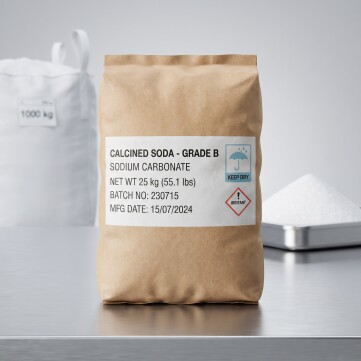
Supply is in paper or polypropylene bags with a polyethylene liner of 25 kg, as well as in flexible specialized containers (big bags) of 500, 750 or 1000 kg capacity. For export batches, packaging and net weight are established in accordance with the foreign trade organization order.
Packaging, Containers and Labeling
Sodium tripolyphosphate is not a dangerous good, so packaging must primarily provide moisture protection and mechanical strength. Multi-wall paper bags with a polyethylene liner, polypropylene bags and big bags made of polypropylene fabric are used.
Transport Marking
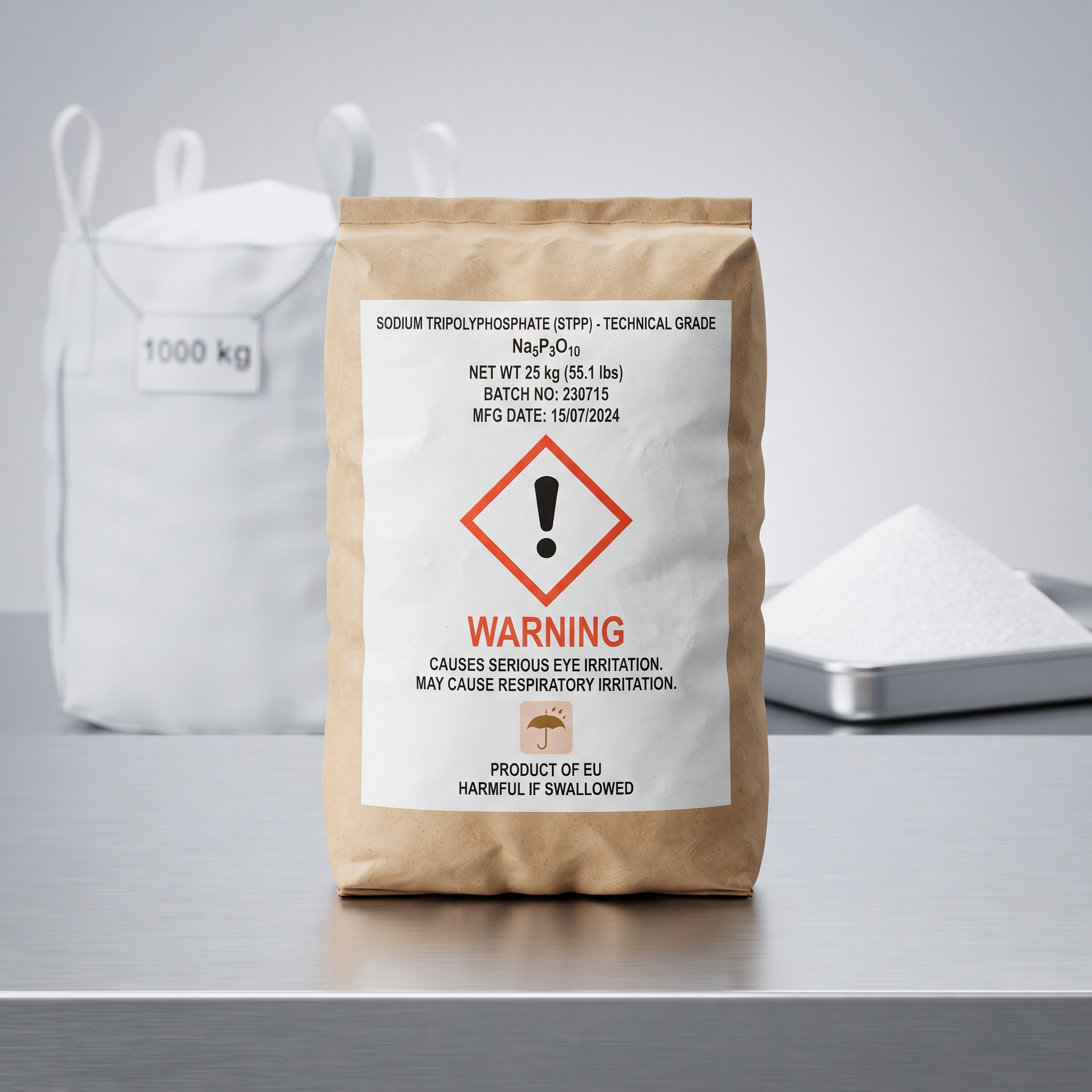
Transport marking is applied per GOST 14192 with the Keep Dry handling symbol. Since the product is not classified as a dangerous good, transport hazard diamonds of class 5.1, 8 or others are not applied. However, under GHS the product may be labeled with the GHS07 exclamation mark pictogram and the signal word Warning because dust causes irritation of skin, eyes and respiratory tract. Product marking must contain the manufacturer name, product name, grade and sort, batch number and date of manufacture, standard designation and guaranteed phosphorus pentoxide content.
Storage Conditions
The product is stored in closed packaging in dry, well-ventilated warehouses protected from atmospheric precipitation. Due to low hygroscopicity, sodium tripolyphosphate is stable during storage, but prolonged contact with moisture can lead to caking and partial hydrolysis.
Regulatory Framework for Incoming Inspection
- GOST 13493-86 - sodium tripolyphosphate. Specifications. Establishes requirements for technical and food grade product, analytical methods and acceptance rules.
- GOST 12.1.007-76 - classification of hazardous substances. Sodium tripolyphosphate belongs to moderately hazardous substances; dust irritates mucous membranes.
- GOST 12.4.041 - personal respiratory protection equipment (filtering respirators).
- GOST 12.4.013 - protective goggles.
- GOST 14192 - cargo marking.
- GOST 30333-2022 - safety data sheet for chemical products.
- ISO 850, ISO 851, ISO 852, ISO 2996, ISO 3000 - international standards to which GOST 13493-86 fully corresponds.
For imported batches, the specification is based on manufacturer standards and harmonized ISO methods. The batch specification is confirmed by the manufacturer certificate of quality and the results of incoming laboratory control by the recipient.
Mechanism of Action and Functional Role
Sodium tripolyphosphate is a polyanion that forms soluble complexes with calcium and magnesium ions. This property underlies water softening: by binding hardness ions, STPP prevents the precipitation of carbonates and sulfates on heating elements and fabrics. In detergents it acts as a builder, enhancing the action of surfactants and preventing redeposition of soils onto fibers.
In ceramic slurries and paint pastes, sodium tripolyphosphate adsorbs on the surface of pigment or clay particles, imparting a negative charge and providing electrostatic repulsion. This reduces system viscosity, improves dispersion and prevents particle aggregation. In food systems, STPP retains moisture, stabilizes emulsions and improves product texture, and also slows oxidative processes.
In oil recovery, sodium tripolyphosphate is used to treat drilling fluids, where it acts as a peptizer and dispersant, reducing viscosity and improving fluid stability under high temperature and salt aggression.
Applications by Industry
Synthetic Detergents
The largest consumption direction. STPP is used as a builder in powder and liquid detergents, dishwasher products and cleaning compositions. It softens water, enhances detergency and prevents scale formation.
Water Softening and Treatment of Heat Power Equipment
Used for treating water intended for boiler feed and in circulating water supply systems. Binds hardness salts and prevents deposits.
Ceramic and Paint Industry
Used as a dispersant and rheology modifier for ceramic slurries, glazes, pigment pastes and paints. Reduces viscosity, improves uniformity and prevents sedimentation.
Textile and Leather Industry
Used for preparation, dyeing and finishing of fabrics, as well as leather processing. Improves wettability, promotes uniform dye distribution and reduces water hardness in washing processes.
Oil Recovery and Drilling Fluids
Used as a peptizer and dispersant in drilling fluids, reduces viscosity and stabilizes the system under complex geological conditions.
Food Industry
Food grade is used in meat and dairy industries as a moisture-retaining agent, stabilizer and emulsifier. Used in processed cheese, sausages, canned goods and frozen products.
Other Industries
Used in fire-retardant compositions, paper and board production, ore flotation, as an anti-corrosion pigment, and in synthetic rubber production.
Comparison with Alternative Phosphate and Complexing Agents
Compared with trisodium phosphate, sodium tripolyphosphate provides higher complexing capacity for calcium and magnesium and performs better in hard water. Compared with zeolites used in phosphate-free detergents, STPP dissolves faster and provides higher detergency but is inferior in environmental performance due to eutrophication of water bodies.
Compared with EDTA and other chelating agents, sodium tripolyphosphate is cheaper and safer for food applications but is inferior in complex stability in strongly acidic media. In ceramics and paints it competes with polyacrylates and lignosulfonates, having an advantage in cost but being inferior in heat resistance and stability at high pH.
Supplier Selection Criteria and Specification Development
The specification for sodium tripolyphosphate must include the grade (technical premium or first, food grade), P2O5 and Na5P3O10 mass fractions, pH of 1 percent solution, iron and insoluble matter content, and for food grade, limits for heavy metals and arsenic. The supply form (bags, big bags) and transport conditions are also specified.
The supplier confirms batch-to-batch quality consistency, a valid safety data sheet under GOST 30333-2022, readiness to provide packaging that protects against moisture, and to organize transport in compliance with food product requirements (for food grade). For imported batches, it is important to verify labeling and actual parameters, as well as storage conditions at the warehouse before shipment.
Typical Processing, Storage and Logistics Errors
- Violation of storage conditions. Despite low hygroscopicity, prolonged storage in humid areas leads to caking and partial hydrolysis of the product.
- Co-storage with acids and oxidizers. Sodium tripolyphosphate is a weakly alkaline product; contact with acids can cause a reaction with heat release and pH change.
- Use of contaminated packaging. Residues of other products can contaminate STPP, especially for food grade, where heavy metals and arsenic are standardized.
- Neglecting dust protection. Sodium tripolyphosphate dust irritates mucous membranes and the respiratory tract; a respirator, protective goggles and gloves are required when working with powder.
- Use of technical grade for food purposes. Technical product is not standardized for heavy metals and arsenic at the same limits as food grade and must not be used in contact with food products.
- Labeling errors. Applying transport hazard labels that do not correspond to the product, or omitting the GHS07 label when irritant action is present, can mislead the consumer.
Quality Control and Laboratory Methods
Incoming inspection of sodium tripolyphosphate includes determination of total phosphorus pentoxide mass fraction (photometric or titrimetric), Na5P3O10 mass fraction, pH of 1 percent solution (potentiometric), iron and water-insoluble matter content, and for food grade, heavy metals and arsenic. Sampling is performed in accordance with GOST 21560.0, and the combined sample is analyzed in the plant laboratory.
When changing supplier or batch for food applications, verification of compliance with safety parameters is recommended, since even minor differences in raw materials can affect impurity content.