















Bitumen and SBS-Modified Bitumen
What Bitumen and Modified Bitumen Are and Why They Form Two Binder Levels
Petroleum bitumen is a solid or viscous product of oxidation of heavy petroleum residues, consisting of asphaltenes, resins and oils. Modified bitumen, or polymer-bitumen binder (PBB), is produced by introducing a polymer modifier into bitumen, most commonly a styrene-butadiene-styrene (SBS) thermoplastic elastomer, which forms a strong elastic network in the bitumen matrix when uniformly dispersed. This network gives PBB increased elasticity, heat resistance and resistance to repeated shear loads, extending pavement service life.
For procurement teams, three groups must be distinguished. Road bitumen per GOST 33133-2014 grades BND 50/70, 70/100 and 100/130 is used for pavement construction and repair, and as a base for PBB. Construction bitumen per GOST 6617-76 grades BN 50/50, 70/30 and 90/10 is used for roofing, waterproofing and insulation works. SBS-modified bitumen per GOST R 52056 and GOST R 58400.1 is intended for demanding road projects with high loads and wide service temperature ranges.
The key feature of the group that determines logistics is temperature dependence. Hot bitumen is transported in heated tank cars at 150-180 degrees Celsius, requiring temperature maintenance and protection from overheating that leads to aging. Cold forms (briquettes, pellets, PBB in big bags and clovertainers) are convenient for long-distance transport and long-term storage but require protection from moisture and contamination. Bitumen is combustible, and its dust and vapors on heating irritate the respiratory tract.
Chemical Identification and Procurement Data
- Chemical name: petroleum bitumen, road bitumen, construction bitumen, polymer-bitumen binder.
- Main components: asphaltenes, resins, oils; PBB additionally contains SBS polymer and plasticizer.
- CAS number: 8052-42-4 for bitumen of general designation.
- HS code: 2713200000 for petroleum bitumen.
- UN number: not assigned for solid and cold forms; hot bitumen above its flash point may be classified as a class 3 dangerous good during transport.
- Commercial form: hot bulk (liquid at 150-180 degrees Celsius), cold briquettes, pellets, PBB in big bags or clovertainers.
In the Russian regulatory system, road bitumen is governed by GOST 33133-2014, construction bitumen by GOST 6617-76, and SBS-based polymer-bitumen binders by GOST R 52056 and GOST R 58400.1. The standards establish grades by penetration, softening point, ductility and brittleness temperature, and for PBB additionally standardize elasticity and aging resistance. The supplier confirms batch conformity to the applicable standard and provides a certificate of quality with actual values for each parameter.
Quality Parameters Relevant to Processing
For road bitumen per GOST 33133-2014, the key parameters are needle penetration at 25 degrees Celsius, ring and ball softening point, ductility at 0 and 25 degrees Celsius, Fraass brittleness temperature, flash point and mass change after aging. For grade BND 50/70, penetration is 51-70 units, softening point not lower than 51 degrees Celsius, ductility at 0 degrees Celsius not less than 3.5 cm, and brittleness temperature not higher than minus 16 degrees Celsius. For BND 70/100 and 100/130, penetration limits shift toward higher values, corresponding to a softer binder.
For construction bitumen per GOST 6617-76, penetration at 25 degrees Celsius, softening point, ductility, solubility, mass change after heating and flash point are standardized. Grade BN 70/30 has penetration 21-40 units and softening point 70-80 degrees Celsius; grade BN 90/10 has penetration 5-20 units and softening point 90-105 degrees Celsius.
For PBB per GOST R 52056 and GOST R 58400.1, elasticity at 25 and 0 degrees Celsius (not less than 80 and 70 percent respectively for typical grades), aging resistance and resistance to repeated shear loads are additionally controlled. SBS polymer content in PBB typically ranges from 3 to 6 percent, with optimum compatibility achieved at 5-6 percent.
Technical Grades and Supply Forms
Road Bitumen (GOST 33133-2014)
Grades BND 50/70, 70/100, 100/130, 130/200 and 200/300 differ in penetration and are used for different climatic zones and traffic loads. Hot bitumen is supplied in bulk in heated rail and road tank cars, as well as in bitumen trucks. Cold briquettes and pellets are supplied in big bags, paper bags or clovertainers.
Construction Bitumen (GOST 6617-76)
Grades BN 50/50, 70/30 and 90/10 are used for roofing and waterproofing works. Supplied in solid form in paper bags, big bags, drums, as well as hot bulk.
SBS-Modified Bitumen (GOST R 52056, GOST R 58400.1)
Grades PBB 40, 60, 90 and 130, and PG classes per GOST R 58400.1. Hot PBB is supplied in heated tank cars and bitumen trucks; cold PBB in big bags, clovertainers, drums and special containers for subsequent reheating by the consumer.
Packaging, Containers and Labeling
Hot bitumen and PBB are transported in specialized heated tank cars and bitumen trucks. Cold forms are packed in multi-wall paper or polymer bags, big bags, clovertainers and drums. Packaging must provide protection from moisture and contamination.
Transport Marking
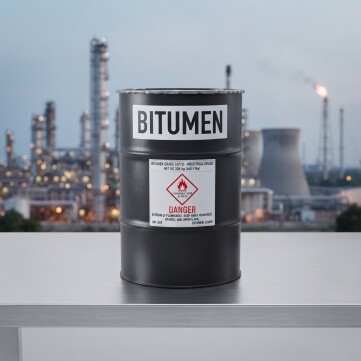
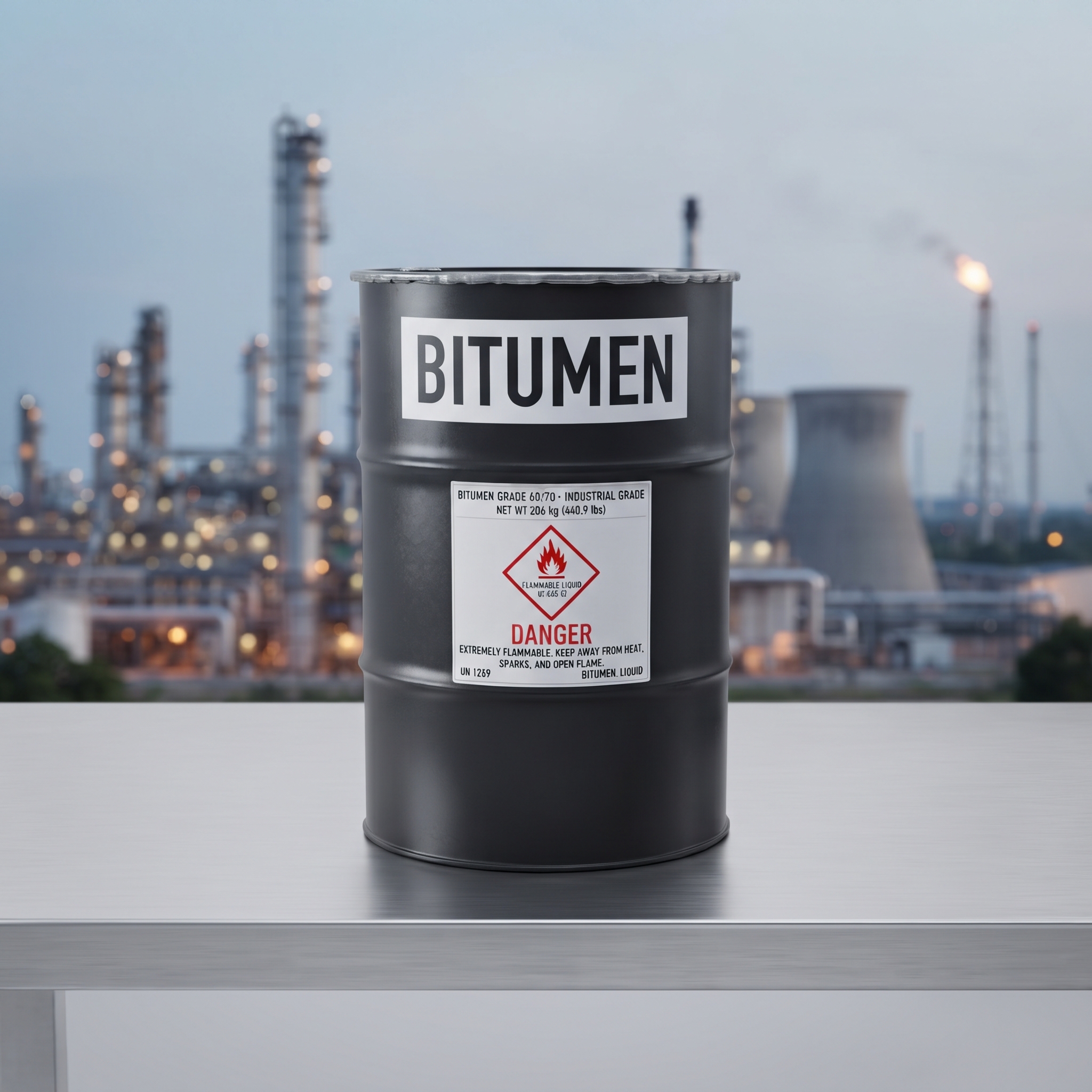
Transport marking is applied per GOST 14192 with the Keep Dry handling symbol and, for hot forms, indication of the temperature regime. Bitumen is combustible, so class 3 hazard labels may apply when transporting hot product if its temperature exceeds the flash point. In solid and cold form, the product is not classified as a dangerous good under GOST 19433. Under GHS, bitumen dust and vapors may be labelled with GHS07 as irritating to the respiratory tract, and on heating with GHS02 as a flammable material.
Storage Conditions
Hot bitumen is stored in heated tanks at a temperature that ensures mobility without overheating. Cold forms are stored in closed warehouses or under a canopy, protected from moisture and direct sunlight.
Regulatory Framework for Incoming Inspection
- GOST 33133-2014 - viscous road petroleum bitumens. Specifications.
- GOST 6617-76 - construction petroleum bitumens. Specifications.
- GOST R 52056-2003 - SBS-based road polymer-bitumen binders. Specifications.
- GOST R 58400.1-2019 - petroleum bitumen binders. Specifications based on service temperature range.
- GOST 1510-2022 - petroleum and petroleum products. Marking, packaging, transport and storage.
- GOST 19433-88 - classification and labeling of dangerous goods.
Mechanism of Action and Functional Role
In road construction, bitumen acts as a binder that binds mineral aggregates in asphalt concrete. On heating, bitumen softens, coats the grains of crushed stone and sand, and on cooling solidifies, forming a strong and waterproof composite. SBS modification changes the rheology: polystyrene blocks form physical network nodes, while polybutadiene segments provide elasticity. As a result, PBB withstands large deformations without cracking at low temperatures and resists rutting at high temperatures.
In construction and waterproofing, bitumen and PBB are used to create waterproof membranes, roofing, mastics and sealants. Modified bitumen surpasses unmodified bitumen in heat resistance and flexibility, which is especially important for roofs subject to temperature fluctuations.
Applications by Industry
Road Construction
The largest consumption direction. Road bitumen and PBB are used for construction and repair of highways, airfields, bridge decks and parking lots. PBB is preferred for heavily loaded roads and regions with sharp continental climate.
Roofing and Waterproofing
Construction bitumen and PBB are used to produce roofing felt, bitumen shingles, roofing membranes, waterproofing mastics and foundation coatings.
Industrial and Civil Construction
Bitumen is used for anti-corrosion protection of pipelines, cable insulation, waterproofing of basements and swimming pools.
Other Applications
Bitumen is used in the production of bitumen emulsions, paints and varnishes, and as a component in certain fuels and lubricants.
Comparison of Bitumen and PBB with Alternative Binders
Compared with pure bitumen, PBB provides significantly higher elasticity, heat resistance and aging resistance, but is more expensive and requires a more complex preparation technology. Compared with bitumen emulsions, PBB gives a stronger and more durable pavement but requires hot application. Compared with cement concrete, bitumen-based asphalt concrete is faster to commission and easier to repair, but is inferior in durability under high loads.
Supplier Selection Criteria and Specification Development
The specification must include the product type (road, construction, PBB), grade, penetration, softening point, ductility, brittleness temperature, SBS content for PBB, as well as the supply form (hot bulk, briquettes, big bags, clovertainers) and temperature regime.
The supplier confirms quality consistency, availability of a safety data sheet and readiness to ensure the temperature regime during transport of hot forms.
Typical Processing, Storage and Logistics Errors
- Overheating of hot bitumen. Leads to intense aging, increased viscosity and loss of elasticity.
- Solidification of bitumen in tank cars and pipelines. Requires reheating and may damage equipment.
- Moisture ingress into cold forms. Moisture causes foaming on melting and reduces quality.
- Mixing different grades without confirmation. May alter the properties of the final binder.
- Neglecting dust protection when handling powder forms. Bitumen dust irritates the respiratory tract.
Quality Control and Laboratory Methods
Incoming inspection includes determination of penetration, softening point, ductility, brittleness temperature, flash point and mass change after aging. For PBB, elasticity and shear load resistance are additionally controlled. Sampling is performed by standardized methods.
Storage and Transportation Conditions
Hot bitumen is stored in heated tanks at working temperature, cold forms in closed warehouses. Transportation is carried out in heated tank cars, bitumen trucks, as well as in big bags and clovertainers. When transporting hot product, dangerous goods requirements are observed where applicable.
Finding Analogues and Interchangeability
PBB has no direct analogues among unmodified bitumens for demanding road projects. Replacing PBB with pure bitumen is possible only for secondary roads with low loads, but reduces pavement service life. Replacing construction bitumen with PBB improves properties but increases cost.
Supply Routes: Russia, China and Other Regions
Russia has large refineries producing road and construction bitumen, as well as PBB. Supplies are delivered throughout the country and for export.
Chinese producers supply bitumen and PBB, including in big bags and clovertainers. Other global producers are located in the Middle East, Europe and Asia. Suppliers from these regions are engaged when required, taking into account logistical and regulatory factors.
Logistics and Customs Clearance
Customs clearance includes classification under HS code 2713200000, preparation of a safety data sheet and conformity declaration. The portal provides customs broker services.
Risk Factors and Safety Measures
The main risks are associated with the combustibility and high temperature of hot bitumen. Work is performed with heat-resistant gloves, protective goggles and protective clothing. On heating, vapors may be released that irritate the respiratory tract.
FAQ: Common Questions from Procurement and Process Specialists
How does PBB differ from ordinary bitumen
PBB contains an SBS polymer that forms an elastic network in the bitumen matrix, increasing heat resistance, elasticity and aging resistance.
Which bitumen grade is suitable for road construction
The grade is selected by climatic conditions and load: BND 50/70 for cold climate and high loads, BND 70/100 and 100/130 for moderate climate.
In what packaging is cold bitumen supplied
In big bags, clovertainers, paper bags and drums.
What documents are required for import
Contract, invoice, packing list, safety data sheet, certificate of quality and transport documents.
Conclusion
Bitumen and SBS-modified bitumen remain key binders for road construction and waterproofing. GOST 33133-2014, GOST 6617-76, GOST R 52056 and GOST R 58400.1 establish requirements for grades and properties, and logistics takes into account the temperature dependence of the material. For procurement teams, the practical task reduces to correct type and grade selection, confirmation of batch conformity to the standard, and organization of supplies with observance of the temperature regime for hot forms and moisture protection for cold forms.
Contact Us
For procurement inquiries and supply chain organization, contact the portal team at info@apptrade.ru.