















Activated Carbon
What Activated Carbon Is and Why It Remains a Universal Industrial Adsorbent
Activated carbon is a porous carbonaceous material produced from various carbon-containing raw materials: wood, coal coke, peat, petroleum coke and coconut shells. During steam-gas activation at 800-950 degrees Celsius, an enormous number of pores is opened in the feedstock, forming a developed specific surface area reaching 500-1500 square meters per gram. This porous structure provides the ability to absorb a wide variety of organic and inorganic impurities from gas and liquid media.
For procurement teams, activated carbon matters primarily as a consumable for continuous water and gas treatment processes, as well as for food and pharmaceutical production. Unlike many reagents, carbon does not chemically react with contaminants but retains them through physical adsorption, making it suitable for contact with drinking water and food products where appropriate approvals exist. The variety of grades allows selection of the material for a specific task, from fine purification of spirits to capture of solvent vapors.
The key feature of activated carbon that determines the entire supply chain is its porous structure and the associated ability to become saturated with moisture and contaminants before operation. The product belongs to hazard class 3 by health impact, and its dust forms explosive concentrations. This requires sealed packaging, moisture protection and dust protection measures during handling.
Chemical Identification and Procurement Data
- Chemical name: activated carbon, activated charcoal.
- Chemical formula: C (amorphous carbon).
- CAS number: 7440-44-0.
- HS code: 3802100000 for activated carbon, including spent carbon.
- UN number: not assigned for most technical grades; the product is not classified as a dangerous good for transport.
- Commercial form: black granules, crushed particles or powder without mechanical impurities.
In the Russian regulatory system, GOST 6217-74 applies to wood-based crushed active carbon, covering grades BAU-A, BAU-Ats, DAK, OU-A and others obtained from charcoal. For coal-based granular carbon, GOST 20464-75 (grade AG-3) and GOST 23998-80 (grade AG-2) apply, as well as the more recent GOST R 56357-2015 and GOST R 56358-2015. The supplier confirms batch conformity to the applicable standard and provides a certificate of quality with actual values for each parameter.
Quality Parameters Relevant to Processing
For wood-based crushed carbon BAU-A per GOST 6217-74, the key parameters are iodine adsorption activity (not less than 60 percent), total pore volume by water (not less than 1.6 cubic centimeters per gram), bulk density (not more than 240 grams per cubic decimeter), ash mass fraction (not more than 6 percent) and moisture content (not more than 10 percent). For coal-based granular carbon AG-3 per GOST 20464-75, bulk density is 400-550 grams per cubic decimeter, and attrition strength and adsorption capacity are standardized depending on the application.
For the processor, adsorption activity and strength are critical. Low activity requires increased loading or frequent carbon replacement, while insufficient strength leads to granule breakdown, dusting and increased bed pressure drop. Bulk density determines vessel loading and pressure drop.
Technical Grades and Supply Forms
Wood-Based Crushed Grades (GOST 6217-74)
BAU-A is used in the liquor and vodka industry and for adsorption from solutions and aqueous media; BAU-Ats is used for filling acetylene cylinders; DAK is intended for purification of steam condensate from oil, aquarium water treatment and wastewater treatment from petroleum products; OU-A is used for purification and manufacture of medicines.
Coal-Based Granular Grades (GOST 20464-75, GOST 23998-80)
AG-3 is intended for adsorption from gaseous and liquid media, including drinking water purification; AG-2 is used for personal respiratory protection equipment and the manufacture of absorbers and catalysts.
Peat-Based and Other Grades
SKT on a peat basis is used for adsorption extraction of petroleum products from wastewater. Coconut activated carbon obtained from coconut shells is characterized by high strength and is used in water filters and gold recovery.
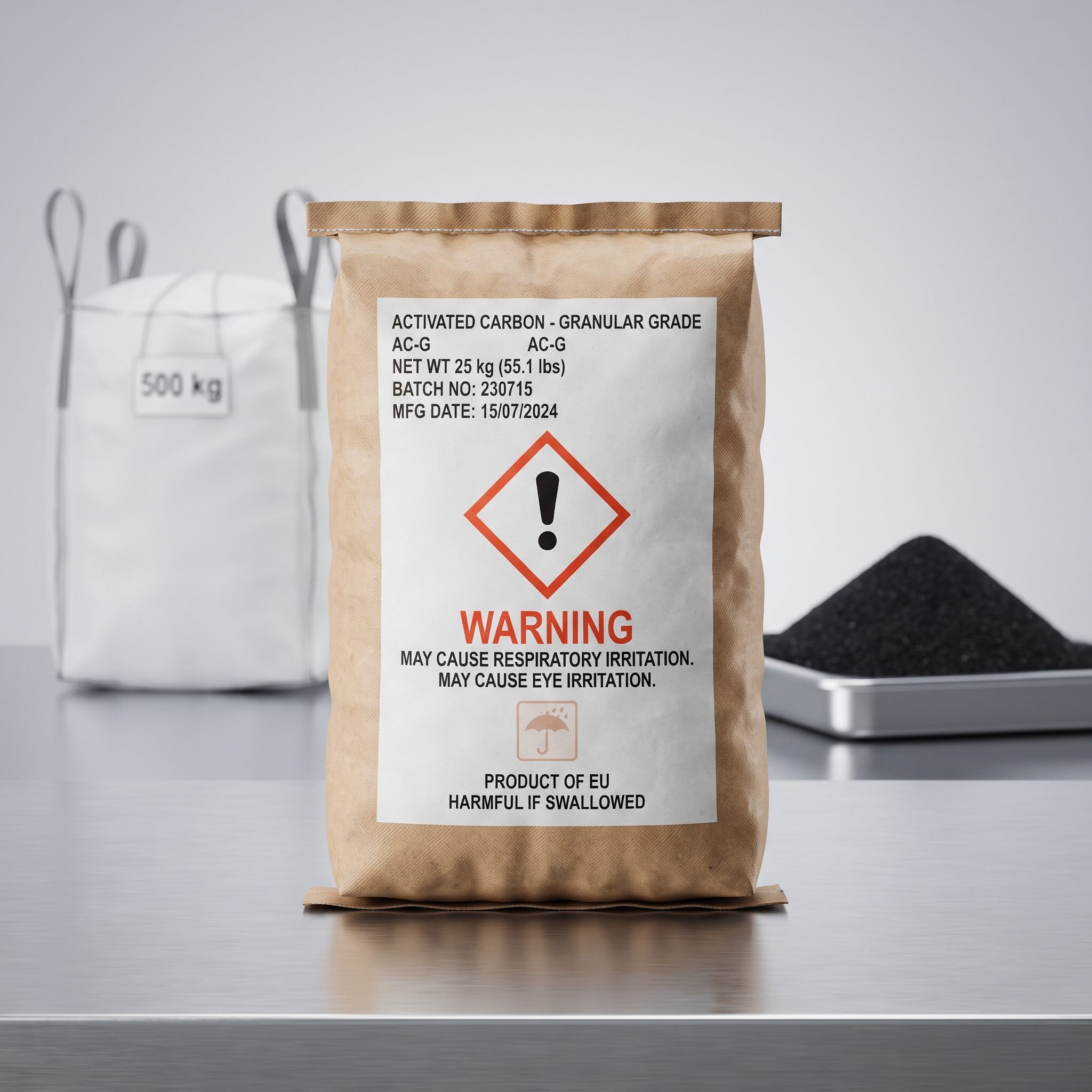
Supply is in multi-wall paper bags of 10 or 25 kg, polypropylene bags, as well as flexible specialized containers of the big bag type with a net mass of not more than 500 kg.
Packaging, Containers and Labeling
Activated carbon is not classified as a dangerous good for transport, but its dust is explosive and irritates the respiratory tract, so packaging must be sealed and durable. Four- and five-ply paper bags of grades PM, VMP and NM, polypropylene bags, and big bags with a polyethylene liner are used.
Transport Marking
Transport marking is applied to each packaging unit per GOST 14192 with the Keep Dry handling symbol. Since the product is not classified as a dangerous good, transport hazard labels are not applied. Under GHS, carbon may be labeled with the GHS07 exclamation mark pictogram and the signal word Warning because dust causes respiratory irritation. Marking must contain the manufacturer name, product name, grade, batch number, gross and net mass, date of manufacture and standard designation.
Storage Conditions
Carbon is stored in original sealed packaging in closed clean warehouses protected from groundwater and atmospheric precipitation. Bags are stacked in piles not more than 2 meters high. The shelf life is 36 months from the date of manufacture.
Regulatory Framework for Incoming Inspection
- GOST 6217-74 - wood-based crushed active carbon. Specifications.
- GOST 20464-75 - active carbon AG-3. Specifications.
- GOST 23998-80 - granular active carbon AG-2. Specifications.
- GOST R 56357-2015 - activated carbon AG-3. Specifications.
- GOST R 56358-2015 - activated carbon AG-2. Specifications.
- GOST 12.1.007-76 - classification of hazardous substances; activated carbon belongs to hazard class 3.
- GOST 12.1.005-88 - maximum permissible concentration of activated carbon dust in the working area air is 10 mg/m3.
For imported batches, the specification is based on manufacturer standards and harmonized methods. The batch specification is confirmed by the manufacturer certificate of quality and the results of incoming laboratory control by the recipient.
Mechanism of Action and Functional Role
Activated carbon acts as a physical adsorbent: contaminant molecules are retained on the pore surface by van der Waals forces and electrostatic interactions. Adsorption efficiency depends on pore size, specific surface area and molecular polarity. Micropores are effective for capturing gases and vapors of low-molecular-weight compounds, mesopores for large organic molecules and colloidal particles, and macropores serve as transport channels.
In water treatment, carbon removes chlorine, organochlorine compounds, petroleum products, phenols, pesticides and other organic impurities, improving taste and odor. In gas treatment, it captures solvent vapors, hydrogen sulfide, mercaptans and other harmful substances. In the food industry, carbon is used for clarification and stabilization of spirits, juices and oils, as well as for purification of steam condensate.
For the B2B buyer, it is important to understand that different carbon grades have different porous structures and, consequently, selectivity. Wood-based carbons with a wide pore distribution are effective for treating aqueous media, coal-based granules with high strength for gas streams and aggressive media, and coconut carbons with high microporosity for fine drinking water purification and gold recovery.
Applications by Industry
Water Treatment and Wastewater Purification
The largest consumption direction. Carbon is used for purification of drinking water at municipal plants, in household and industrial filters, as well as for tertiary treatment of wastewater from petroleum products, dyes and organic compounds.
Gas Treatment and Respiratory Protection
Used for purification of ventilation emissions, capture of solvent vapors, in respirators and air purification filters. Grade AG-2 is specifically intended for respiratory protection equipment.
Food and Liquor Industry
BAU-A and DAK are used for purification of spirits, liquor products, juices, oils and other food products. Carbon removes impurities and improves color and stability.
Metallurgy and Gold Recovery
Coconut activated carbon is used for sorption of gold from cyanide solutions, as well as for purification of process solutions and gases in metallurgical processes.
Medicine and Pharmaceuticals
OU-A and other grades are used for purification of medicines, in the production of medical sorbents and for blood purification in hemosorption.
Comparison with Alternative Adsorbents
Compared with zeolites, activated carbon does not provide selective molecular separation and is inferior in drying depth, but has an advantage in capacity for organic compounds and cost. Compared with silica gel, carbon is ineffective for drying moist gases but surpasses it in adsorption of non-polar organic substances. Compared with ion exchange resins, carbon does not require chemical regeneration and operates over a wide pH range but is inferior in selectivity for individual ions.
For water purification from organic impurities, activated carbon remains the most economical and versatile solution, often used in combination with mechanical filtration and disinfection. For fine gas treatment, carbon may compete with zeolites and catalysts, with the choice determined by impurity composition and purification depth requirements.
Supplier Selection Criteria and Specification Development
The specification for activated carbon must include the grade (BAU-A, DAK, OU-A, AG-3, AG-2 and others), grain form (granules, crushed, powder), iodine adsorption activity or other parameter, bulk density, attrition strength and supply form (bags, big bags). For food and drinking water applications, confirmation of suitability for contact with food products is additionally required.
The supplier confirms batch-to-batch quality consistency, a valid safety data sheet under GOST 30333-2022, readiness to provide packaging that protects against moisture and to organize transport in compliance with cargo transport rules. For imported batches, it is important to verify labeling and actual parameters, as well as storage conditions at the warehouse before shipment.
Typical Processing, Storage and Logistics Errors
- Violation of packaging sealing. Carbon adsorbs moisture and contaminants from the air, reducing its capacity before operation. Packaging is opened immediately before loading.
- Storage in damp areas. Moist carbon loses activity and may self-heat upon drying due to oxidation. Warehouses must be dry and well ventilated.
- Co-storage with chemicals. Carbon readily adsorbs vapors of solvents, acids and other substances, making it unsuitable for food and drinking water applications.
- Neglecting dust protection. Activated carbon dust irritates the respiratory tract and forms explosive concentrations. A respirator, protective goggles and gloves are required during handling.
- Use of carbon beyond its shelf life without control. After 36 months, incoming inspection of adsorption activity is required, as it may decrease.
- Labeling errors. Absence of the Keep Dry handling symbol or the GHS07 label when irritant action is present can mislead the consumer.
Quality Control and Laboratory Methods
Incoming inspection of activated carbon includes determination of iodine adsorption activity (titration), total pore volume by water, bulk density, ash mass fraction and moisture. For granular grades, attrition strength is additionally controlled. Sampling is performed by standardized methods; the combined sample is analyzed in the plant laboratory. For critical processes, a control filtration run is recommended to confirm purification efficiency.
Storage and Transportation Conditions
Activated carbon is not classified as a dangerous good, but its dust is fire- and explosion-hazardous. The auto-ignition temperature of dust in aerosol form is 729 degrees Celsius, the smoldering temperature in a layer is more than 425 degrees Celsius, and the lower explosive limit is 300 grams per cubic meter. Storage is carried out in sealed packaging in dry, well-ventilated warehouses at ambient temperature. The shelf life is 36 months.
Transportation is by rail, road and sea in covered vehicles in bags and big bags. Moistening, contamination and mechanical damage to packaging must be excluded.
Finding Analogues and Interchangeability
When replacing activated carbon, a grade with a similar porous structure and adsorption activity is selected. Replacing wood-based carbon with coal-based carbon is possible in processes requiring higher granule strength but may change adsorption selectivity. Replacing granular carbon with powdered carbon is possible in stirred-tank applications but requires changes in filtration technology. The replacement decision is based on laboratory testing and, for critical processes, pilot-scale verification.
Supply Routes: Russia, China and Other Regions
Domestic supply is provided by enterprises with activated carbon production capacity from wood, coal and peat raw materials. Products are supplied to the domestic market and for export.
Chinese producers have large capacities for coconut and coal-based activated carbon. Supplies are delivered by sea with subsequent transfer to rail or road transport. Other global producers are located in Southeast Asia (coconut carbon), Europe and North America. Suppliers from these regions are engaged when required, taking into account logistical and regulatory factors.
Logistics and Customs Clearance
Transportation of activated carbon is carried out in bags on pallets and big bags in covered vehicles. Customs clearance includes classification under HS code 3802100000, preparation of a safety data sheet under GOST 30333-2022 (if required) and conformity declaration. The portal provides customs broker services and supports all clearance stages.
Risk Factors and Safety Measures
Activated carbon belongs to hazard class 3 per GOST 12.1.007-76; the maximum permissible concentration of dust in the working area air is 10 mg/m3. Dust irritates the mucous membranes of the eyes, nose and respiratory tract, and prolonged inhalation may cause lung diseases. Moist carbon can absorb oxygen from the air in confined spaces, so oxygen content must be monitored when working in vessels and wells.
Work is performed in ventilated rooms with respirators, protective goggles and gloves. In case of a spill, carbon is collected mechanically, moistened if necessary to reduce dusting, and disposed of in accordance with requirements. Discharge of spent carbon into water bodies without prior treatment is not permitted.
FAQ: Common Questions from Procurement and Process Specialists
How does BAU-A differ from AG-3
BAU-A is a wood-based crushed carbon per GOST 6217-74 with iodine adsorption activity of at least 60 percent and bulk density of not more than 240 grams per cubic decimeter, used for treating aqueous media and in the liquor industry. AG-3 is a coal-based granular carbon per GOST 20464-75 with bulk density of 400-550 grams per cubic decimeter, intended for adsorption from gaseous and liquid media, including drinking water purification.
Is activated carbon a dangerous good
No, for most technical grades activated carbon is not classified as a dangerous good for transport and has no UN number. However, its dust is explosive and irritates the respiratory tract, so dust protection and fire safety measures are required during handling.
Which packaging is used for activated carbon
Multi-wall paper bags of 10 or 25 kg, polypropylene bags, and flexible specialized containers of the big bag type with a net mass of not more than 500 kg are used. Packaging must be sealed and bear the Keep Dry marking.
What is the shelf life of activated carbon
The shelf life is 36 months from the date of manufacture under proper storage conditions (sealed packaging, dry warehouses, protection from atmospheric precipitation). After this period, incoming inspection of adsorption activity is required.
What documents are required for activated carbon import
Import requires a contract, invoice, packing list, safety data sheet under GOST 30333-2022 (if required), manufacturer certificate of quality and transport documents. For food and drinking water applications, confirmation of suitability for contact with food products may be required. The portal organizes the preparation of the document set and interaction with the customs broker.
Conclusion
Activated carbon remains a demanded adsorbent for water and gas treatment, food, metallurgical and pharmaceutical industries. GOST 6217-74 and GOST 20464-75 establish requirements for wood-based and coal-based grades differing in porous structure and adsorption activity. For procurement teams, the practical task reduces to correct grade selection, confirmation of batch conformity to the standard, and organization of supplies with storage conditions that exclude moistening and contamination of the product, as well as dust protection and fire safety measures during handling.
Contact Us
For procurement inquiries and supply chain organization, contact the portal team at info@apptrade.ru.