Ammonium Sulfate
Ammonium Sulfate: Technical Overview for Agro-Industrial and Industrial Applications
Ammonium sulfate (ammonium sulphate, (NH4)2SO4) is an inorganic salt of sulfuric acid and ammonia, produced industrially by the action of sulfuric acid on ammonia, as well as a by-product of coke-chemical production, caprolactam production, and acrylates production. In the agro-industrial complex, ammonium sulfate occupies a stable niche as a physiologically acidic nitrogen-sulfur fertilizer, particularly valuable for sulfur-demanding crops and for soils with an alkaline reaction. In industry, the product is used as a source of ammonium and sulfate ions in chemical synthesis, in the production of storage batteries, in the textile industry, and as a component of construction mixtures.
Chemical Identification
Ammonium sulfate is identified by CAS 7783-20-2, empirical formula (NH4)2SO4, relative molecular mass 132.14. In international trade, it is classified under HS heading 3102 21 000 0 as ammonium sulfate. Synonyms include ammonium sulphate, ammonium sulfate, and diammonium sulfate. The substance is not classified as dangerous goods for transport and is fire- and explosion-safe under normal conditions. Under GOST 9097-82, ammonium sulfate is intended for agriculture, industry, retail trade, and export. The product is hygroscopic and tends to cake when moistened, which must be considered during storage.
Physicochemical Properties
Ammonium sulfate consists of white or transparent crystals; in granular form, it consists of white or light-gray granules. The nitrogen mass fraction calculated on dry substance is at least 21 percent. The water mass fraction does not exceed 0.2 percent for the crystalline product. The free sulfuric acid mass fraction is not more than 0.03 percent. The fractional composition of the crystalline product requires a fraction larger than 0.5 mm at not less than 80 percent and particles smaller than 6 mm at 100 percent. Flowability is 100 percent. The water-insoluble residue mass fraction is not more than 0.02 percent. Density at 20 degrees Celsius is about 1.77 g/cm3. Melting point is 235-280 degrees Celsius with decomposition. Ammonium sulfate is readily soluble in water: at 25 degrees Celsius, about 77 g dissolves in 100 ml of water. The aqueous solution has a slightly acidic reaction (pH about 5.0-6.0 for a 1 M solution).
Technical Grades and Supply Forms
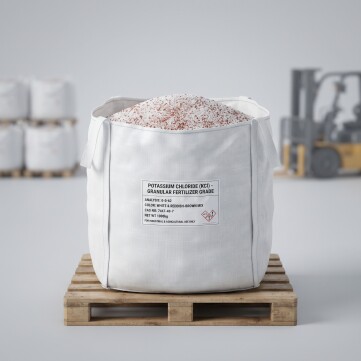
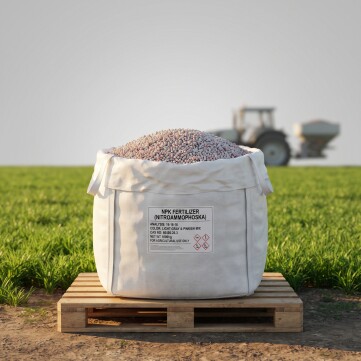
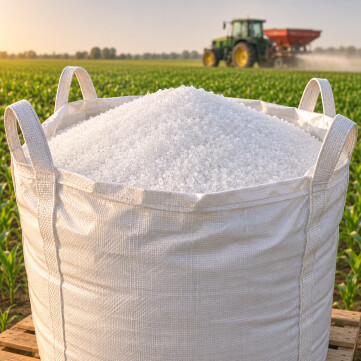
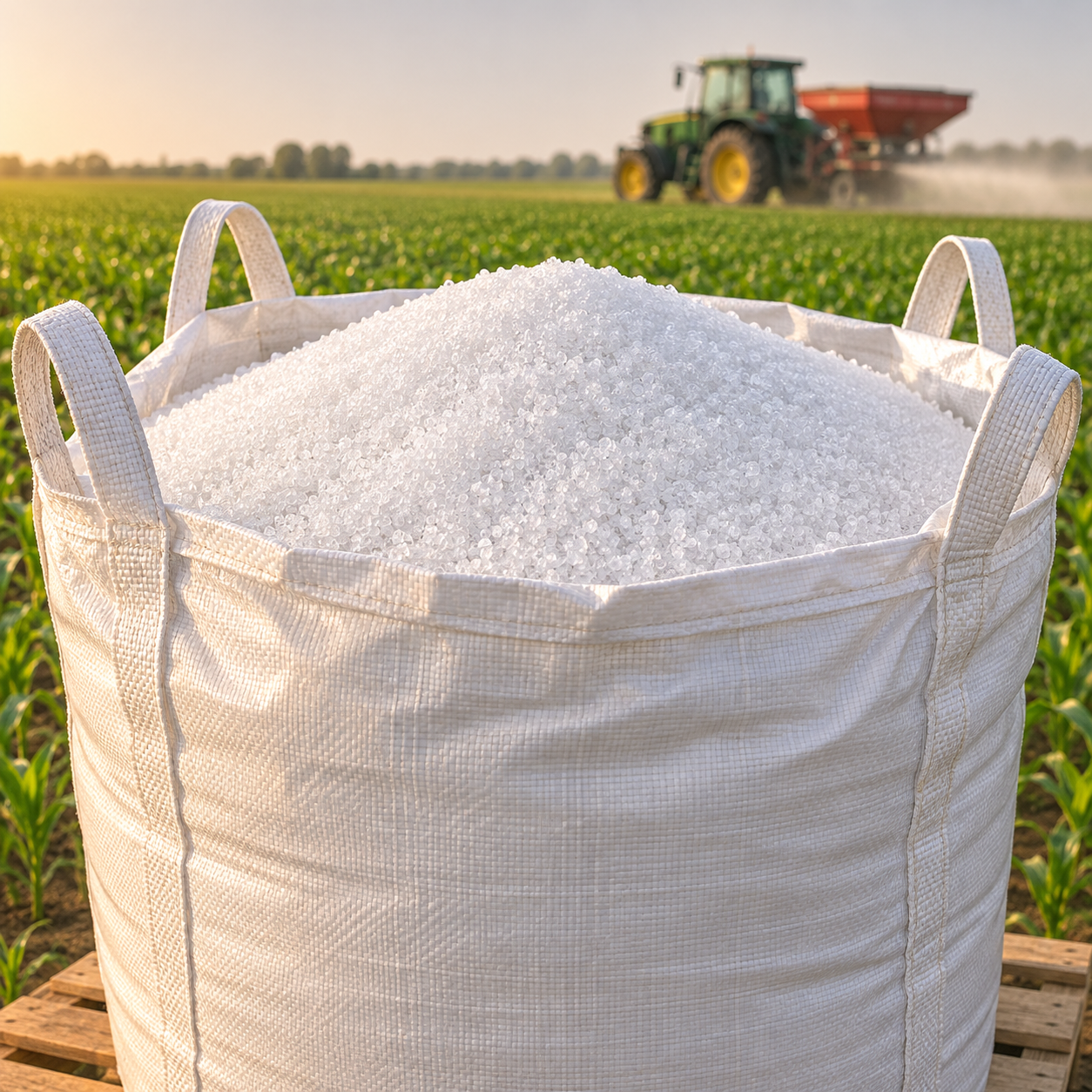
Under GOST 9097-82, ammonium sulfate is produced in crystalline and granular forms. The crystalline product is intended primarily for industrial use and export; the granular product is intended for agriculture and retail trade. The product is supplied in bulk in rail mineral carriers and road transport with covering, in big bags of 900-1000 kg capacity, and in polypropylene bags. Typical agricultural bulk shipments start from one tonne; for large agroholdings and traders, from 20 tonnes and more. Transport marking includes the handling sign Keep Dry.
Regulatory Framework
In the EAEU region, quality of ammonium sulfate is governed by GOST 9097-82 Ammonium Sulfate. Specifications. The standard sets requirements for physicochemical indicators, packaging, marking, transportation, and storage. Products intended for agriculture, as mineral fertilizers, are subject to conformity declaration under the EAEU technical regulation on requirements for mineral fertilizers, which sets radiation and chemical safety norms. For customs purposes, the explanatory notes to HS heading 3102 21 000 0 apply.
Mechanism of Action and Functional Role
In soil, ammonium sulfate dissociates to release ammonium and sulfate ions. The ammonium ion is absorbed by the soil absorption complex and gradually nitrified by microorganisms to form nitrates available to plants. Nitrification produces some acid, which accounts for the physiological acidity of the fertilizer. This effect is particularly valuable on alkaline and calcareous soils, where acidification of the root zone improves the availability of phosphorus and micronutrients. The sulfate ion is a source of sulfur necessary for protein, vitamin, and enzyme synthesis and participates in nitrogen metabolism. For crops with high sulfur removal (rapeseed, crucifers, cereals), ammonium sulfate provides balanced nutrition with these two elements.
Applications by Industry
Agriculture consumes the largest share of ammonium sulfate. The product is used as a basal fertilizer for various crops and is especially effective on alkaline, calcareous, and saline soils, as well as for sulfur-demanding crops: rapeseed, mustard, crucifers, cereals, potatoes, and vegetables. Ammonium sulfate is also used for top dressing and in fertilizer blends. In livestock farming, it is used as a feed additive for ruminants, increasing protein content in feed. In industry, it is used in the production of viscose fiber, in the textile industry, in the production of storage batteries, as a flux in welding, as a flame retardant for fabrics, and as a reagent in chemical synthesis and wastewater treatment.
Comparison with Alternative Materials
Compared with urea, ammonium sulfate contains significantly less nitrogen (21 percent versus 46.2 percent) but additionally supplies plants with sulfur and has physiological acidity, making it preferable on alkaline soils. Compared with ammonium nitrate, ammonium sulfate is less hygroscopic and stores better but is inferior in nitrogen content. Compared with simple superphosphate, ammonium sulfate does not contain phosphorus but is a more concentrated source of sulfur. The choice between these fertilizers is determined by soil agrochemical parameters and crop requirements.
Typical Processing Errors
- Storing ammonium sulfate under high humidity without protection from atmospheric precipitation, leading to caking and loss of flowability.
- Mixing ammonium sulfate with lime, chalk, or other alkaline materials without considering compatibility, causing ammonia release and nitrogen loss.
- Applying ammonium sulfate on acidic soils without prior liming, which may increase acidification and reduce fertilizer efficiency.
- Using contaminated product or product with elevated free sulfuric acid content for top dressing, which may damage plants.
- Violating the tightness of big bags or sacks during storage on open platforms, causing product wetting and loss of commercial properties.
- Neglecting granulometric composition control when using the crystalline product in fertilizer blends, which may lead to component segregation.
Quality Control and Laboratory Methods
Incoming inspection of ammonium sulfate includes determination of appearance and color, nitrogen mass fraction calculated on dry substance, water mass fraction, free sulfuric acid mass fraction, fractional composition, flowability, and water-insoluble residue mass fraction. Nitrogen content is determined by ammonia distillation after sample decomposition. Free sulfuric acid content is determined by titrimetric method. Water mass fraction is determined by drying. Test methods are governed by GOST 9097-82 and relevant standards for mineral fertilizer analysis.
Storage and Transportation Conditions
Ammonium sulfate is stored in closed, dry warehouses excluding atmospheric precipitation and groundwater ingress. Product packaged in big bags or sacks may be stored on pallets. When storing in bulk, mixing with other fertilizers, especially alkaline materials, should be avoided. Ammonium sulfate is not classified as dangerous goods for transport; however, it is a hygroscopic cargo, and during bulk sea shipments the risk of hardening under high humidity must be considered. Transportation is carried out by all modes of transport in accordance with cargo transport rules. In bulk, it is transported in rail mineral carriers, deck ships, and road vehicles with covering.
Finding Analogues and Interchangeability
When selecting an analogue for ammonium sulfate, the key criteria are nitrogen content, sulfur content, physiological acidity, and release form. For sulfur-demanding crops, ammonium sulfate can be partially replaced by potassium sulfate or magnesium sulfate, but this alters the nutrient ratio. For acidifying alkaline soils, elemental sulfur is an alternative, but it acts more slowly. For nitrogen nutrition without sulfur, replacement with urea or ammonium nitrate is possible with dosage adjustment, but the acidifying and sulfur-supplying effects are lost. Direct substitution without consideration of agronomic requirements is not recommended.
Supply Scheme
For agricultural producers and industrial buyers, ammonium sulfate is available worldwide through the apptrade.ru platform. Shipments can be organized from producing regions across different continents, with logistics and customs support adapted to the destination market. International sourcing allows buyers to balance cost and lead time depending on batch size and logistical distance, especially for bulk sea shipments.
Logistics and Customs Clearance
Ammonium sulfate is transported by sea, rail, and road. For large batches, bulk transport in sea vessels or mineral carriers is economically viable; for medium and small volumes, big bags and sacks are used. When imported into the EAEU, products are classified under HS heading 3102 21 000 0. As ammonium sulfate is not dangerous goods, special dangerous goods packaging and marking requirements do not apply; however, phytosanitary and sanitary norms must be observed, and the hygroscopic nature of the cargo must be considered during sea transport. The portal customs broker prepares declarations, confirms classification codes, and manages non-tariff regulation procedures.
FAQ
What is the difference between ammonium sulfate and urea?
Ammonium sulfate contains 21 percent nitrogen and 24 percent sulfur, and its solution has a slightly acidic reaction. Urea contains 46.2 percent nitrogen but does not contain sulfur and does not have physiological acidity. Ammonium sulfate is preferable on alkaline soils and for sulfur-demanding crops.
Can ammonium sulfate be used on acidic soils?
Ammonium sulfate is a physiologically acidic fertilizer and may increase acidification. On acidic soils, its use requires prior liming or combination with neutralizing materials. On alkaline and calcareous soils, its use is most effective.
Is ammonium sulfate classified as dangerous goods for transport?
No, ammonium sulfate is not classified as dangerous goods. According to manufacturer data, there is no UN number, and hazard signs under GOST 19433-88 do not apply. However, the product is hygroscopic, and protection from moisture is required during transport.
What is the sulfur content in ammonium sulfate?
The sulfur content in ammonium sulfate is about 24 percent. This makes it a valuable source of sulfur for plants, especially on soils with a deficiency of this element.
What is the shelf life of ammonium sulfate?
The guaranteed shelf life of ammonium sulfate under proper storage in closed dry warehouses is typically several months; specific periods should be confirmed with the manufacturer. After expiry, the product must undergo laboratory testing before use.
Can ammonium sulfate be mixed with other fertilizers?
Ammonium sulfate can be mixed with most fertilizers; however, mixing with lime, chalk, and other alkaline materials should be avoided, as this causes ammonia release and nitrogen loss. Compatibility testing is recommended before preparing fertilizer blends.
Conclusion
Ammonium sulfate remains an in-demand nitrogen-sulfur fertilizer and multifunctional industrial feedstock due to its optimal combination of nitrogen and sulfur, physiological acidity, and availability. For agro-industrial and industrial buyers, critical factors include batch-to-batch consistency, especially nitrogen content and free sulfuric acid, correct customs classification, and compliance with storage conditions to prevent caking. The apptrade.ru portal organizes the full supply cycle, from product form selection for a specific task to customs clearance and delivery to the manufacturing site.
Contact Us
For procurement inquiries, technical documentation, and logistics coordination, contact the apptrade.ru team at info@apptrade.ru.