















Technical Sodium Sulfate
What Technical Sodium Sulfate Is and Why It Remains a Critical Inorganic Product
Sodium sulfate, or salt cake (Na2SO4), is a white powder or granule, a grayish tint is permitted, odorless, readily soluble in water. In nature it occurs as the mineral thenardite and as part of mirabilite (Glauber salt). Industrially, technical sodium sulfate is produced from natural halurgical raw materials, as well as a by-product of viscose production, metal pickling and other chemical processes.
For procurement teams, sodium sulfate matters primarily as a multi-industry product. In the glass industry it is used as a batch component that lowers the melting point and clarifies the glass melt. In the pulp and paper industry sodium sulfate is a key reagent in kraft pulping, providing wood delignification. In synthetic detergent production it acts as a filler and flow regulator, in textiles it is used in dyeing and finishing, and in non-ferrous metallurgy for refining.
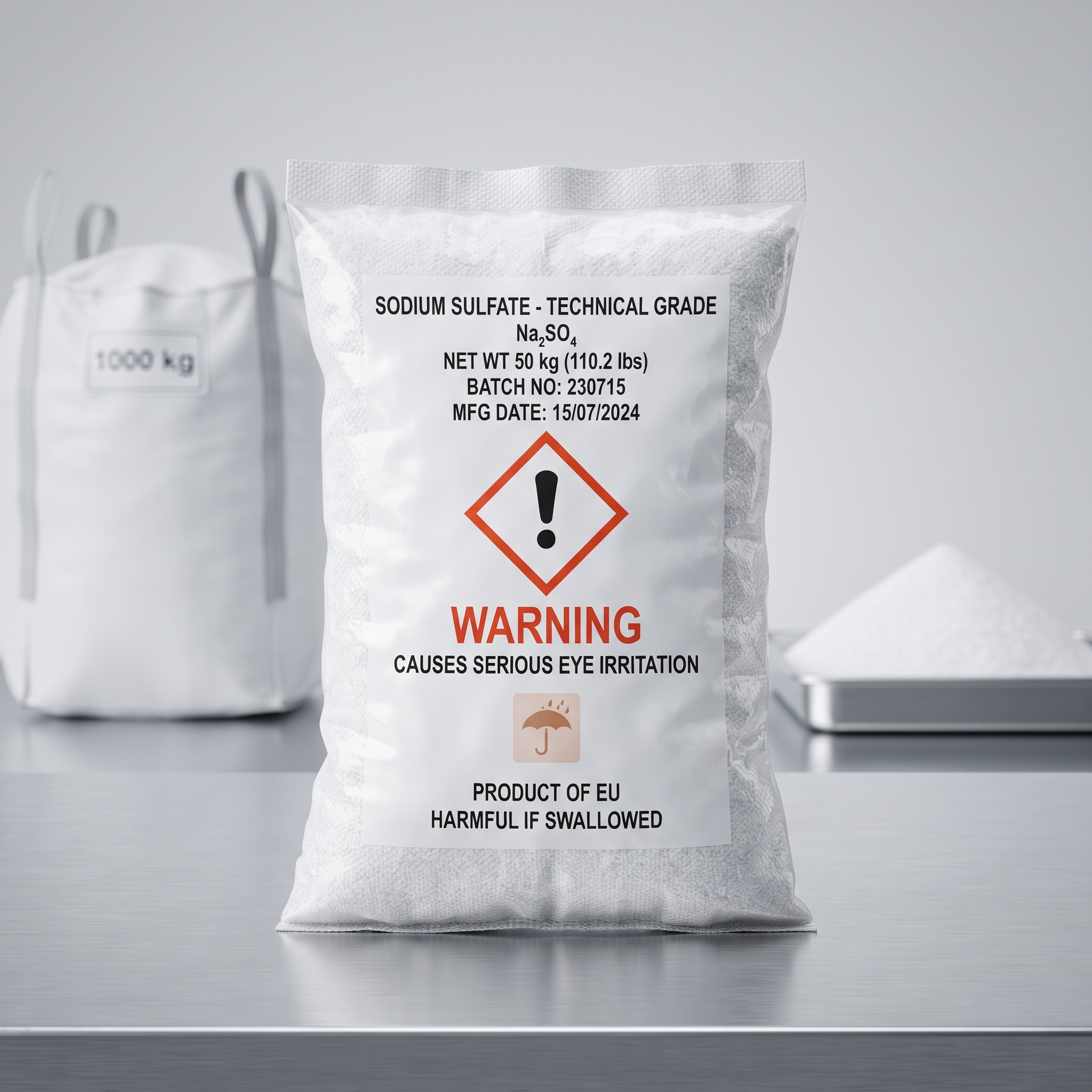
The key feature of technical sodium sulfate that determines the entire supply chain is its hygroscopicity and tendency to cake when moistened, as well as the generation of dust that irritates mucous membranes. The product is not classified as a dangerous good for transport, and no UN number is assigned, which simplifies logistics. However, under GHS it may be labeled with the GHS07 exclamation mark pictogram and the signal word Warning.
Chemical Identification and Procurement Data
- Chemical name: sodium sulfate, disodium sulfate, salt cake.
- Chemical formula: Na2SO4.
- Molar mass: 142.04 g/mol.
- CAS number: 7757-82-6.
- UN number: not assigned; the product is not classified as a dangerous good for transport.
- HS code: 2833110000 for sodium sulfate.
- Commercial form: white powder or granules; a grayish tint is permitted.
In the Russian regulatory system, the primary document for technical sodium sulfate is GOST 6318-77, which covers product obtained from natural halurgical raw materials and intended for the pulp and paper, glass, chemical industries and other purposes. The standard provides for grades A and B with sort divisions. The supplier confirms batch conformity to GOST 6318-77 and provides a certificate of quality with actual values for each parameter.
Quality Parameters Relevant to Processing
- Sodium sulfate (Na2SO4) mass fraction: at least 99.4 percent for grade A premium; at least 98 percent for first grade; at least 97 percent for second grade; at least 94 percent for grade B.
- Water-insoluble residue mass fraction: not more than 0.4 percent for premium; not more than 0.9 percent for first; not more than 1.2 percent for second; not more than 4.5 percent for grade B.
- Chlorides mass fraction calculated as NaCl: not more than 0.2 percent for premium; not more than 0.7 percent for first; not more than 1.2 percent for second; not more than 2.0 percent for grade B.
- Calcium sulfate (CaSO4) mass fraction: not standardized for premium; not more than 1.0 percent for first and second grades.
- Magnesium (Mg) mass fraction: not more than 0.02 percent for premium; not more than 0.1 percent for first; not more than 0.2 percent for second; not standardized for grade B.
- Iron mass fraction calculated as Fe2O3: not more than 0.010 percent for premium; not more than 0.015 percent for first; not more than 0.03 percent for second and grade B.
- Water mass fraction: not more than 0.1 percent for premium; not more than 1.0 percent for first; not more than 4.0 percent for second; not more than 7.0 percent for grade B.
For the processor, water and insoluble residue content are critical. Increased moisture leads to caking and loss of flowability during storage and pneumatic transport, while increased insoluble matter affects the quality of the glass melt and paper pulp.
Technical Grades and Supply Forms
Grade A (Premium, First and Second Sort)
Product obtained by industrial methods. Premium and first grades are intended for the pulp and paper, chemical, glass industries and other purposes. The second grade of grade A is equivalent in application to grade B and is used in the glass industry. Premium grade intended for synthetic detergent production is manufactured with a whiteness of at least 60 percent and a water-insoluble residue content of not more than 0.2 percent.
Grade B
Product obtained under natural conditions. Intended, like the second grade of grade A, only for the glass industry. Contains at least 94 percent Na2SO4 and allows higher impurity and water content (up to 7 percent).
Supply is in bulk, in paper or polypropylene bags with a polyethylene liner of 25 or 50 kg, as well as in flexible specialized containers (big bags) of 1000 or 1250 kg capacity.
Packaging, Containers and Labeling
Technical sodium sulfate is not a dangerous good, so packaging must primarily provide moisture protection and mechanical strength. Multi-wall paper bags, polypropylene bags with a polyethylene liner and big bags made of polypropylene fabric are used.
Transport Marking
Transport marking is applied per GOST 14192 with the Keep Dry handling symbol. Since the product is not classified as a dangerous good, transport hazard diamonds of class 5.1, 8 or others are not applied. Under GHS, the product may be labeled with the GHS07 exclamation mark pictogram and the signal word Warning because dust causes irritation of skin, eyes and respiratory tract. Marking must contain the manufacturer name, product name, grade and sort, batch number and date of manufacture, standard designation and guaranteed Na2SO4 content.
Storage Conditions
The product is stored in closed packaging in dry, well-ventilated warehouses protected from atmospheric precipitation. Bulk storage must exclude moistening and contamination.
Regulatory Framework for Incoming Inspection
- GOST 6318-77 - technical sodium sulfate. Specifications. Establishes requirements for grades A and B, sorts, analytical methods and acceptance rules.
- GOST 21458-75 - crystalline sodium sulfate. Specifications (for crystalline product).
- GOST 12.1.007-76 - classification of hazardous substances. Sodium sulfate belongs to moderately hazardous substances; dust irritates mucous membranes.
- GOST 14192 - cargo marking.
- GOST 30333-2022 - safety data sheet for chemical products.
- ICSC 0952 - international chemical safety card for sodium sulfate.
For imported batches, the specification is based on manufacturer standards and harmonized methods. The batch specification is confirmed by the manufacturer certificate of quality and the results of incoming laboratory control by the recipient.
Mechanism of Action and Functional Role
In the glass batch, sodium sulfate acts as a source of sodium oxide (Na2O) and as a clarifier. At high temperatures it reacts with silica, reducing the viscosity of the glass melt and promoting the removal of gas bubbles. In kraft pulping, sodium sulfate is a carrier of active alkali and sulfur: during cooking it is reduced to sodium sulfide, which provides wood delignification and preserves fiber strength.
In synthetic detergents, sodium sulfate acts as an inert filler regulating bulk density and powder flowability, and as a carrier for surfactants. In the textile industry it is used in dyeing to salt out dyes onto the fiber and level the color, as well as in mercerization and finishing.
In non-ferrous metallurgy, sodium sulfate is used for metal refining and as a component of fluxes, and in synthetic detergent and paper production as a process additive affecting rheology and product structure.
Applications by Industry
Glass Industry
The largest consumption direction. Sodium sulfate is used in the production of flat, container, automotive and other types of glass as a batch component and clarifier. Grade B and the second grade of grade A are used primarily in this segment.
Pulp and Paper Industry
Sodium sulfate is a key reagent in kraft pulping. It ensures the production of strong fiber and is used in paper and board production. Premium and first grades of grade A are intended for this direction.
Synthetic Detergents
Used as a filler and flow regulator in powder detergents. Premium grade A with a whiteness of at least 60 percent is specifically intended for this segment.
Textile and Leather Industry
Used in fabric dyeing for salting out dyes, as well as in fiber and leather preparation and finishing processes.
Non-Ferrous Metallurgy
Used for metal refining and as a component of fluxes in metallurgical processes.
Other Industries
Used in the production of aerated concrete and foam blocks, as a component of drilling fluids, in medicine and veterinary practice, and in laboratory practice (crystalline sodium sulfate per GOST 21458-75).
Comparison with Alternative Sodium and Sulfur Products
Compared with calcined soda, sodium sulfate does not provide such high alkalinity, but in glass melting it performs a specific function as a clarifier and Na2O source, complementing soda. Compared with sodium sulfite, sodium sulfate is a more stable and less reactive product, which simplifies storage and transport but requires higher temperatures for reduction during cooking.
In synthetic detergent production, sodium sulfate competes with sodium chloride and sodium carbonate as a filler. Sulfate has an advantage in flowability and inertness but is inferior in cost. In the textile industry it competes with sodium chloride in salting-out processes but provides a milder action and better compatibility with optical brighteners.
Supplier Selection Criteria and Specification Development
The specification for technical sodium sulfate must include the grade (A or B), sort (for grade A), Na2SO4 mass fraction, insoluble residue, chloride, iron and water content, as well as the supply form (bulk, bags, big bags) and transport conditions. For the glass industry, product whiteness is additionally important; for pulp and paper, iron and insoluble matter content.
The supplier confirms batch-to-batch quality consistency, a valid safety data sheet under GOST 30333-2022, readiness to provide packaging that protects against moisture and to organize transport in compliance with cargo transport rules. For imported batches, it is important to verify labeling and actual parameters, as well as storage conditions at the warehouse before shipment.
Typical Processing, Storage and Logistics Errors
- Violation of storage conditions. Sodium sulfate is hygroscopic; storage in humid areas or in the open leads to caking and loss of flowability. The product is stored in closed warehouses protected from atmospheric precipitation.
- Co-storage with acids and oxidizers. Sodium sulfate is a neutral salt, but on contact with strong acids it may release hydrogen chloride (if chlorides are present) or sulfur gases. Co-storage with acids is not recommended.
- Use of contaminated packaging. Residues of other products can contaminate sodium sulfate, especially for the glass industry where purity for iron and insoluble matter is important.
- Neglecting dust protection. Sodium sulfate dust irritates mucous membranes and the respiratory tract; a respirator, protective goggles and gloves are required when working with the product.
- Use of grade B for pulp and paper. Grade B is intended only for the glass industry and is not standardized for iron and chloride content at the same limits as grade A for critical processes.
- Labeling errors. Applying transport hazard labels that do not correspond to the product, or omitting the GHS07 label when irritant action is present, can mislead the consumer.
Quality Control and Laboratory Methods
Incoming inspection of sodium sulfate includes determination of the Na2SO4 mass fraction (gravimetric or titrimetric), water-insoluble residue (gravimetric), chlorides (argentometry), iron (photometry), calcium and magnesium (complexometry), as well as water mass fraction (drying). Sampling is performed by standardized methods; the combined sample is analyzed in the plant laboratory.
When changing supplier or batch for the glass industry, a control glass melt run is recommended to confirm compatibility with the batch, since even minor iron impurities can affect glass color.
Storage and Transportation Conditions
Technical sodium sulfate is not classified as a dangerous good. Storage is carried out in closed packaging in dry, well-ventilated warehouses at ambient temperature, protecting the product from atmospheric precipitation and direct sunlight. The shelf life is established by the manufacturer and is typically 12-24 months from the date of manufacture under proper transport and storage conditions.
Transportation is by rail, road and water in covered vehicles in bags and big bags. Bulk product is transported in specialized hopper cars or containers. No special temperature regime is required, but moistening and contamination of the product must be excluded.
Finding Analogues and Interchangeability
When replacing sodium sulfate, a product of the same grade and sort with similar Na2SO4, insoluble residue and water parameters is selected. Replacing premium grade A with first or second grade is possible in processes where wider impurity limits are acceptable, with confirmation of final product properties. Replacing grade A with grade B for pulp and paper is not permitted.
In the glass industry, replacing sodium sulfate with soda or sodium sulfite is possible but requires revision of the batch and confirmation of glass melt quality. In synthetic detergent production, replacement with sodium chloride or sodium carbonate is possible with formulation adjustment and confirmation of flowability. The decision is based on laboratory testing and, for critical processes, pilot-scale verification.
Supply Routes: Russia, China and Other Regions
Domestic supply is provided by chemical complexes and mining and processing facilities with sodium sulfate production capacity. Products are supplied to the domestic market and for export. Shipment is by rail in covered cars and hoppers, and by road in bags and big bags.
Chinese producers have large sodium sulfate capacities. Supplies are delivered by sea with subsequent transfer to rail or road transport. Other global producers are located in the Middle East, Southeast Asia and Europe. Suppliers from these regions are engaged when required, taking into account logistical and regulatory factors.
Logistics and Customs Clearance
Transportation of sodium sulfate is carried out in bulk in specialized rail cars and road transport, as well as in bags and big bags in covered vehicles. Customs clearance includes classification under HS code 2833110000, preparation of a safety data sheet under GOST 30333-2022 (if required) and conformity declaration. The portal provides customs broker services and supports all clearance stages.
Risk Factors and Safety Measures
Technical sodium sulfate is non-toxic, non-flammable and non-explosive and is not classified as a dangerous good. The main risks are associated with dust generation: dust irritates the mucous membranes of the eyes, nose and respiratory tract, and ingestion of large amounts may cause nausea, vomiting, abdominal pain and diarrhea. When heated above the melting point, the product decomposes with the release of sulfur and sodium oxides.
Work is performed in ventilated rooms with filtering respirators, protective goggles and gloves. In case of a spill, the product is collected mechanically, moistened if necessary to avoid dust generation, and disposed of in closed containers. Discharge of concentrated solutions into water bodies without prior dilution is not permitted.
FAQ: Common Questions from Procurement and Process Specialists
How does grade A differ from grade B under GOST 6318-77
Grade A is obtained by industrial methods and is produced in premium, first and second grades. It is intended for the pulp and paper, chemical, glass industries and other purposes. Grade B is obtained under natural conditions and is intended, like the second grade of grade A, only for the glass industry. Grade B contains at least 94 percent Na2SO4 and allows higher impurity and water content (up to 7 percent).
Is sodium sulfate a dangerous good
No, the product is not classified as a dangerous good for transport, and no UN number is assigned. Transport hazard labels (class 5.1, 8 and others) are not applied. However, under GHS the product may be labeled with the GHS07 pictogram and the signal word Warning due to the irritant action of dust.
Which packaging is used for sodium sulfate
Paper or polypropylene bags with a polyethylene liner of 25 or 50 kg, as well as big bags of 1000 or 1250 kg capacity, are used. Bulk supply in specialized rail cars and road transport is possible. Packaging must protect the product from moisture and bear the Keep Dry marking.
What is the shelf life of sodium sulfate
The shelf life is established by the manufacturer and is typically 12-24 months from the date of manufacture under proper storage conditions (dry, ventilated areas, protection from precipitation). After this period, incoming inspection of Na2SO4 and moisture content is required.
What documents are required for sodium sulfate import
Import requires a contract, invoice, packing list, safety data sheet under GOST 30333-2022 (if required), manufacturer certificate of quality and transport documents. The product is not classified as a dangerous good, so additional permits for the transport of dangerous goods are not required. The portal organizes the preparation of the document set and interaction with the customs broker.
Conclusion
Technical sodium sulfate remains a demanded inorganic product for the glass, pulp and paper, chemical and textile industries. GOST 6318-77 establishes grades A and B with sort divisions differing in Na2SO4 and impurity content. For procurement teams, the practical task reduces to correct grade and sort selection, confirmation of batch conformity to the standard, and organization of supplies with storage conditions that exclude moistening and caking of the product, as well as dust protection measures during handling.
Contact Us
For procurement inquiries and supply chain organization, contact the portal team at info@apptrade.ru.