Hydrochloric Acid
What Hydrochloric Acid Is and Why It Remains a Critical Industrial Reagent
Hydrochloric acid (HCl) is an aqueous solution of hydrogen chloride, a colorless or slightly yellowish liquid with a pungent odor. Industrially, it is produced synthetically by burning chlorine in hydrogen followed by absorption of hydrogen chloride in water, as well as a by-product of organic chlorination. Synthetic acid contains fewer organic impurities and is a purer product compared to by-product acid.
For procurement teams, hydrochloric acid matters primarily as a reagent for metal pickling, acid treatment of oil and gas wells, regeneration of ion exchange resins, and as a feedstock for the production of metal chlorides and various chemical compounds. GOST 857-95 sets requirements for synthetic technical acid of grades A and B, while GOST 3118-77 covers reagent grade, enabling selection of the product for a specific process and handling conditions.
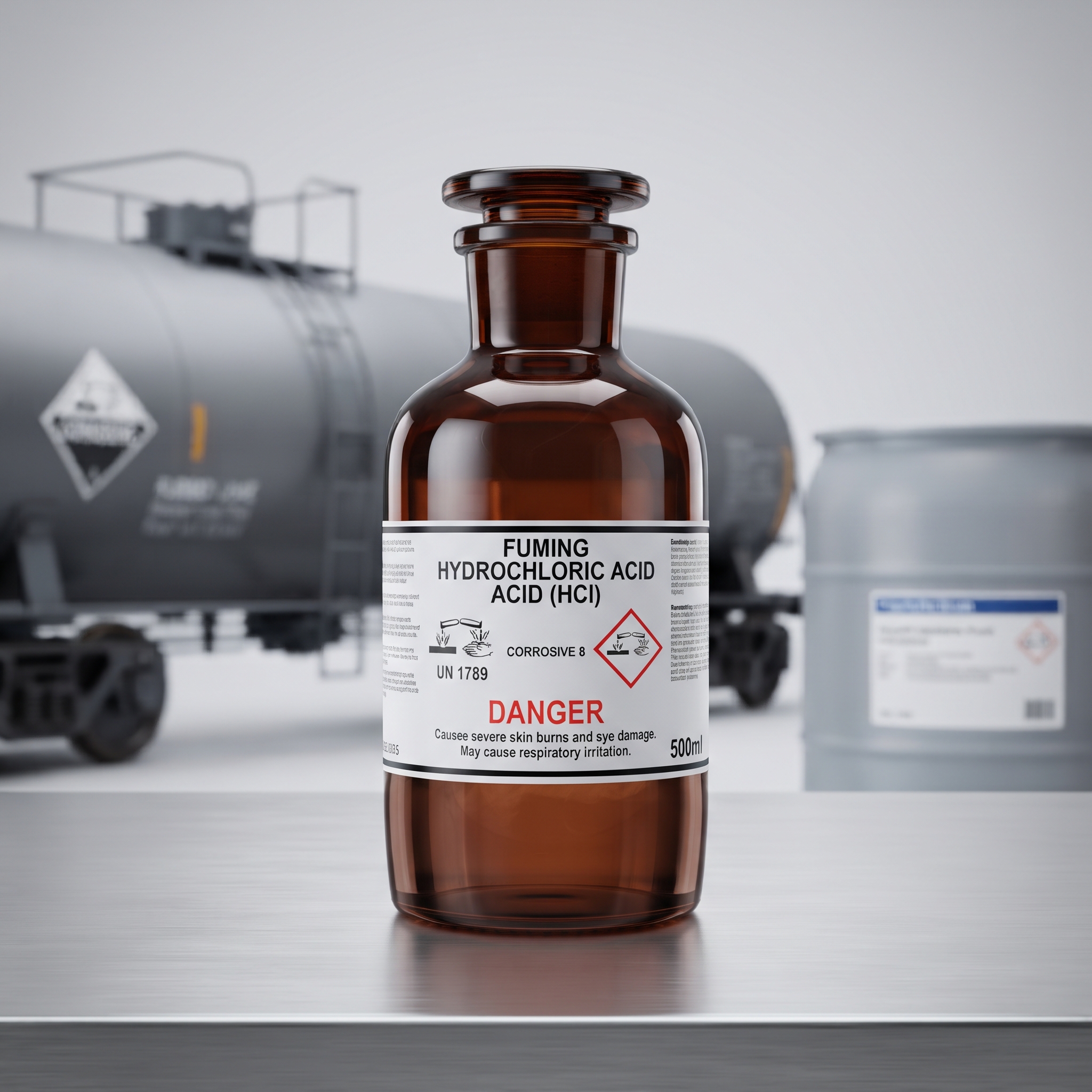
The key feature of hydrochloric acid that determines the entire supply chain is its high corrosiveness toward most metals, its ability to release toxic hydrogen chloride on evaporation, and its tendency to form acid mist in air. The acid is classified as a class 8 hazardous good, UN number 1789, requiring specialized rubber-lined or polymer packaging, sealing and strict compliance with transport regulations.
Chemical Identification and Procurement Data
- Chemical name: hydrochloric acid, hydrogen chloride solution.
- Chemical formula: HCl.
- Molar mass: 36.46 g/mol.
- CAS number: 7647-01-0.
- UN number: 1789.
- HS code: 2806100000.
- Commercial form: clear colorless or yellowish liquid, fuming in air; density 1.15-1.19 g/cm3.
In the Russian regulatory system, GOST 857-95 applies to synthetic technical hydrochloric acid produced by absorption of hydrogen chloride formed by the reaction of chlorine with hydrogen. The standard provides for grades A and B, with grade B divided into premium and first grade. For reagent qualification, GOST 3118-77 applies, establishing requirements for grade Ch acid. The supplier confirms batch conformity to the applicable standard and provides a certificate of quality with actual values for each parameter.
Physical and Chemical Properties Relevant to Processing and Logistics
- Density at 20 degrees Celsius: 1.15-1.19 g/cm3 depending on concentration.
- Hydrogen chloride mass fraction: at least 35 percent for grade A; at least 33 percent for grade B premium; at least 31.5 percent for grade B first.
- Iron mass fraction: not more than 0.001 percent for grade A; not more than 0.002 percent for grade B premium; not more than 0.015 percent for grade B first.
- Residue after calcination: not more than 0.010 percent for grade A; not more than 0.015 percent for grade B premium; not more than 0.100 percent for grade B first.
- Free chlorine mass fraction: not more than 0.002 percent for grades A and B premium; not more than 0.008 percent for grade B first.
- Boiling point: about 110 degrees Celsius for concentrated acid; decreases with dilution.
- Solubility: miscible with water in all proportions.
For the processor and logistics specialist, the critical factors are the release of hydrogen chloride into the gas phase, especially on heating or dilution, and the ability of the acid to dissolve oxides and metals with hydrogen evolution. Hydrochloric acid vapors irritate the upper respiratory tract and eye mucous membranes, and skin contact causes burns. The maximum permissible concentration of vapors in the working area air is 5 mg/m3, hazard class 2.
Technical Grades and Supply Forms
Synthetic Technical Hydrochloric Acid (GOST 857-95)
Grade A is the purest product with minimal iron and calcination residue. It is used in the chemical industry for the production of dyes, mineral fertilizers, coagulants, in the food industry for equipment washing and casing production, and in the medical industry.
Grade B is produced in two grades. The premium grade is used in the same industries as grade A but allows slightly wider impurity limits. The first grade is used in non-ferrous and ferrous metallurgy for pickling and surface preparation of metal for electroplating, as well as in other processes not requiring high purity. For metal pickling, the iron and calcination residue mass fractions are not standardized.
Reagent Hydrochloric Acid (GOST 3118-77)
Produced as grade Ch with an HCl mass fraction of 35-38 percent and strict limits for sulfates, sulfites, ammonium salts and heavy metals. Used in laboratory practice and fine chemical synthesis.
Packaging, Containers and Labeling
The choice of packaging for hydrochloric acid is determined by its corrosiveness. Ordinary carbon steel without coating is unsuitable, so rubber-lined (rubberized) containers or polymer materials are used.
Technical Acid
Filled into special rubber-lined rail tank cars of the shipper or consignee, rubber-lined containers, polyethylene drums of 50 dm3 capacity and glass carboys of 20 dm3 capacity. The use of fiberglass road tankers and special containers of 1000 dm3 capacity consisting of a metal frame, wooden pallet and plastic vessel is permitted. The inner surface of the packaging must be rubber-lined or lined with materials resistant to hydrochloric acid.
Reagent Acid
Supplied in special containers of 1000 dm3 capacity, polyethylene drums of 50-200 dm3 capacity, as well as glass carboys.
Hazard Labeling
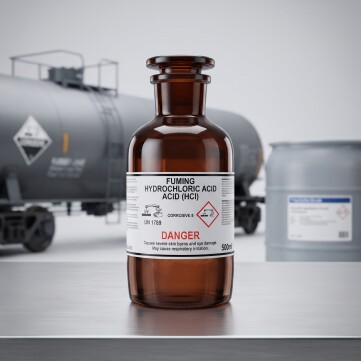
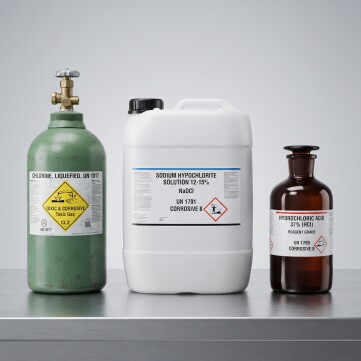
Hydrochloric acid is labeled per GOST 19433 and dangerous goods transport rules. Hazard label 8 (corrosive) is mandatory. Transport marking includes warning inscriptions and handling signs per GOST 14192.
Regulatory Framework for Incoming Inspection
- GOST 857-95 - synthetic technical hydrochloric acid. Specifications.
- GOST 3118-77 - reagents. Hydrochloric acid. Specifications.
- GOST 19433 - classification and labeling of dangerous goods.
- GOST 30333-2022 - safety data sheet for chemical products.
- GOST 14192 - cargo marking.
- GOST 12.1.005 - general sanitary and hygienic requirements for working area air; maximum permissible concentration of HCl vapors is 5 mg/m3.
For imported batches, the specification is based on manufacturer standards and harmonized methods. The batch specification is confirmed by the manufacturer certificate of quality and the results of incoming laboratory control by the recipient.
Mechanism of Action and Functional Role
Hydrochloric acid is a strong monobasic acid that dissociates in aqueous solutions to form hydrogen and chloride ions. It actively reacts with metals before hydrogen in the activity series, displacing hydrogen and forming metal chlorides. This reaction underlies metal pickling - the removal of oxides and scale from the surface of steel and non-ferrous metals before rolling, drawing or coating.
In oil production, hydrochloric acid is used for acidizing wells: it dissolves carbonate rocks and deposits, increasing the permeability of the near-wellbore zone and stimulating oil or gas flow. Corrosion inhibitors are added to the acid to protect equipment. In chemical synthesis, the acid serves as a feedstock for metal chlorides, chlorine, coagulants for water treatment, and is also used for regeneration of ion exchange resins.
For the B2B buyer, it is important to understand that acid concentration and impurity profile directly affect pickling rate, surface quality and corrosive attack on equipment. Iron and free chlorine impurities can catalyze side reactions and contaminate the final product, so control under GOST 857-95 is a mandatory incoming inspection step.
Applications by Industry
Metallurgy and Metalworking
The largest consumption direction. Hydrochloric acid is used for pickling ferrous and non-ferrous metals, rust and scale removal, and surface preparation for electroplating. Technical acid, often with corrosion inhibitors, is used for these purposes.
Oil and Gas Industry
Acid treatment of oil and gas wells to increase productivity, as well as chemical cleaning of boilers and apparatus from carbonate deposits.
Chemical Industry
Production of dyes, mineral fertilizers, coagulants for water treatment, metal chlorides and other chemical compounds. The acid is also used for regeneration of ion exchange resins.
Food and Medical Industry
Used for equipment washing, casing production, ethyl alcohol and molasses production, as well as in the medical industry. Grade A or grade B premium acid with minimal impurities is used for these purposes.
Other Industries
Electroplating, laboratory practice (reagent acid), water and wastewater treatment, chemical reagent production.
Supplier Selection Criteria and Specification Development
The specification for hydrochloric acid must include the product type (synthetic technical per GOST 857-95 or reagent per GOST 3118-77), grade (A or B, sort for grade B), HCl mass fraction, limit values for iron, calcination residue and free chlorine, as well as packaging and transport requirements.
The supplier confirms batch-to-batch quality consistency, a valid safety data sheet under GOST 30333-2022, readiness to provide packaging approved for the given product type (rubber-lined tank cars, polyethylene drums, glass carboys) and to organize loading in compliance with safety measures. For imported batches, it is important to verify that labeling and actual parameters match.
Typical Processing, Storage and Logistics Errors
- Use of non-specialized packaging. Hydrochloric acid requires rubber-lined or polymer tanks; ordinary carbon steel corrodes rapidly, potentially causing loss of containment and leakage.
- Neglecting sealing. The acid releases toxic hydrogen chloride; storage must be in sealed tanks in well-ventilated areas.
- Co-storage with oxidizers and alkalis. A violent neutralization or oxidation reaction with heat and toxic gas release is possible; co-storage is not permitted.
- Neglecting personal protective equipment. The acid causes chemical burns to skin and eyes, and its vapors irritate the respiratory tract; work is performed with acid-resistant gloves, protective goggles and protective clothing, and if necessary with a filtering respirator.
- Errors in dangerous goods documentation. Incorrect classification or labeling leads to customs delays and penalties.
- Use of contaminated packaging. Residues of other acids or organic substances can react with hydrochloric acid, so packaging must be dry, clean and intended for this product.
Quality Control and Laboratory Methods
Incoming inspection of hydrochloric acid includes determination of the HCl mass fraction by titration, iron mass fraction by photometric or atomic absorption methods, calcination residue by gravimetric method, free chlorine, and for reagent acid also sulfates, sulfites and ammonium salts. Sampling is performed in acid-resistant containers with observance of safety measures; the combined sample is analyzed in the plant laboratory.
When changing supplier or batch, a control run of the target product is recommended to confirm compatibility with the process.
Storage and Transportation Conditions
Hydrochloric acid is classified as a class 8 dangerous good (corrosive substances), UN number 1789. Storage is carried out in sealed tanks made of materials resistant to hydrochloric acid: rubber-lined steel tanks or polymer tanks. Premises must be equipped with ventilation and spill neutralization equipment.
Transportation is by rail and road rubber-lined tank cars, tank containers, polyethylene drums and glass carboys in accordance with dangerous goods transport rules. Sea transport uses specialized tank containers and vessels complying with IMDG requirements.
Finding Analogues and Interchangeability
There is no direct analogue of hydrochloric acid as a source of chloride ions and a pickling reagent in large-tonnage processes. In some applications, such as certain neutralization processes, hydrochloric acid can be replaced by sulfuric or nitric acid, but this changes the reaction product composition and requires process revision. For pickling stainless steels, hydrochloric acid is often preferred over sulfuric acid because it is less prone to surface passivation.
When changing supplier, a product of the same type and grade with similar main substance and impurity parameters is selected. The replacement decision is based on laboratory testing and, for critical processes, pilot-scale verification.
Supply Routes: Russia, China and Other Regions
Domestic supply is provided by chemical complexes with synthetic hydrochloric acid production capacity. Products are supplied to the domestic market and for export. Shipment is by rail in rubber-lined tank cars and by road in rubber-lined or fiberglass tank cars.
Chinese producers have large hydrochloric acid capacities. Supplies are delivered by sea with subsequent transfer to rail or road transport, in compliance with dangerous goods requirements. Other global producers are located in the Middle East, Southeast Asia and Europe. Suppliers from these regions are engaged when required, taking into account logistical and regulatory factors.
Risk Factors and Safety Measures
The main risks are associated with chemical burns to skin and eyes, irritation of the respiratory tract by hydrogen chloride vapors, and the release of explosive hydrogen on contact of the acid with metals. Hydrochloric acid is non-flammable, but its reaction with active metals can produce hydrogen-air mixtures.
Work is performed in ventilated rooms with filtering respirators, protective goggles or shields, acid-resistant gloves and protective clothing. In case of a spill, the area is cordoned off, the spill is neutralized with alkaline solutions (lime, soda), then collected and disposed of. Discharge of acid into sewers and water bodies is not permitted.
FAQ: Common Questions from Procurement and Process Specialists
How does grade A differ from grade B under GOST 857-95
Grade A has a higher HCl mass fraction (at least 35 percent) and stricter limits for iron (not more than 0.001 percent) and calcination residue (not more than 0.010 percent). Grade B is produced in two grades: premium contains at least 33 percent HCl and up to 0.002 percent iron, first grade contains at least 31.5 percent HCl and up to 0.015 percent iron.
Which packaging is suitable for hydrochloric acid storage
Special rubber-lined rail tank cars and containers, polyethylene drums of 50 dm3 capacity and glass carboys of 20 dm3 capacity are used for technical acid. Fiberglass road tankers and special containers of 1000 dm3 capacity with a plastic vessel are permitted.
What hazard labels must be on hydrochloric acid packaging
Hazard label 8 (corrosive) is mandatory. Transport marking is applied in accordance with dangerous goods transport rules and includes warning inscriptions.
Can hydrochloric acid be stored in an ordinary steel tank
No, ordinary carbon steel without coating corrodes rapidly under the action of hydrochloric acid. Rubber-lined (rubberized) steel tanks or polymer tanks are used for storage and transport.
What documents are required for hydrochloric acid import
Import requires a contract, invoice, packing list, safety data sheet under GOST 30333-2022 in Russian, manufacturer certificate of quality, transport documents and a declaration of conformity. For dangerous goods, transport permits and compliance with carriage rules are additionally confirmed.
Conclusion
Hydrochloric acid remains an indispensable large-tonnage inorganic product, enabling metal pickling, oil recovery, chemical synthesis and the food industry. GOST 857-95 and GOST 3118-77 establish requirements for technical and reagent acid, while the choice of packaging and labeling is determined by the corrosiveness of the product. For procurement teams, the practical task reduces to correct selection of acid type and grade, confirmation of batch conformity to the standard, and organization of supplies in compliance with dangerous goods transport rules, rubber-lined packaging requirements and safety measures.
Contact Us
For procurement inquiries and supply chain organization, contact the portal team at info@apptrade.ru.