Pigmentary Titanium Dioxide
What Pigmentary Titanium Dioxide Is and Why It Remains the Primary White Pigment
Pigmentary titanium dioxide, or titanium dioxide (TiO2), is a synthetic inorganic white pigment produced by hydrolysis of titanium sulfate solutions followed by calcination of hydrated titanium dioxide. Its molar mass is 79.87 g/mol, density of the rutile form is about 4.2 g/cm3, and of the anatase form about 3.9 g/cm3. The melting point of rutile exceeds 1800 degrees Celsius.
For procurement teams, titanium dioxide matters primarily as a pigment with the highest refractive index among large-tonnage white fillers (2.7 for rutile and 2.5 for anatase). This property provides high hiding power, whiteness and the ability to cover the substrate even at low coating thickness. The product is demanded in the paint industry, production of plastics, paper, rubber, artificial leather, ceramics, cosmetics and food packaging materials.
The key feature of titanium dioxide that determines the entire supply chain is the difference between rutile and anatase forms. Rutile has higher weathering resistance, hardness and refractive index, while anatase is softer, easier to disperse and used in applications where whiteness and the absence of abrasive action are important. GOST 9808-84 establishes requirements for both forms and their grades.
Chemical Identification and Procurement Data
- Chemical name: titanium dioxide, titanium (IV) oxide.
- Chemical formula: TiO2.
- Molar mass: 79.87 g/mol.
- CAS number: 13463-67-7.
- UN number: not assigned for the pigmentary form; the product is not classified as a dangerous good for transport. For nano-sized forms, UN 3260 may be assigned.
- HS code: 3206110000 for pigments and preparations based on titanium dioxide with a TiO2 content of at least 80 percent calculated on a dry basis.
- Commercial form: white powder; a creamy or grayish tint is permitted depending on the grade.
In the Russian regulatory system, the primary document for pigmentary titanium dioxide is GOST 9808-84, which covers synthetic inorganic white pigment of anatase and rutile forms and establishes requirements for grades, analytical methods and acceptance rules. The supplier confirms batch conformity to GOST 9808-84 and provides a certificate of quality with actual values for each parameter.
Quality Parameters Relevant to Processing
- Titanium dioxide (TiO2) mass fraction: at least 98 percent for rutile grades R-1 and R-02 premium; at least 92 percent for anatase grades A-1 and A-2.
- Whiteness: at least 95 conventional units for rutile premium; at least 92 conventional units for anatase.
- Tinting strength: at least 1200 conventional units for rutile; at least 800-900 for anatase depending on grade.
- Volatile matter mass fraction at 105 degrees Celsius: not more than 0.5 percent for rutile; not more than 1.0 percent for anatase.
- Water-soluble matter mass fraction: not more than 0.3 percent for rutile; not more than 0.5 percent for anatase.
- pH of aqueous suspension: 6.5-8.5 depending on grade and surface treatment.
- Residue on a 0.045 mm sieve: not more than 0.1 percent for rutile; not more than 0.3 percent for anatase.
- Aluminum and silicon oxide mass fraction (for treated grades): standardized depending on the type of surface treatment.
For the processor, whiteness, tinting strength and sieve residue are critical. Low whiteness or coarse residue leads to surface defects, uneven coloring and reduced hiding power of the coating. The presence of surface treatment (aluminum, silicon, zirconium oxides) affects dispersibility and weathering resistance.
Technical Grades and Supply Forms
Rutile Form (Grades R-1 and R-02)
R-1 is intended for white concrete, rubber and organosilicon construction enamels. R-02 is used in paints for exterior applications, artificial leather and other articles requiring high weathering resistance. TiO2 content is at least 98 percent, whiteness at least 95 conventional units. The rutile form has the highest hiding power and UV resistance.
Anatase Form (Grades A-1 and A-2)
A-1 is used for paper, rubber and films. A-2 is used in productions requiring a soft pigment with good dispersibility. TiO2 content is at least 92 percent, whiteness at least 92 conventional units. The anatase form is inferior to rutile in weathering resistance but has an advantage in whiteness and softness.
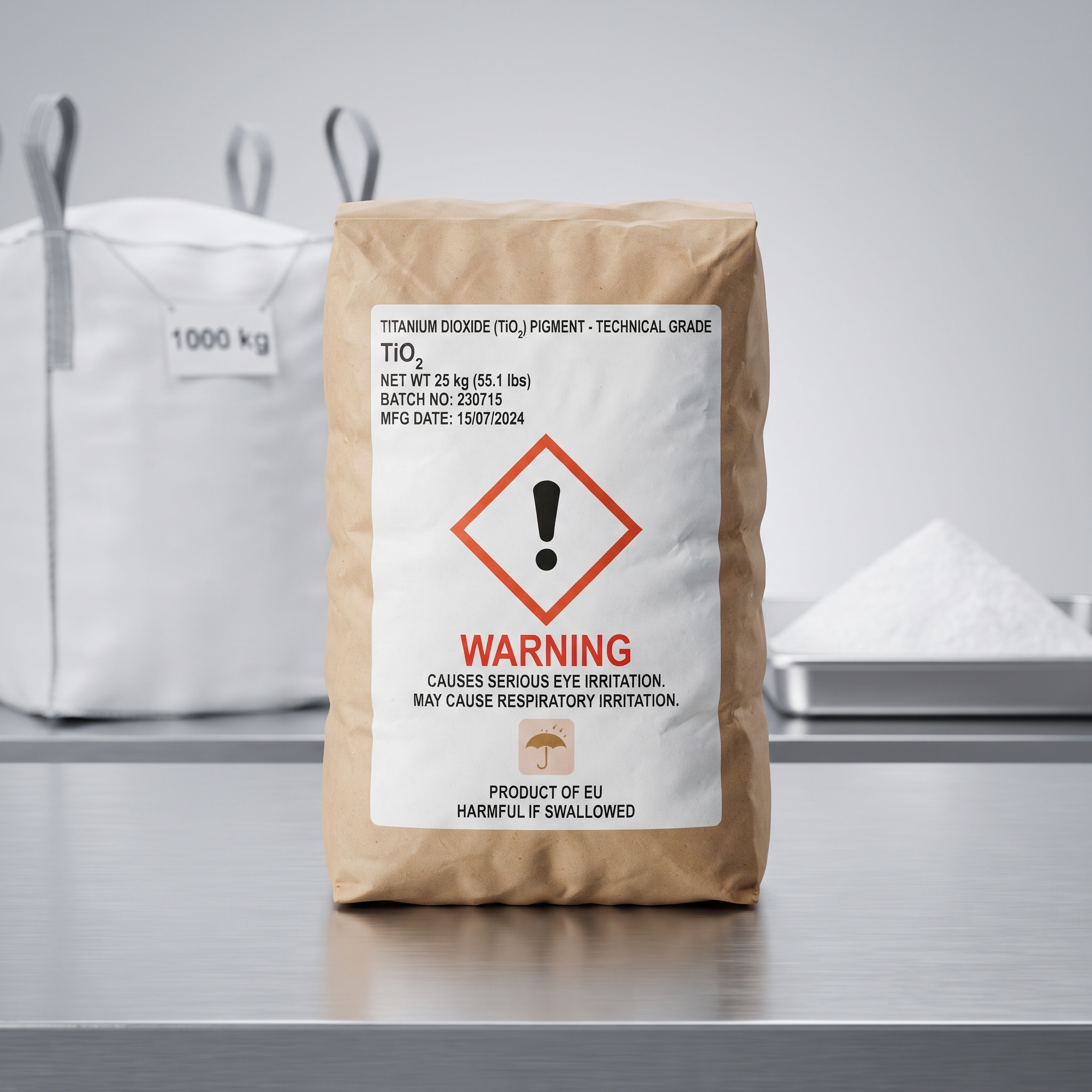
Supply is in multi-wall paper bags of 25 kg, as well as in flexible specialized containers (big bags) of 500 or 1000 kg capacity. For export batches, packaging and net weight are established in accordance with the foreign trade organization order.
Packaging, Containers and Labeling
Pigmentary titanium dioxide is not a dangerous good, so packaging must primarily provide moisture protection and mechanical strength. Multi-wall paper bags with a polyethylene liner and big bags made of polypropylene fabric with UV stabilizers are used.
Transport Marking
Transport marking is applied per GOST 14192 with the Keep Dry handling symbol. Since the product is not classified as a dangerous good, transport hazard diamonds of class 5.1, 8 or others are not applied. Under GHS, the product may be labeled with the GHS07 exclamation mark pictogram and the signal word Warning because dust causes irritation of the respiratory tract. Marking must contain the manufacturer name, product name, grade and form (rutile or anatase), batch number and date of manufacture, standard designation and guaranteed TiO2 content.
Storage Conditions
The product is stored in closed packaging in dry, well-ventilated warehouses protected from atmospheric precipitation. Big bags with UV stabilizers may be stored on open platforms, but prolonged exposure to moisture can lead to caking.
Regulatory Framework for Incoming Inspection
- GOST 9808-84 - pigmentary titanium dioxide. Specifications. Establishes requirements for rutile and anatase forms, grades, analytical methods and acceptance rules.
- GOST 12.1.007-76 - classification of hazardous substances. Titanium dioxide belongs to low-hazard substances (hazard class 4); dust may irritate the respiratory tract.
- GOST 14192 - cargo marking.
- GOST 30333-2022 - safety data sheet for chemical products.
- ISO 591-1 - titanium dioxide pigments for paints. Technical requirements (harmonized with GOST 9808-84).
- ASTM D476 - standard classification of white titanium dioxide pigments.
For imported batches, the specification is based on manufacturer standards and harmonized ISO and ASTM methods. The batch specification is confirmed by the manufacturer certificate of quality and the results of incoming laboratory control by the recipient.
Mechanism of Action and Functional Role
Titanium dioxide acts as a pigment due to its high refractive index, which provides light scattering at the particle-binder interface. The higher the refractive index and the smaller the particle size (optimally about 0.2-0.3 micrometers for rutile), the more efficient the scattering and the higher the hiding power. The rutile form, due to its higher refractive index and density, provides better hiding power and weathering resistance compared to anatase.
In paints, titanium dioxide not only provides whiteness and hiding power but also protects the film from UV radiation by scattering and reflecting sunlight. In plastics, it acts as a white pigment and UV stabilizer, preventing polymer degradation. In paper, titanium dioxide improves whiteness, opacity and smoothness, and in rubber, whiteness and resistance to atmospheric influences.
For the B2B buyer, it is important to understand that the type of surface treatment (aluminum, silicon, zirconium oxides, organic dispersants) affects dispersibility, weathering resistance and compatibility with a specific binder. Untreated titanium dioxide tends to agglomerate and exhibit photocatalytic activity, while treated grades provide stable properties in coatings and plastics.
Applications by Industry
Paint Industry
The largest consumption direction. Rutile grades are used in exterior and interior paints, enamels, primers and putties. Anatase grades are used in less demanding coatings and for interior work.
Plastics Production
Titanium dioxide serves as a white pigment and UV stabilizer in polyethylene, polypropylene, PVC, polystyrene and other polymers. Rutile grades are preferred for outdoor articles and films.
Paper Industry
Anatase and special rutile grades are used for surface treatment and filling of paper and board, improving whiteness, opacity and printing properties.
Rubber and Leather Industry
Used for white and colored rubber articles, artificial leather and footwear materials. Anatase grades are used where softness and the absence of abrasive action are important.
Ceramics, Cosmetics and Food Packaging
Titanium dioxide is used in ceramic glazes and enamels, in cosmetic products (as a physical UV filter and white pigment), as well as in food contact packaging materials, subject to appropriate approvals.
Comparison with Alternative White Pigments and Fillers
Compared with zinc oxide, titanium dioxide provides significantly higher hiding power and whiteness at a lower content in the formulation but is inferior in bactericidal properties. Compared with lithopone (a mixture of zinc sulfide and barium sulfate), titanium dioxide has an advantage in hiding power and light fastness, although lithopone is cheaper.
Compared with calcium carbonate and kaolin, titanium dioxide is a pigment rather than a filler: it provides hiding power and whiteness, while fillers reduce cost and affect rheology. Formulations often use combinations of titanium dioxide with fillers to optimize cost and coating properties.
Among titanium dioxide grades, the rutile form competes with anatase. Rutile is preferred for exterior applications and plastics, anatase for paper, cosmetics and interior coatings where softness and whiteness are important.
Supplier Selection Criteria and Specification Development
The specification for pigmentary titanium dioxide must include the form (rutile or anatase), grade, TiO2 mass fraction, whiteness, tinting strength, sieve residue, type of surface treatment and pH. The supply form (bags, big bags) and transport conditions are also specified.
The supplier confirms batch-to-batch quality consistency, a valid safety data sheet under GOST 30333-2022, readiness to provide packaging that protects against moisture and to organize transport in compliance with cargo transport rules. For imported batches, it is important to verify labeling and actual parameters, as well as storage conditions at the warehouse before shipment.
Typical Processing, Storage and Logistics Errors
- Violation of storage conditions. Titanium dioxide is hygroscopic; storage in humid areas leads to caking and loss of flowability. The product is stored in closed warehouses protected from atmospheric precipitation.
- Use of contaminated packaging. Residues of other pigments or fillers can contaminate titanium dioxide and change its whiteness and shade.
- Neglecting dust protection. Titanium dioxide dust irritates mucous membranes and the respiratory tract; a respirator, protective goggles and gloves are required when working with powder.
- Use of anatase form for exterior applications. Anatase is less weather-resistant and chalking and loses whiteness faster under UV radiation compared to rutile.
- Ignoring the type of surface treatment. Untreated titanium dioxide tends to agglomerate and exhibit photocatalytic activity, which can lead to binder degradation in the coating.
- Labeling errors. Applying transport hazard labels that do not correspond to the product, or omitting the GHS07 label when irritant action is present, can mislead the consumer.
Quality Control and Laboratory Methods
Incoming inspection of titanium dioxide includes determination of the TiO2 mass fraction (titration or gravimetry), whiteness (photometric per GOST 9529-80), tinting strength, sieve residue (sieve analysis), pH of aqueous suspension (potentiometric), volatile and water-soluble matter mass fractions. Sampling is performed by standardized methods; the combined sample is analyzed in the plant laboratory.
When changing supplier or batch for paint or plastic applications, a control run of the target product is recommended to confirm dispersibility, hiding power and weathering resistance.
Storage and Transportation Conditions
Pigmentary titanium dioxide is not classified as a dangerous good. Storage is carried out in closed packaging in dry, well-ventilated warehouses at ambient temperature, protecting the product from atmospheric precipitation and direct sunlight. The shelf life is established by the manufacturer and is typically 24 months from the date of manufacture under proper transport and storage conditions.
Transportation is by rail, road and sea in covered vehicles in bags and big bags. No special temperature regime is required, but moistening and contamination of the product must be excluded.
Finding Analogues and Interchangeability
When replacing titanium dioxide, a product of the same form (rutile or anatase) and grade with similar TiO2, whiteness and tinting strength parameters is selected. Replacing the rutile form with anatase is possible only in applications where high weathering resistance and hiding power are not required, with confirmation of final product properties. Replacing a surface-treated grade with an untreated one requires formulation adjustment and confirmation of dispersibility.
In the paint industry, replacing titanium dioxide with zinc oxide or lithopone is possible only with formulation revision and reduced hiding power requirements. In plastics, replacement with calcium carbonate or kaolin is possible only in compositions where titanium dioxide acts as a filler rather than a pigment. The decision is based on laboratory testing and, for critical processes, pilot-scale verification.
Supply Routes: Russia, China and Other Regions
Domestic supply is provided by enterprises with pigmentary titanium dioxide production capacity. Products are supplied to the domestic market and for export. Shipment is by rail in covered cars and by road in bags and big bags.
Chinese producers have the world largest titanium dioxide capacities and are the main exporters. Supplies are delivered by sea with subsequent transfer to rail or road transport. Russia share in Chinese titanium dioxide exports is about 4 percent, comparable to Vietnam, the UAE and Indonesia. Other global producers are located in Europe, North America and Southeast Asia. Suppliers from these regions are engaged when required, taking into account logistical and regulatory factors.
Logistics and Customs Clearance
Transportation of titanium dioxide is carried out in bags on pallets and big bags in covered vehicles. Customs clearance includes classification under HS code 3206110000, preparation of a safety data sheet under GOST 30333-2022 (if required) and conformity declaration. The portal provides customs broker services and supports all clearance stages.
Risk Factors and Safety Measures
Pigmentary titanium dioxide belongs to low-hazard substances (hazard class 4), is non-toxic, non-flammable and non-explosive, and is not classified as a dangerous good. The main risks are associated with dust generation: dust irritates the mucous membranes of the eyes, nose and respiratory tract. Prolonged inhalation of large amounts of dust may cause irritation of the upper respiratory tract.
Work is performed in ventilated rooms with filtering respirators, protective goggles and gloves. In case of a spill, the product is collected mechanically, moistened if necessary to avoid dust generation, and disposed of in closed containers. Discharge of concentrated suspensions into water bodies without prior dilution is not permitted.
FAQ: Common Questions from Procurement and Process Specialists
How does the rutile form of titanium dioxide differ from the anatase form
The rutile form has a higher refractive index (2.7 versus 2.5), higher density and better weathering resistance. It is preferred for exterior coatings, plastics and articles exposed to UV radiation. The anatase form is softer, easier to disperse and used in paper, cosmetics and interior coatings where whiteness and the absence of abrasive action are important.
Is titanium dioxide a dangerous good
No, the pigmentary form of titanium dioxide is not classified as a dangerous good for transport, and no UN number is assigned. Transport hazard labels (class 5.1, 8 and others) are not applied. However, under GHS the product may be labeled with the GHS07 pictogram and the signal word Warning due to the irritant action of dust. For nano-sized forms, UN 3260 may be assigned.
Which packaging is used for titanium dioxide
Multi-wall paper bags with a polyethylene liner of 25 kg, as well as big bags of 500 or 1000 kg capacity, are used. Packaging must protect the product from moisture and bear the Keep Dry marking. Big bags for TiO2 require UV stabilizers to prevent sticking during storage.
What is the shelf life of titanium dioxide
The shelf life is established by the manufacturer and is typically 24 months from the date of manufacture under proper storage conditions (dry, ventilated areas, protection from precipitation). After this period, incoming inspection of TiO2 content, whiteness and sieve residue is required.
What documents are required for titanium dioxide import
Import requires a contract, invoice, packing list, safety data sheet under GOST 30333-2022 (if required), manufacturer certificate of quality and transport documents. The product is not classified as a dangerous good, so additional permits for the transport of dangerous goods are not required. The portal organizes the preparation of the document set and interaction with the customs broker.
Conclusion
Pigmentary titanium dioxide remains an indispensable white pigment for the paint, plastics, paper, rubber and cosmetics industries. GOST 9808-84 establishes rutile and anatase forms with grade divisions by application and TiO2 content. For procurement teams, the practical task reduces to correct form and grade selection, confirmation of batch conformity to the standard, and organization of supplies with storage conditions that exclude moistening and contamination of the product, as well as dust protection measures during handling.
Contact Us
For procurement inquiries and supply chain organization, contact the portal team at info@apptrade.ru.