Formaldehyde Concentrates
Formaldehyde Concentrates: Technical Overview for Industrial Applications
Formaldehyde concentrates are aqueous formaldehyde solutions stabilized with methanol or urea to prevent polymerization during storage. In industrial practice, these products occupy a central position as feedstock for large-scale production of synthetic resins and adhesive compositions. Their primary function is to provide the feedstock base for urea-formaldehyde, phenol-formaldehyde, and melamine-formaldehyde resins used in wood processing and wood panel production, as well as to serve as disinfecting and preserving agents.
Chemical Identification
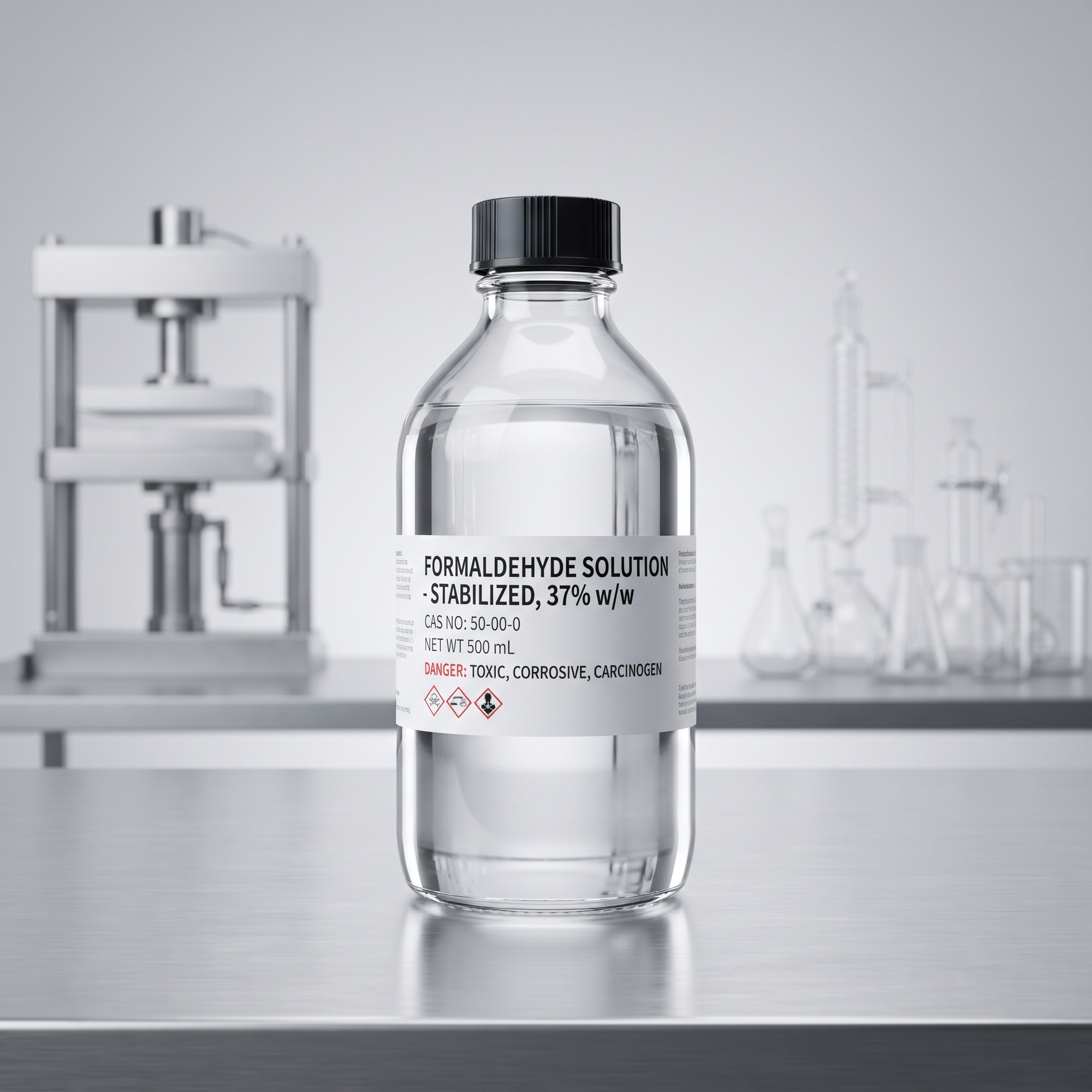
The active substance of formaldehyde concentrates is formaldehyde (methanal), identified by CAS 50-00-0, empirical formula CH2O, relative molecular mass 30.03. In international trade, formaldehyde solutions are classified under HS heading 2912 11 000 0 as methanal (formaldehyde). Technical formalin is a water-methanol solution of formaldehyde with a main substance mass fraction of about 37 percent. Urea-formaldehyde concentrate (UFC) contains formaldehyde bound with urea and is characterized by a lower free methanol content. Formaldehyde is assigned to hazard class 2 for health effects (highly hazardous substance) and is a carcinogen.
Physicochemical Properties
Technical formalin grade FM is a colorless transparent liquid with a characteristic pungent odor. Density at 20 degrees Celsius is about 1.123 g/cm3 for a 37 percent solution. The formaldehyde mass fraction ranges from 36.9 to 37.5 percent for the highest grade and from 36.5 to 37.5 percent for the first grade. The methanol mass fraction is 4.0 to 8.0 percent for grade FM; for the methanol-free grade FBM it is not more than 1.0 percent. The mass fraction of acids calculated as formic acid does not exceed 0.02 percent. The boiling point of formalin depends on concentration and ranges from 98 to 100 degrees Celsius. Formalin is miscible with water and most polar organic solvents. During storage, turbidity or white paraformaldehyde sediment may form, which dissolves when heated to not above 40 degrees Celsius.
Technical Grades and Supply Forms
Technical formalin is produced under GOST 1625-2016 in two grades: FM (stabilized with methanol) and FBM (methanol-free). Grade FM contains 4.0 to 8.0 percent methanol; grade FBM contains not more than 1.0 percent. Urea-formaldehyde concentrate grade KFK-85 is produced under technical specifications and contains 59 to 60.5 percent total formaldehyde and 24 to 25.5 percent total urea. Products are supplied in bulk in rail and road tank cars, as well as in steel drums and cans. Typical bulk shipments start from one tonne.
Regulatory Framework
In the EAEU region, quality of technical formalin is governed by GOST 1625-2016 Formalin Technical. Specifications. The standard sets requirements for physicochemical indicators, marking, packaging, transportation, and storage. Transport hazard marking is performed under GOST 19433 indicating hazard class 8, UN number 2209, and classification code 8013. For customs purposes, the explanatory notes to HS heading 2912 11 000 0 apply.
Mechanism of Action and Functional Role
In synthetic resin production, formaldehyde undergoes polycondensation with urea, melamine, or phenol to form three-dimensional polymer networks. Urea-formaldehyde concentrate already contains initial condensation products, which simplifies further resin synthesis and reduces free formaldehyde emissions. As a disinfectant, formaldehyde alkylates protein molecules of microorganisms, inactivating enzyme systems and DNA. As a preservative, it inhibits the growth of bacteria and fungi in aqueous systems and biological preparations. In the leather and textile industries, formaldehyde is used for tanning and imparting resistance to creasing and shrinkage.
Applications by Industry
The wood processing industry consumes the largest share of formaldehyde concentrates for the production of urea-formaldehyde, phenol-formaldehyde, and melamine-formaldehyde resins used in particleboard, MDF, plywood, and laminates. In the chemical industry, formalin serves as feedstock for polyacetal resins, pentaerythritol, and other organic synthesis products. In agriculture, it is used for seed treatment, soil disinfection, and livestock facility sanitation. In medicine and biology, it is used as a disinfectant and preservative for anatomical preparations. In the textile and leather industries, it is used for treating materials to improve their quality characteristics.
Comparison with Alternative Materials
Compared with urea-formaldehyde concentrate, technical formalin contains significantly more free formaldehyde and methanol, creating higher handling risks and requiring stricter safety measures. Urea-formaldehyde concentrate ensures lower formaldehyde emissions during processing and is often preferred for modern wood processing facilities with stringent environmental requirements. Compared with paraformaldehyde (solid formaldehyde polymer), liquid concentrates are easier to dose and transport in bulk but require temperature control to prevent polymerization.
Typical Processing Errors
- Storing formalin below 10 degrees Celsius without mixing, leading to paraformaldehyde sediment formation and concentration changes.
- Using formalin past its shelf life or with compromised packaging without prior laboratory testing.
- Working with formaldehyde concentrates without respiratory and skin protection, creating a risk of acute poisoning.
- Mixing formalin with acids or oxidizers without control, which may cause an exothermic reaction.
- Applying technical formalin for food or pharmaceutical purposes without confirming compliance with pharmacopoeial requirements.
- Neglecting methanol content control in grade FBM for applications where methanol is unacceptable.
Quality Control and Laboratory Methods
Incoming inspection of formalin includes determination of appearance and color, density at 20 degrees Celsius, formaldehyde mass fraction, methanol mass fraction, acid mass fraction calculated as formic acid, and iron mass fraction. Formaldehyde content is determined by titrimetric method or gas chromatography. For urea-formaldehyde concentrate, total urea mass fraction, formaldehyde to urea molar ratio, color on the Arna scale, pH, and methanol mass fraction are additionally controlled.
Storage and Transportation Conditions
Technical formalin is stored in heated containers made of materials ensuring product quality preservation at temperatures from 10 to 25 degrees Celsius. Urea-formaldehyde concentrate is stored in tanks made of stainless steel, aluminum, or epoxy-coated carbon steel at 20 plus or minus 10 degrees Celsius. Formalin is classified as dangerous goods: hazard class 8, UN number 2209, packing group III. Transportation is carried out by all modes of transport in accordance with dangerous goods regulations.
Finding Analogues and Interchangeability
When selecting an analogue for a formaldehyde concentrate, the key criteria are formaldehyde and methanol mass fractions, free formaldehyde content, color, and compatibility with the specific process. For wood processing facilities, replacing technical formalin with urea-formaldehyde concentrate is possible after formulation adjustment and testing of the final resin properties. For applications where methanol is unacceptable, grade FBM is the preferred alternative to grade FM. Direct substitution without preliminary testing is not recommended.
Supply Scheme
For industrial buyers, formaldehyde concentrates are available worldwide through the apptrade.ru platform. Shipments can be organized from producing regions across different continents, with logistics and customs support adapted to the destination market. International sourcing allows buyers to balance cost and lead time depending on batch size and logistical distance.
Logistics and Customs Clearance
Formaldehyde concentrates are transported by sea, rail, and road. For large batches, sea tank containers or dedicated tankers are economically viable; for medium and small volumes, drums and cans are used. When imported into the EAEU, products are classified under HS heading 2912 11 000 0. As formalin is class 8 dangerous goods, compliance with ADR packaging, marking, and documentation requirements is mandatory. The portal customs broker prepares declarations, confirms classification codes, and manages non-tariff regulation procedures.
FAQ
What is the difference between technical formalin and urea-formaldehyde concentrate?
Technical formalin is a water-methanol solution of formaldehyde with a mass fraction of about 37 percent. Urea-formaldehyde concentrate contains formaldehyde bound with urea and is characterized by significantly lower free formaldehyde and methanol content, reducing handling risks and emissions during processing.
Can formalin be used as a disinfectant?
Yes, technical formalin is used as a disinfectant and antiseptic in agriculture and medicine. However, due to the high toxicity and carcinogenicity of formaldehyde, strict protective measures and sanitary standards must be observed when working with it.
What hazard class is assigned to formalin?
Formalin is classified as class 8 dangerous goods (corrosive substances) with UN number 2209 and packing group III. Formaldehyde as a substance is hazard class 2 for health effects.
How long can formalin be stored?
The guaranteed shelf life of formalin is typically 12 months from the date of manufacture at temperatures from 10 to 25 degrees Celsius in sealed containers. After expiry, the product must undergo laboratory testing before use.
Is special packaging required for formalin transportation?
Yes, because formalin is class 8 dangerous goods. Hermetic tank cars, drums, and cans complying with ADR requirements for corrosive substances are used. Packaging must ensure tightness and protection against leaks.
What is the difference between grades FM and FBM?
Grade FM is stabilized with methanol and contains 4.0 to 8.0 percent methanol. Grade FBM is methanol-free and contains not more than 1.0 percent methanol, making it preferable for applications where methanol presence is unacceptable.
Conclusion
Formaldehyde concentrates remain foundational feedstock for synthetic resin and adhesive production, and are also in demand in agriculture, medicine, and the textile industry. For industrial buyers, critical factors include batch-to-batch consistency, especially formaldehyde and methanol content, correct customs classification considering dangerous goods status, and compliance with storage conditions. The apptrade.ru portal organizes the full supply cycle, from grade selection for a specific process to customs clearance and delivery to the manufacturing site.
Contact Us
For procurement inquiries, technical documentation, and logistics coordination, contact the apptrade.ru team at info@apptrade.ru.