Acrylonitrile Monomer
Acrylonitrile: Technical Overview for Industrial Applications
Acrylonitrile (acrylic acid nitrile, prop-2-enenitrile, cyanoethylene) is an unsaturated nitrile produced by ammoxidation of propylene. In industrial practice, acrylonitrile occupies a central position as the monomer for large-scale production of ABS plastics, styrene-acrylonitrile copolymers, and acrylic fibers. Its primary function is to provide the feedstock base for high-impact engineering thermoplastics, synthetic fibers, and nitrile rubbers, as well as to serve as an intermediate for the synthesis of acrylamide and adiponitrile.
Chemical Identification
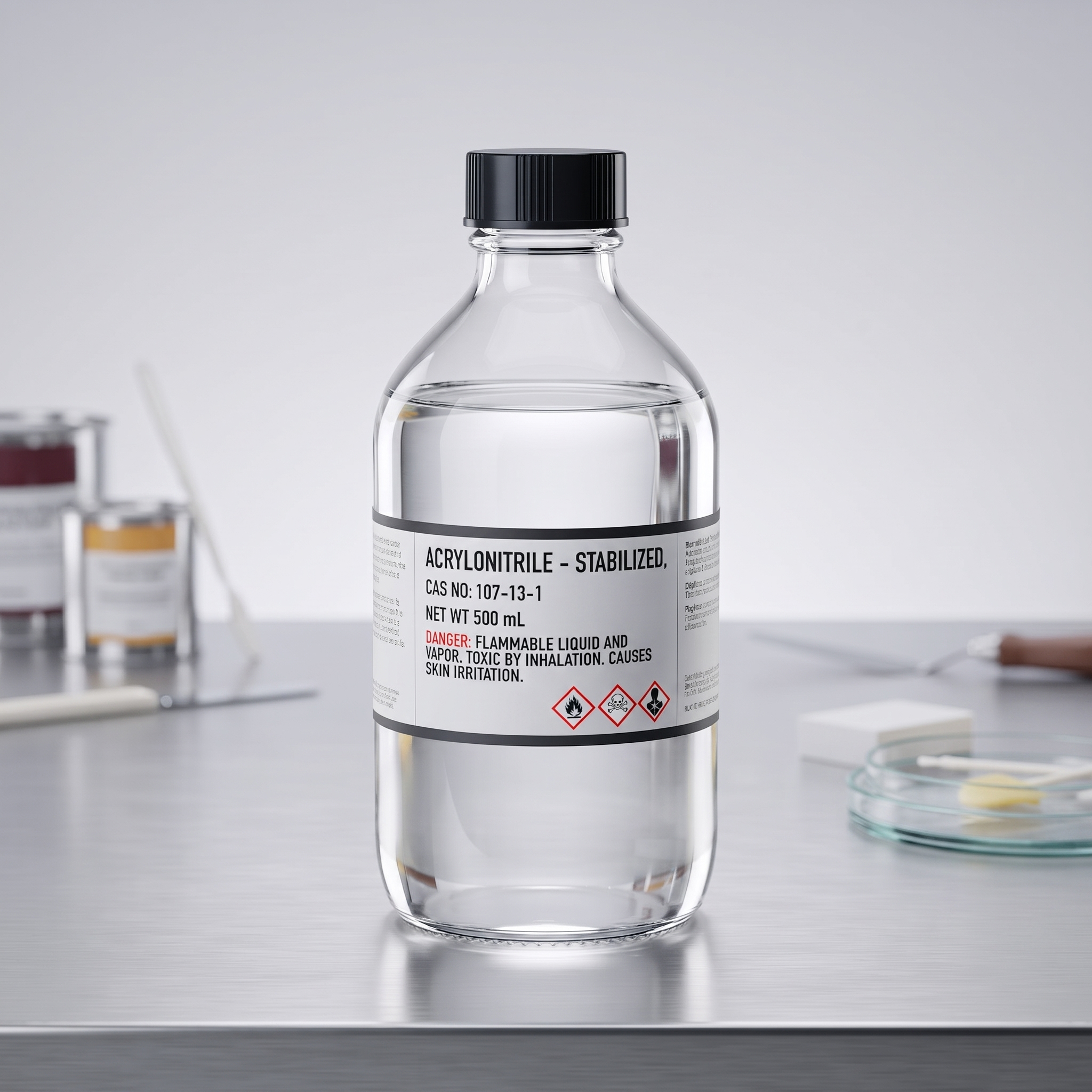
Acrylonitrile is identified by CAS 107-13-1, empirical formula C3H3N, structural formula CH2=CH-CN, relative molecular mass 53.06. In international trade, it is classified under HS heading 2926 10 000 0 as acrylonitrile. Synonyms include acrylic acid nitrile, prop-2-enenitrile, cyanoethylene, and vinyl cyanide. The substance is assigned to hazard class 2 for health effects (highly hazardous substance) and shows evidence of carcinogenic potential for humans.
Physicochemical Properties
Acrylonitrile is a colorless transparent mobile liquid with a mild odor. Density at 20 degrees Celsius is 0.805-0.807 g/cm3. Boiling point is 77.3 degrees Celsius, pour point minus 83.5 degrees Celsius. Flash point is minus 1 degree Celsius in a closed cup, autoignition temperature 481 degrees Celsius. Explosive limits in air are 3.0 percent (lower) and 17.0 percent (upper) by volume. Solubility in water is about 7.3 g per 100 ml at 20 degrees Celsius; acrylonitrile is miscible with most organic solvents. Upon storage, it tends to undergo spontaneous polymerization, so the industrial product is stabilized with ammonia, hydroquinone, or p-methoxyphenol.
Technical Grades and Supply Forms
Acrylonitrile is produced under GOST 11097-86. The standard provides for highest and first grades, differing in the mass fraction of main substance, acids, water, and hydrocyanic acid. The acrylonitrile mass fraction is at least 99.5 percent. The product is supplied in bulk in rail and road tank cars, tank containers, and steel drums. Typical bulk shipments start from one tonne.
Regulatory Framework
In the EAEU region, quality is governed by GOST 11097-86 Acrylic Acid Nitrile Technical. Specifications. The standard covers technical acrylonitrile produced by ammoxidation of propylene and stabilized with ammonia, hydroquinone, or p-methoxyphenol. Transport marking is performed under GOST 19433 indicating hazard class 3, subsidiary hazard 6.1, UN number 1093, and classification code 3221. For customs purposes, the explanatory notes to HS heading 2926 10 000 0 apply.
Mechanism of Action and Functional Role
In polymerization processes, acrylonitrile undergoes chain reactions initiated thermally, photochemically, or by chemical initiators. The double bond of the vinyl group opens, enabling the binding of monomer units into a macromolecule. The nitrile group imparts rigidity, heat resistance, and resistance to chemical attack to the polymer. In copolymerization with butadiene and styrene, acrylonitrile increases the impact strength and heat resistance of ABS plastics. In acrylic fibers, nitrile groups provide strength, shape stability, and resistance to ultraviolet radiation.
Applications by Industry
The main volume of acrylonitrile is consumed in the production of ABS plastics and styrene-acrylonitrile copolymers (SAN) for the automotive industry, electronics, and household appliances. The production of acrylic fibers (nitron) for the textile industry is the second-largest application. Nitrile rubbers (NBR) are used in the production of oil-resistant seals, hoses, and conveyor belts. Acrylonitrile also serves as feedstock for the synthesis of acrylamide, adiponitrile, and carbon fibers.
Comparison with Alternative Materials
Compared with styrene, acrylonitrile provides higher chemical resistance and heat resistance of polymers but is inferior in transparency and dielectric properties. Compared with methyl methacrylate, acrylonitrile imparts higher rigidity and oil resistance to copolymers but is inferior in weather resistance and optical clarity. In the production of impact-resistant materials, acrylonitrile in ABS plastics competes with polycarbonate compositions, being inferior to the latter in heat resistance but superior in chemical resistance and processability.
Typical Processing Errors
- Storing acrylonitrile without a stabilizer or with an expired stabilizer, leading to spontaneous polymerization in the container.
- Violating storage temperature conditions above 25 degrees Celsius or under direct sunlight, accelerating polymerization.
- Working with acrylonitrile without respiratory and skin protection, creating a risk of acute poisoning.
- Mixing acrylonitrile with oxidizers or polymerization initiators without control, which may cause an uncontrolled reaction.
- Using contaminated acrylonitrile or product with elevated polymer content in polymerization processes, reducing final product quality.
- Applying acrylonitrile in systems requiring long-term storage without stabilization, without considering its tendency to polymerize.
Quality Control and Laboratory Methods
Incoming inspection of acrylonitrile includes determination of appearance and color, density at 20 degrees Celsius, refractive index, main substance content by gas chromatography, polymer content, acid content calculated as acetic acid, water content by the Karl Fischer method, hydrocyanic acid content, and stabilizer content. For critical applications, aldehyde content and thermal stability time are controlled.
Storage and Transportation Conditions
Acrylonitrile is stored in sealed containers in ventilated warehouses at temperatures from minus 10 to plus 25 degrees Celsius, protected from direct sunlight and heat sources. The guaranteed shelf life is typically 3 to 6 months depending on conditions and stabilizer content. Acrylonitrile is classified as dangerous goods: hazard class 3, subsidiary hazard 6.1, UN number 1093, packing group I, classification code 3221. Transportation is carried out by all modes of transport in accordance with dangerous goods regulations. Road transport follows ADR requirements; sea transport follows IMDG Code.
Finding Analogues and Interchangeability
When selecting an analogue for acrylonitrile, the key criteria are main substance content, stabilizer content, polymer content, and color. For ABS and SAN production, replacing acrylonitrile with other monomers alters the properties of the final polymer and requires revision of the entire formulation and technology. For applications in acrylamide or adiponitrile synthesis, replacement is possible only through revision of catalyst systems. Direct substitution without preliminary testing is not recommended.
Supply Scheme
For industrial buyers, acrylonitrile is available worldwide through the apptrade.ru platform. Shipments can be organized from producing regions across different continents, with logistics and customs support adapted to the destination market. International sourcing allows buyers to balance cost and lead time depending on batch size and logistical distance.
Logistics and Customs Clearance
Acrylonitrile is transported by sea, rail, and road. For large batches, sea tank containers or dedicated tankers are economically viable; for medium and small volumes, drums and intermediate bulk containers are used. When imported into the EAEU, products are classified under HS heading 2926 10 000 0. As acrylonitrile is class 3 dangerous goods with subsidiary hazard 6.1, compliance with ADR packaging, marking, and documentation requirements is mandatory. The portal customs broker prepares declarations, confirms classification codes, and manages non-tariff regulation procedures.
FAQ
What is the difference between acrylonitrile and styrene?
Acrylonitrile (C3H3N) contains a nitrile group and provides polymers with higher chemical resistance and heat resistance. Styrene (C8H8) contains a vinyl group attached to a benzene ring and imparts transparency and rigidity. Both monomers are used together in ABS plastics production.
Why does acrylonitrile require stabilization?
Acrylonitrile tends to undergo spontaneous polymerization upon heating, exposure to light, and in the presence of impurities. To prevent undesirable polymerization during storage and transportation, a stabilizer, typically ammonia, hydroquinone, or p-methoxyphenol, is added to acrylonitrile.
What hazard class is assigned to acrylonitrile?
Acrylonitrile is hazard class 2 for health effects as a highly hazardous substance. For transport, it is classified as class 3 dangerous goods with subsidiary hazard 6.1, UN number 1093, packing group I.
How long can acrylonitrile be stored?
The guaranteed shelf life of acrylonitrile is typically 3 to 6 months from the date of manufacture at temperatures from minus 10 to plus 25 degrees Celsius in sealed containers. After expiry, the product must undergo laboratory testing before use.
Is special packaging required for acrylonitrile transportation?
Yes, because acrylonitrile is class 3 dangerous goods with subsidiary hazard 6.1. Hermetic tank cars, tank containers, and steel drums complying with ADR requirements for flammable toxic liquids are used. Packaging must ensure tightness and protection against leaks.
What is the difference between highest and first grade acrylonitrile?
Highest grade has stricter limits for acid content (not more than 0.0020 percent), water, and hydrocyanic acid. First grade allows acid content not more than 0.0045 percent. The difference in purity affects the quality of final polymers and the stability of the polymerization process.
Conclusion
Acrylonitrile remains a foundational monomer for the production of ABS plastics, SAN, acrylic fibers, and nitrile rubbers, determining the properties of a wide range of polymeric materials. For industrial buyers, critical factors include batch-to-batch consistency, especially stabilizer and polymer content, correct customs classification considering dangerous goods status, and compliance with storage conditions. The apptrade.ru portal organizes the full supply cycle, from grade selection for a specific process to customs clearance and delivery to the manufacturing site.
Contact Us
For procurement inquiries, technical documentation, and logistics coordination, contact the apptrade.ru team at info@apptrade.ru.