Liquid Chlorine and Derivatives
What Liquid Chlorine and Its Derivatives Are and Why They Matter
Liquid chlorine is a liquefied gas under pressure with a yellowish-green color and a pungent suffocating odor. Industrially, it is produced by electrolysis of sodium or potassium chloride solution, as well as by oxidation of hydrogen chloride. Chlorine is simultaneously a large-tonnage product and a feedstock for a wide range of inorganic and organic derivatives, including hydrochloric acid, sodium hypochlorite, sodium chlorate, chlorine dioxide and chlorinated hydrocarbons.
For procurement teams, this group is interesting because the same need for active chlorine can be met by different commercial forms. Liquefied chlorine provides maximum concentration and is used at large plants, sodium hypochlorite is convenient for local disinfection and does not require pressure vessels, and hydrochloric acid is the transportable form of hydrogen chloride used in pickling, oil recovery and synthesis. The choice of form is determined by the consumer infrastructure, safety requirements and logistics.
The key feature of the group is the high toxicity of chlorine and the corrosiveness of its derivatives. Liquefied chlorine is classified as a class 2.1 hazardous good with additional hazards 5.1 and 8, UN number 1017; hydrochloric acid and sodium hypochlorite belong to class 8. This requires specialized packaging, trained personnel and strict compliance with transport regulations.
Chemical Identification and Procurement Data
- Liquid chlorine: Cl2, CAS 7782-50-5, UN 1017, GOST 6718-93, HS code 2801100000.
- Sodium hypochlorite: NaClO, aqueous solution, GOST 11086-76, grades A and B, HS code 2828900000.
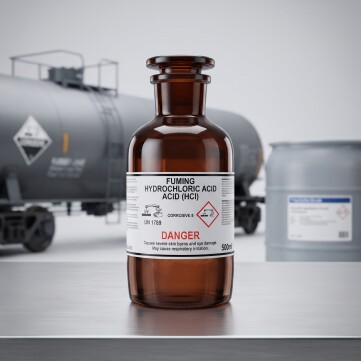
- Hydrochloric acid: HCl, aqueous solution, GOST 857-95 (technical) and GOST 3118-77 (reagent), UN 1789, HS code 2806100000.
- Sodium chlorate: NaClO3, strong oxidizer, CAS 7775-09-9, UN 1495, HS code 2829190000.
- Chlorine dioxide: ClO2, gas/solution, CAS 10049-04-4, UN 9191 (solution), HS code 2812100000.
In the Russian regulatory system, liquid chlorine is produced under GOST 6718-93, which establishes two grades with a chlorine volume fraction of at least 99.8 and 99.6 percent and standardizes water, nitrogen trichloride and non-volatile residue content. Sodium hypochlorite is regulated by GOST 11086-76, hydrochloric acid by GOST 857-95 and GOST 3118-77. For sodium chlorate and chlorine dioxide, the regulatory basis is formed by manufacturer standards and international dangerous goods transport rules.
Properties and Mechanism of Action
Chlorine is a strong oxidizer. In aqueous solutions it disproportionates to form hydrochloric and hypochlorous acids, and it is hypochlorous acid and the hypochlorite ion that provide bactericidal and bleaching action. This mechanism underlies the disinfection of drinking water, wastewater and swimming pool water, as well as the bleaching of cellulose and fabrics.
Hydrochloric acid acts as a strong monobasic acid: it dissolves oxides and metals to form chlorides and is used for pickling, acid treatment of wells and synthesis of chlorides. Sodium hypochlorite exhibits oxidizing and disinfecting properties and, when acidified, releases chlorine or chlorine dioxide depending on conditions. Sodium chlorate acts as a strong oxidizer in pyrotechnics, chlorine dioxide production and herbicides. Chlorine dioxide is a selective oxidizer and disinfectant that does not form chlorinated organic by-products in the same quantities as free chlorine.
Technical Grades and Supply Forms
Liquid Chlorine (GOST 6718-93)
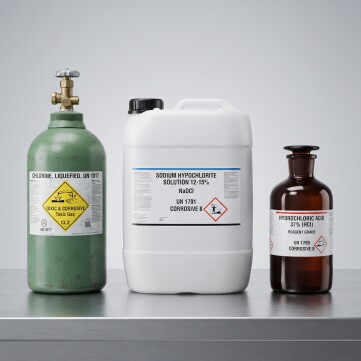
Produced in two grades. The premium grade contains at least 99.8 volume percent chlorine, the first grade at least 99.6 percent. Supplied in specialized rail tank cars, containers and cylinders under pressure. Transport packaging is painted in a protective color and marked with the inscriptions Chlorine, Poisonous, Liquefied Gas.
Sodium Hypochlorite (GOST 11086-76)
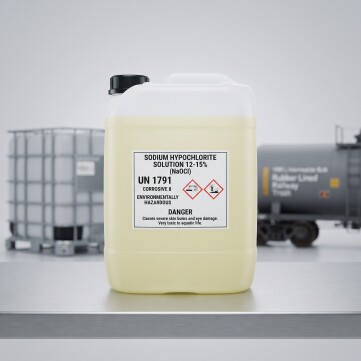
Grade A is used for disinfection of drinking water, swimming pool water, disinfection and bleaching; grade B is used in the vitamin industry as an oxidizer and for fabric bleaching. Supplied in polyethylene canisters, drums and containers, as well as in bulk in tank cars.
Hydrochloric Acid (GOST 857-95)
Technical synthetic acid of grades A and B is supplied in rubber-lined rail tank cars, rubber-lined containers, polyethylene drums and glass carboys. Reagent acid per GOST 3118-77 is supplied in glass packaging.
Packaging, Containers and Labeling
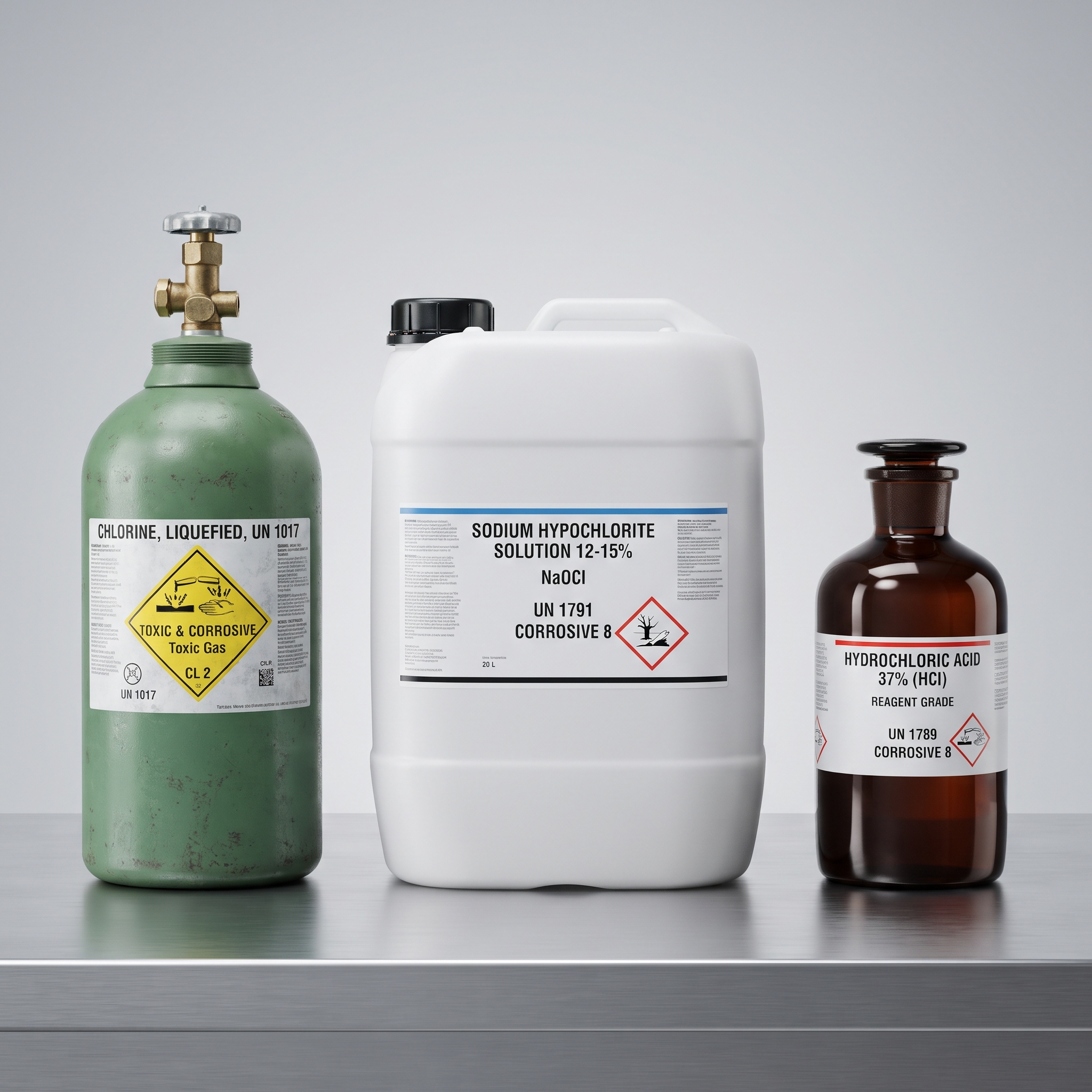
Liquefied chlorine is transported only in vessels rated for working pressure, with mandatory safety devices. Small-volume cylinders are packed in wooden crates. The outer surface of tank cars and containers is painted in a protective color and bears distinctive stripes and the inscriptions Chlorine, Poisonous, Liquefied Gas in green paint.
Sodium hypochlorite is packed in polyethylene packaging resistant to alkaline media and the oxidizer. Hydrochloric acid requires rubber-lined or polymer packaging; glass carboys are packed in crates. All packaging is marked with hazard labels: for chlorine, label 2.1 with additional labels 5.1 and 8; for acid and hypochlorite, label 8.
Regulatory Framework for Incoming Inspection
- GOST 6718-93 - liquid chlorine. Specifications.
- GOST 11086-76 - sodium hypochlorite. Specifications.
- GOST 857-95 - synthetic technical hydrochloric acid. Specifications.
- GOST 3118-77 - reagents. Hydrochloric acid. Specifications.
- GOST 19433 - classification and labeling of dangerous goods.
- GOST 30333-2022 - safety data sheet for chemical products.
- Federal norms and rules in the field of industrial safety for chlorine production, storage, transport and use.
For imported batches, the specification is based on manufacturer standards and international rules (IMDG, RID, ADR), taking into account labeling and packaging compatibility requirements. The batch specification is confirmed by the manufacturer certificate of quality and the results of incoming laboratory control by the recipient.
Mechanism of Action and Functional Role
Chlorine is a strong oxidizer that reacts with water to form hydrochloric and hypochlorous acids, the latter providing the biocidal effect. In water treatment, chlorine and hypochlorite destroy the cell walls of bacteria and viruses, ensuring disinfection. In bleaching, hypochlorous acid oxidizes the chromophore groups of lignin and other colored compounds, lightening the material.
Hydrochloric acid dissolves oxides and scale from metal surfaces, preparing them for further processing, and reacts with carbonates in oil reservoirs to increase permeability. Sodium chlorate and chlorine dioxide act as selective oxidizers in bleaching and disinfection, with chlorine dioxide reducing the formation of chlorinated organic by-products.
Applications by Industry
Water Treatment and Disinfection
Chlorine and sodium hypochlorite are used for disinfection of drinking water, wastewater, swimming pool water, as well as for disinfection in the food industry and medicine. Chlorine dioxide is used for water treatment and food processing.
Chemical Synthesis
Chlorine serves as a feedstock for hydrochloric acid, metal chlorides, chlorinated hydrocarbons, sodium chlorate and chlorine dioxide. Hydrochloric acid is used in the synthesis of chlorides, dyes, coagulants and pharmaceutical substances.
Pulp and Paper and Textile Industry
Sodium hypochlorite and chlorine are used for bleaching cellulose, paper and fabrics. Sodium chlorate is used in chlorine dioxide production for bleaching without the formation of chlorinated organic compounds.
Metallurgy and Oil Recovery
Hydrochloric acid is used for metal pickling and acid treatment of oil and gas wells. Chlorine is used in pyrometallurgy of titanium, zirconium and other metals.
Pyrotechnics and Specialty Applications
Sodium chlorate acts as an oxidizer in pyrotechnic compositions and herbicides. Chlorine dioxide is used for gas sterilization of medical equipment and air purification.
Comparison of Commercial Forms
Liquefied chlorine provides the maximum concentration of active substance per unit mass and minimal transport costs but requires pressure vessels and the strictest safety measures. Sodium hypochlorite is inferior in concentration but does not require pressure, is easier to dose and safer in local use; its main limitation is relatively low storage stability. Hydrochloric acid covers the need for hydrogen chloride and chloride ions but is not a source of active chlorine for disinfection. Chlorine dioxide surpasses free chlorine in selectivity and the absence of trihalomethane formation but requires on-site generation or special stabilized solutions.
Supplier Selection Criteria and Specification Development
The specification must include the commercial form, grade or sort, mass or volume fraction of the main substance, normative document, packaging requirements and transport conditions. For liquefied chlorine, the vessel volume, working pressure and safety device requirements are additionally specified; for sodium hypochlorite, the active chlorine concentration and stability; for hydrochloric acid, the grade, sort and limits for iron and chlorides.
The supplier confirms quality consistency, a valid safety data sheet under GOST 30333-2022, readiness to provide packaging approved for the given product and to organize transport in compliance with dangerous goods transport rules. For imported batches, labeling and actual parameters are verified.
Typical Processing, Storage and Logistics Errors
- Use of incompatible packaging. Chlorine requires steel pressure vessels; sodium hypochlorite must not be stored in uncoated metal containers; hydrochloric acid requires rubber-lined or polymer tanks.
- Violation of sealing and ventilation. A chlorine leak creates a hazardous airborne concentration; storage and transfer must be carried out in closed systems with emergency ventilation.
- Co-storage with incompatible substances. Chlorine and hypochlorite must not be stored with acids, reducing agents and organic materials; hydrochloric acid with alkalis and oxidizers.
- Overheating of chlorine packaging. A temperature increase raises pressure and the risk of vessel rupture.
- Neglecting personal protective equipment. Chlorine and its derivatives cause chemical burns and respiratory damage; work is performed with filtering respirators, protective goggles, acid-resistant gloves and protective clothing.
- Use of sodium hypochlorite beyond its shelf life. Active chlorine decomposes and the product loses its disinfecting properties.
Quality Control and Laboratory Methods
For liquid chlorine, the chlorine volume fraction, water, nitrogen trichloride and non-volatile residue mass fractions are determined. For sodium hypochlorite, the active chlorine mass fraction, density and pH are controlled; for hydrochloric acid, the HCl mass fraction, iron, calcination residue and free chlorine. Sampling is performed in sealed containers with observance of safety measures; the combined sample is analyzed in the plant laboratory.
Storage and Transportation Conditions
Liquefied chlorine is stored in steel pressure vessels in closed, well-ventilated areas equipped with gas analyzers and neutralization equipment. Transportation is carried out in specialized tank cars, containers and cylinders in compliance with dangerous goods transport rules.
Sodium hypochlorite is stored in closed polyethylene packaging at temperatures from minus 10 to plus 30 degrees Celsius, protected from light and heat. Hydrochloric acid is stored in rubber-lined or polymer tanks with ventilation. For all products, contact with acids, reducing agents and organic materials is excluded.
Finding Analogues and Interchangeability
When replacing liquefied chlorine with sodium hypochlorite or chlorine dioxide, the disinfection and dosing technology must be revised; for large plants such replacement is often economically impractical. Replacing sodium hypochlorite with chlorine is possible if liquefied gas infrastructure is available but requires higher safety measures. Hydrochloric acid in pickling processes can be partially replaced by sulfuric acid, but this changes the reaction rate and surface quality. The decision is based on laboratory and pilot-scale testing.
Supply Routes: Russia, China and Other Regions
Domestic supply of chlorine and its derivatives is provided by chemical complexes with electrolysis capacity. Products are supplied to the domestic market and for export.
Chinese producers have large capacities for chlorine, hypochlorite and hydrochloric acid. Supplies are delivered by sea with subsequent transfer to rail or road transport in compliance with dangerous goods requirements. Other global producers are located in the Middle East, Southeast Asia and Europe. Suppliers from these regions are engaged when required, taking into account logistical and regulatory factors.
Logistics and Customs Clearance
Transport of liquefied chlorine is carried out in specialized tank cars and cylinders, sodium hypochlorite and hydrochloric acid in tank cars, containers and drums. Customs clearance includes HS code classification, preparation of a safety data sheet under GOST 30333-2022, conformity declaration and compliance with dangerous goods labeling requirements. The portal provides customs broker services and supports all clearance stages.
Risk Factors and Safety Measures
The main risks are associated with chlorine toxicity, its ability to cause respiratory damage and pulmonary edema, and the corrosive effects of its derivatives. Chlorine belongs to hazard class 2 substances; work is performed in ventilated rooms with filtering respirators, protective goggles and protective clothing. In case of a leak, the area is cordoned off, vapors are suppressed with a water curtain, and discharge of chlorine into sewers and water bodies is not permitted.
FAQ: Common Questions from Procurement and Process Specialists
What makes liquid chlorine hazardous
Liquid chlorine is toxic by inhalation, causes chemical burns to skin and eyes, and at high concentrations can cause pulmonary edema. It is classified as a class 2.1 hazardous good with additional labels 5.1 and 8 and requires specialized packaging and safety measures.
Which packaging is used for sodium hypochlorite
Sodium hypochlorite is stored and transported in polyethylene canisters, drums and containers, as well as in bulk in tank cars. Uncoated metal packaging is unsuitable due to corrosion.
Can liquefied chlorine be replaced with sodium hypochlorite
Yes, for many disinfection and water treatment tasks, but dosing and technology must be revised. For large-tonnage plants, replacement is often economically impractical.
What hazard labels are applied to chlorine packaging
Hazard label 2.1 (flammable gas), additional labels 5.1 (oxidizer) and 8 (corrosive), as well as the inscriptions Chlorine, Poisonous, Liquefied Gas.
What documents are required for chlorine import
Import requires a contract, invoice, packing list, safety data sheet under GOST 30333-2022, manufacturer certificate of quality, transport documents and a declaration of conformity. For dangerous goods, transport permits and compliance with carriage rules are additionally confirmed.
Conclusion
Liquid chlorine and its derivatives remain indispensable products of chlorine chemistry, enabling water treatment, disinfection, bleaching and large-scale synthesis. The choice between liquefied chlorine, sodium hypochlorite, hydrochloric acid and chlorine dioxide is determined by the consumer infrastructure, safety requirements and logistics. For procurement teams, the practical task reduces to correct selection of commercial form and grade, confirmation of batch conformity to the standard, and organization of supplies in compliance with dangerous goods transport rules, packaging requirements and safety measures.
Contact Us
For procurement inquiries and supply chain organization, contact the portal team at info@apptrade.ru.