















Technical Sulfur
What Technical Sulfur Is and Why It Remains a Base Feedstock for Sulfuric Acid and Rubber
Technical sulfur (S) is a yellow crystalline solid produced from natural sulfur and polymetallic ores, as well as from the purification of natural, coke and petroleum gases. Its atomic mass is 32.06, and the molecule in vapors and melts is predominantly eight-atomic (S8) with a molecular mass of 256.5. The density of the alpha modification is about 2.07 g/cm3, of the beta modification about 1.96 g/cm3, the melting point is 112.8 degrees Celsius for alpha-sulfur and 119.3 degrees Celsius for beta-sulfur, and the boiling point is 444.6 degrees Celsius.
For procurement teams, technical sulfur matters primarily as a large-tonnage feedstock for sulfuric acid production, which accounts for the bulk of global sulfur consumption. The second major direction is phosphate and complex fertilizer production, where sulfur is used to decompose phosphate raw materials. In the rubber and tire industry, sulfur acts as a vulcanizing agent, and in the pulp and paper industry it is a reagent for cellulose cooking. Additionally, sulfur is used in the production of dyes, carbon disulfide, in agriculture as a fertilizer component and for pest control.
The key feature of technical sulfur that determines the entire supply chain is its combustibility and ability to form explosive dust-air mixtures. The product is classified as a class 4.1 dangerous good (flammable solids), UN number 1350, packing group III. Sulfur dust is explosive, the lower explosive limit is 17 grams per cubic meter, and the auto-ignition temperature is 190 degrees Celsius. This requires sealed packaging, protection from moisture, static electricity and strict compliance with transport regulations.
Chemical Identification and Procurement Data
- Chemical name: technical sulfur, elemental sulfur.
- Chemical formula: S (S8).
- Molar mass: 32.06 g/mol (atomic); 256.5 g/mol (S8).
- CAS number: 7704-34-9.
- UN number: 1350 (sulfur).
- Hazard class: 4.1 (flammable solids), packing group III.
- HS code: 2503000000 for sulfur of all kinds, other than sublimed, precipitated and colloidal.
- Commercial form: liquid (molten) — brown liquid; lump — yellow pieces of various sizes and shapes; granular — yellow granules of spherical, hemispherical and other shapes; ground — yellow powder.
In the Russian regulatory system, GOST 127-2018 (formerly GOST 127.1-93) applies to technical sulfur, covering technical gas and natural sulfur and establishing requirements for liquid, lump, granular and ground forms. The standard provides for grades 9998, 9995, 9990, 9950 and 9920, where the first two digits indicate the guaranteed sulfur content in tenths of a percent (for example, grade 9998 — not less than 99.98 percent, grade 9920 — not less than 99.20 percent). For granular sulfur, granulometric composition and granule strength are additionally standardized. The supplier confirms batch conformity to the applicable standard and provides a certificate of quality with actual values for each parameter.
Quality Parameters Relevant to Processing
For liquid sulfur per GOST 127-2018, the standardized parameters include the sulfur mass fraction (not less than 99.98 percent for premium and 99.98 percent for first grade), ash mass fraction (not more than 0.008 and 0.010 percent), organic matter mass fraction (not more than 0.004 and 0.008 percent), and acid mass fraction calculated as sulfuric acid (not more than 0.0010 and 0.0015 percent). Appearance — brown liquid without mechanical contaminants.
For lump sulfur, the premium grade contains at least 99.98 percent sulfur and not more than 0.009 percent ash; the first grade — at least 99.92 percent sulfur and not more than 0.050 percent ash; the second grade — at least 99.20 percent sulfur and not more than 0.300 percent ash. Water mass fraction is not more than 0.5 percent for premium, 1.0 percent for first and 3.0 percent for second grade.
For granular sulfur, the premium grade contains at least 99.98 percent sulfur, the first — at least 99.92 percent, the second — at least 99.20 percent. The mass fraction of granules sized 2.0-7.0 mm for premium is at least 90 percent, for first grade the 1.0-10.0 mm fraction is allowed at not less than 90 percent. Bulk density of granules is 1.1-1.3 g/cm3, ensuring good flowability and dosing convenience.
For the processor, sulfur, ash and moisture content are critical. Increased ash content reduces sulfuric acid quality and requires additional purification, while moisture in lump and granular sulfur leads to caking and handling losses. For liquid sulfur, hydrogen sulfide content is important because it is released during storage and is explosive at concentrations from 4.3 to 46 volume percent.
Technical Forms and Grades
Liquid (Molten) Sulfur
The most economical form for large consumers located at a short transport distance. It is stored and pumped at 130-140 degrees Celsius, at which the melt viscosity is minimal (about 7.4 cP). At 119 degrees Celsius sulfur solidifies, and at 160 degrees Celsius it becomes extremely viscous, requiring precise temperature control. Supplied in heated rail tank cars and tank containers. Grades 9998 and 9995.
Granular Sulfur
The main export format. Low dusting, ease of handling and storage, stability during long-distance transport. Produced by forming the melt into spherical or hemispherical granules. Grades 9998, 9995, 9990, 9950, 9920. Supplied in bulk, big bags and bags.
Lump Sulfur
Produced by crushing solidified sulfur blocks. Cheaper than granular but generates more dust and handling losses. Grades 9998, 9995, 9990, 9950, 9920. Stored under a canopy or on open platforms, supplied in bulk.
Ground Sulfur
Yellow powder used in the tire and rubber industry, as well as in agriculture for dusting. Packed in five- or six-ply bituminized bags per GOST 2226 with a mass of 40 plus or minus 1 kg.
Supply is in 25 or 50 kg bags, 1000-1250 kg big bags, in bulk in gondola cars and vessels, and liquid sulfur in heated tank cars. For export batches, bulk shipment is carried out on Handymax and Panamax vessels of 25,000-60,000 tonnes.
Packaging, Containers and Labeling
Technical sulfur is a class 4.1 dangerous good, so packaging must provide sealing, protection from moisture and static electricity. Polypropylene bags with a polyethylene liner, multi-wall paper bags, and big bags with an inner polyethylene liner are used.
Transport Marking
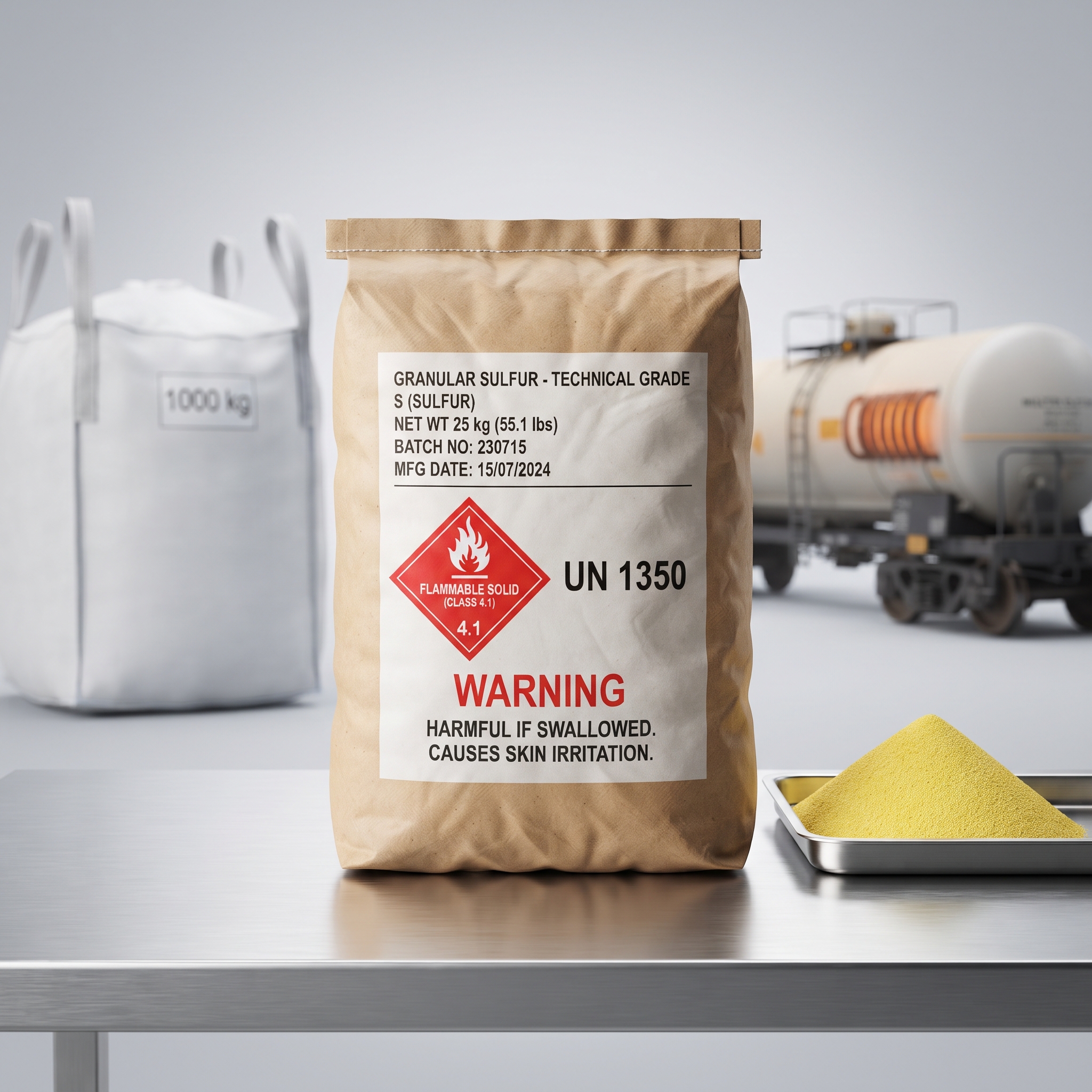
Transport marking is applied per GOST 14192 with the Keep Dry handling symbol. The class 4.1 hazard label (flame) and UN number 1350 are mandatory. Under GHS, sulfur may be labeled with the GHS02 (flame) and GHS07 (exclamation mark) pictograms and the signal word Warning because dust irritates the respiratory tract and skin. Marking must contain the manufacturer name, product name, form (liquid, granular, lump, ground), grade, batch number and date of manufacture, standard designation.
Storage Conditions
Lump sulfur is stored under a canopy or on open platforms, granular and ground sulfur in closed warehouses. Warehouses must be equipped with natural ventilation and protected from ignition sources. The shelf life is 1 year from the date of shipment or manufacture.
Regulatory Framework for Incoming Inspection
- GOST 127-2018 - technical sulfur. Specifications. Establishes requirements for forms and grades, analytical methods and acceptance rules.
- GOST 127.1-93 - technical sulfur. Specifications (predecessor standard often referenced in contracts).
- GOST R 56249-2014 - technical gas sulfur. Specifications (for gas sulfur).
- GOST 12.1.007-76 - classification of hazardous substances. Sulfur belongs to hazard class 4.
- GOST 12.1.005-88 - maximum permissible concentration of sulfur dust in the working area air is 6 mg/m3.
- GOST 19433-88 - classification and labeling of dangerous goods; class 4.1, UN 1350.
- GOST 30333-2022 - safety data sheet for chemical products.
For imported batches, the specification is based on manufacturer standards and international dangerous goods transport rules (IMDG, RID, ADR). The batch specification is confirmed by the manufacturer certificate of quality and the results of incoming laboratory control by the recipient.
Mechanism of Action and Functional Role
In sulfuric acid production, sulfur is burned in air to form sulfur dioxide, which is then catalytically oxidized to sulfur trioxide and absorbed in water or sulfuric acid. This process produces most of the world sulfuric acid. In phosphate fertilizer production, sulfur is used to produce sulfuric acid, which decomposes phosphate raw materials.
In the rubber industry, sulfur acts as a vulcanizing agent: on heating, it reacts with the double bonds of the rubber, forming crosslinks that give the rubber strength, elasticity and heat resistance. In the pulp and paper industry, sulfur in the kraft cooking liquor participates in wood delignification.
In agriculture, sulfur is used as a component of sulfur-containing fertilizers and for pest control, as well as for soil amendment. In chemical synthesis, sulfur serves as a feedstock for carbon disulfide, dyes and various sulfur-containing compounds.
Applications by Industry
Sulfuric Acid Production
The largest consumption direction, accounting for the bulk of global sulfur demand. Sulfur is burned to produce sulfur dioxide, which is then processed into sulfuric acid.
Fertilizer Production
Sulfur is used to produce sulfuric acid, which is used to decompose phosphate raw materials, and as a component of sulfur-containing fertilizers for sulfur-deficient crops.
Rubber and Tire Industry
Sulfur is a vulcanizing agent in the production of tires, conveyor belts, hoses and other rubber goods. Ground sulfur is specifically intended for the tire and rubber industry.
Pulp and Paper Industry
Sulfur is used in the kraft pulping process, providing wood delignification and strong fiber production.
Agriculture
Sulfur is used as a fertilizer component, for pest and disease control, and for improving soil properties.
Other Industries
Production of dyes, carbon disulfide, matches, pyrotechnic compositions, as well as use in metallurgy and oil refining.
Comparison of Forms and Grades
Compared with lump sulfur, granular sulfur provides lower dusting, better flowability and ease of mechanized handling, making it preferable for export shipments and long-term storage. Lump sulfur is cheaper but requires more careful handling due to dust generation and handling losses. Liquid sulfur is economically viable only when the consumer has heated infrastructure and is located at a short transport distance, since it requires maintaining a temperature of 130-140 degrees Celsius.
Among grades, sulfur 9998 is the purest product with minimal ash and organic matter content and is used in demanding chemical productions. Grades 9995 and 9990 are used in most standard processes, while grades 9950 and 9920 are used in less demanding productions, including certain fertilizers and building materials.
Supplier Selection Criteria and Specification Development
The specification for technical sulfur must include the form (liquid, granular, lump, ground), grade (9998, 9995, 9990, 9950, 9920), sulfur, ash, organic matter, acid and water mass fractions, as well as granulometric composition for granular sulfur and packaging requirements (bags, big bags, bulk, heated tank cars). For liquid sulfur, hydrogen sulfide content and transport temperature regime are additionally specified.
The supplier confirms batch-to-batch quality consistency, a valid safety data sheet under GOST 30333-2022, readiness to provide packaging that protects against moisture and static electricity, and to organize transport in compliance with class 4.1 dangerous goods rules. For imported batches, it is important to verify labeling and actual parameters, as well as the cleanliness of holds before bulk loading.
Typical Processing, Storage and Logistics Errors
- Violation of the liquid sulfur temperature regime. Below 119 degrees Celsius sulfur solidifies in pipelines and tank cars, while above 160 degrees Celsius viscosity increases sharply. A temperature of 130-140 degrees Celsius must be maintained.
- Hydrogen sulfide accumulation. Liquid sulfur releases hydrogen sulfide, which is explosive at concentrations from 4.3 to 46 volume percent. Ventilation and gas phase monitoring in tanks are required.
- Dusting and static electricity. Sulfur dust is explosive and can accumulate static charge. Equipment grounding, explosion-proof lighting and aspiration systems are required.
- Co-storage with oxidizers and organic substances. Sulfur reacts with strong oxidizers with heat and toxic gas release. Co-storage is not permitted.
- Moistening of granular and lump sulfur. Moisture leads to caking and handling losses. Packaging must be sealed and warehouses dry.
- Labeling errors. Absence of the 4.1 hazard label or UN 1350 number violates transport rules and may lead to cargo delays.
Quality Control and Laboratory Methods
Incoming inspection of sulfur includes determination of the sulfur mass fraction (titration or gravimetry), ash (gravimetry), organic matter (extraction), acids calculated as sulfuric acid (titration) and water (drying). For granular sulfur, granulometric composition (sieve analysis) and granule strength are additionally controlled. Sampling is performed by standardized methods; the combined sample is analyzed in the plant laboratory.
When changing supplier or batch for critical processes (sulfuric acid production, rubber goods), a control run of the target product is recommended to confirm compatibility with the process.
Storage and Transportation Conditions
Technical sulfur is classified as a class 4.1 dangerous good, UN number 1350, packing group III. Storage is carried out in closed warehouses or under a canopy protecting the product from atmospheric precipitation and groundwater. Warehouses must be equipped with natural ventilation, protected from ignition sources and equipped with firefighting equipment (sand, fine water spray, air-mechanical foam). The shelf life is 1 year.
Transportation is by rail, road and sea. Granular and lump sulfur is transported in bulk in gondola cars, big bags and bags. Liquid sulfur in heated rail tank cars and tank containers at 130-140 degrees Celsius. Sea transport uses specialized vessels and containers complying with IMDG requirements.
Finding Analogues and Interchangeability
When replacing sulfur, a product of the same form and grade with similar sulfur, ash and moisture parameters is selected. Replacing granular sulfur with lump sulfur is possible in processes where increased dusting is acceptable, but requires adjustment of loading and aspiration systems. Replacing grade 9998 with a lower grade is possible only in processes where ash and organic impurities do not affect target product quality, with confirmation of final product properties.
In sulfuric acid production, sulfur can be partially replaced by other sulfur dioxide sources (for example, metallurgical off-gases), but this requires process revision and is often economically impractical. In the rubber industry, sulfur remains the main vulcanizing agent, and its replacement with peroxides or other systems is possible only with reformulation and changes in rubber properties.
Supply Routes: Russia, China and Other Regions
Domestic supply is provided by gas processing and petrochemical complexes with technical and natural sulfur production capacity. Products are supplied to the domestic market and for export. Shipment is by rail in gondola cars and heated tank cars, and by sea through ports.
China is a large producer and consumer of sulfur. Supplies are delivered by sea with subsequent transfer to rail or road transport. Granular sulfur is shipped in big bags and bulk. Other global producers are located in the Middle East, North Africa, Europe and North America. Suppliers from these regions are engaged when required, taking into account logistical and regulatory factors.
Logistics and Customs Clearance
Transportation of sulfur is carried out in accordance with class 4.1 dangerous goods rules. Customs clearance includes classification under HS code 2503000000, preparation of a safety data sheet under GOST 30333-2022, conformity declaration and compliance with dangerous goods labeling requirements. For imported batches, permits and vehicle cleanliness before loading are additionally verified. The portal provides customs broker services and supports all clearance stages.
Risk Factors and Safety Measures
The main risks are associated with sulfur combustibility, explosiveness of its dust and release of toxic gases (sulfur dioxide, hydrogen sulfide) during combustion and storage. Sulfur belongs to hazard class 4 per GOST 12.1.007-76; the maximum permissible concentration of dust in the working area air is 6 mg/m3, sulfur dioxide — 10 mg/m3, hydrogen sulfide — 10 mg/m3. Dust irritates the mucous membranes of the eyes and respiratory tract, and prolonged contact causes dermatitis.
Work is performed in ventilated rooms with filtering respirators, protective goggles and gloves. Equipment must be grounded to prevent static electricity accumulation. In case of fire, sulfur is extinguished with sand, fine water spray or air-mechanical foam; compact water jets are not permitted as they can cause splashing of molten sulfur. In case of a liquid sulfur spill, the spill area is covered with non-combustible adsorbents and bunded, and the surface soil layer with sulfur is cut off and disposed of.
FAQ: Common Questions from Procurement and Process Specialists
How does granular sulfur differ from lump sulfur
Granular sulfur has spherical or hemispherical granules, dusts less, has better flowability and is convenient for mechanized handling and long-term storage. Lump sulfur is produced by crushing blocks, is cheaper, but generates more dust and handling losses. Granular sulfur is preferred for export shipments and use in automated loading systems.
Which sulfur form is suitable for sulfuric acid production
All sulfur forms can be used for sulfuric acid production: liquid, granular, lump and ground. The choice is determined by the plant infrastructure: with heated tanks and a short transport distance, liquid sulfur is economically advantageous; for remote consumers and export shipments, granular or lump sulfur is preferred.
At what temperature is liquid sulfur stored
Liquid sulfur is stored and pumped at 130-140 degrees Celsius. At 119 degrees Celsius it solidifies, and at 160 degrees Celsius it becomes extremely viscous. Precise temperature control is mandatory to prevent solidification in pipelines and tank cars.
Is sulfur a dangerous good
Yes, sulfur is classified as a class 4.1 dangerous good (flammable solids), UN number 1350, packing group III. It requires special labeling with the 4.1 hazard label, compliance with transport rules and fire safety measures. Sulfur dust is explosive.
What documents are required for sulfur import
Import requires a contract, invoice, packing list, safety data sheet under GOST 30333-2022 in Russian, manufacturer certificate of quality, transport documents and a declaration of conformity. For dangerous goods, transport permits and compliance with carriage rules are additionally confirmed. The portal organizes the preparation of the document set and interaction with the customs broker.
Conclusion
Technical sulfur remains an indispensable large-tonnage feedstock for sulfuric acid, fertilizers, rubber and cellulose production. GOST 127 establishes four commercial forms and grades from 9998 to 9920, enabling selection of the product for a specific process. For procurement teams, the practical task reduces to correct form and grade selection, confirmation of batch conformity to the standard, and organization of supplies in compliance with class 4.1 dangerous goods transport rules, the temperature regime for liquid sulfur, and fire safety measures when handling dust.
Contact Us
For procurement inquiries and supply chain organization, contact the portal team at info@apptrade.ru.