Silica Gel and Zeolites
What Silica Gel and Zeolites Are and Why They Remain Critical Industrial Adsorbents
Silica gel and synthetic zeolites are two classes of porous inorganic materials widely used in industry for adsorption, drying and separation of gases and liquids. Silica gel (xSiO2·nH2O) is a dried gel of silicic acid with a highly developed internal surface, produced by reacting sodium silicate solution with sulfuric acid or aluminum sulfate followed by washing and drying. Zeolites are crystalline aluminosilicates with a regular microporous structure that provides selective adsorption based on molecular size.
For procurement teams, this group matters primarily as a consumable for continuous processes in the oil and gas, petrochemical and chemical industries. Silica gel is used for drying and purifying air and other gases, drying and clarifying liquids, and as a catalyst carrier. Zeolites of types NaA (4A), NaX (13X) and CaA (5A) are used for deep gas drying, removal of mercaptans and hydrogen sulfide, gas separation in pressure swing adsorption (PSA) processes and as active catalyst components.
The key feature of this group is the difference in adsorption mechanisms: silica gel has hydrophilic properties and effectively absorbs moisture, while zeolites, due to their regular pore structure, are capable of selectively separating molecules by size and polarity. The products are not classified as dangerous goods for transport, and no UN number is assigned, which simplifies logistics. However, dust from both materials irritates the respiratory tract, and hygroscopicity requires moisture protection during storage.
Chemical Identification and Procurement Data
- Silica gel: amorphous SiO2, CAS 7631-86-9, GOST 3956-76, HS code 2811220000.
- Synthetic zeolites: sodium or calcium aluminosilicates, CAS 1318-02-1 (general designation for zeolites), TU for specific types, HS code 2842100000.
- Commercial form: silica gel as white or slightly yellowish granules or lumps; zeolites as extrudates (cylindrical pellets) or spherical beads of white or beige color.
- UN number: not assigned; the products are not classified as dangerous goods for transport.
In the Russian regulatory system, technical silica gel is produced under GOST 3956-76, which establishes grades depending on grain shape (granular and lump) and porosity (fine-pore and coarse-pore). Synthetic zeolites of types NaA, NaX and CaA are governed by technical specifications, in particular TU 2163-003-15285215-2006 for NaA-U, TU 2163-077-05766575-99 for NaX and TU 2163-004-05766557-97 for CaA-U. The supplier confirms batch conformity to the applicable normative document and provides a certificate of quality with actual values for each parameter.
Quality Parameters Relevant to Processing
For silica gel per GOST 3956-76, the key parameters are bulk density (typically 400-800 g/dm3 depending on grade), moisture mass fraction, water adsorption capacity and mechanical attrition strength. For zeolites, the standardized parameters include dynamic water vapor capacity (for CaA not less than 120-130 mg/cm3, for NaA not less than 220 mg/g), mechanical crushing strength (for CaA 2.0-2.5 kg per pellet, for NaA and NaX within the limits established by TU), bulk density (0.64-0.80 g/cm3) and zeolite crystalline phase content (not less than 75-80 percent).
For the processor, dynamic capacity and pellet strength are critical. Low dynamic capacity leads to frequent regeneration cycles and increased adsorbent consumption, while insufficient strength causes pellet breakdown, dusting and increased bed pressure drop. Bulk density determines vessel loading and pressure drop.
Technical Grades and Supply Forms
Technical Silica Gel (GOST 3956-76)
Granular fine-pore silica gel is produced in grades KSMG (coarse) and ShSMG (charge). Granular coarse-pore - grades KSKG (coarse), ShSKG (charge), MSKG (fine) and ASKG (activated). Lump fine-pore - grades KSMK, ShSMK, MSMK and ASMK. For gas drying and liquid purification, coarse-pore grades KSKG and MSKG are most in demand, providing high capacity and stability in regeneration cycles.
Synthetic Zeolites (NaA, NaX, CaA)
NaA (4A) zeolite has a pore diameter of 0.4 nm and is used for drying gases and liquids and removing moisture and polar molecules. NaX (13X) zeolite with a pore diameter of 0.8-0.9 nm is used for removing mercaptans, hydrogen sulfide and carbon dioxide, as well as for gas separation in PSA processes. CaA (5A) zeolite with a pore diameter of 0.59 nm provides deep drying and separation of normal-structure hydrocarbons. Supply is in the form of extrudates or spherical beads in 25-50 kg bags, 500-1000 kg big bags, as well as steel drums for special conditions.
Packaging, Containers and Labeling
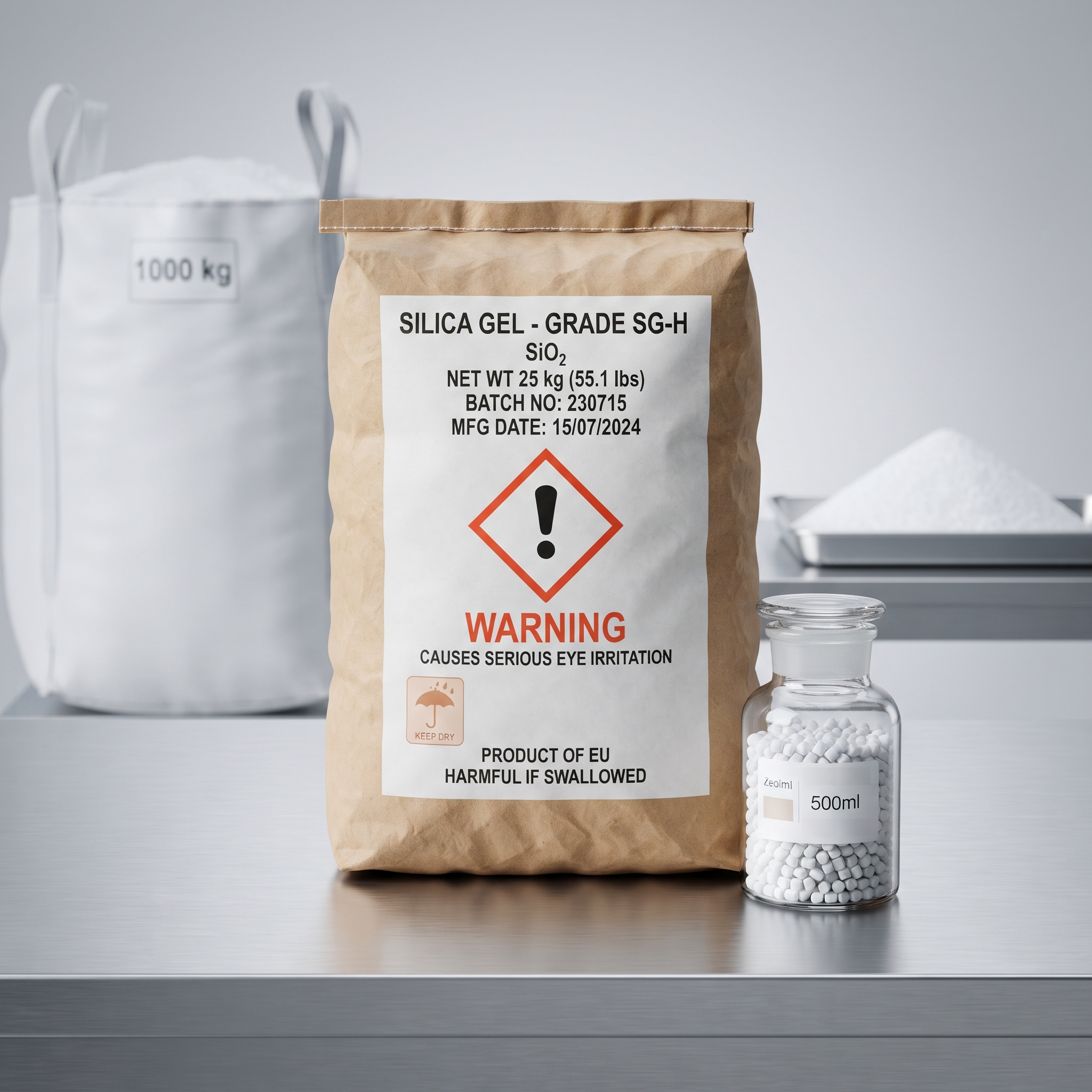
Silica gel and zeolites are not dangerous goods, so packaging must provide moisture protection (the materials are hygroscopic) and mechanical strength. Multi-wall paper or polypropylene bags with a polyethylene liner, as well as big bags made of polypropylene fabric with an inner polyethylene layer, are used. For small batches, sealed polyethylene pails or jars are used.
Transport Marking
Transport marking is applied per GOST 14192 with the Keep Dry handling symbol. Since the products are not classified as dangerous goods, transport hazard labels are not applied. Under GHS, the materials may be labeled with the GHS07 exclamation mark pictogram and the signal word Warning because dust causes irritation of the respiratory tract and mucous membranes. Marking must contain the manufacturer name, product type, grade, batch number and date of manufacture, standard or TU designation.
Regulatory Framework for Incoming Inspection
- GOST 3956-76 - technical silica gel. Specifications.
- TU 2163-003-15285215-2006 - NaA-U molded zeolite.
- TU 2163-077-05766575-99 - synthetic NaX type zeolites.
- TU 2163-004-05766557-97 - CaA-U molded zeolite.
- GOST 12.1.007-76 - classification of hazardous substances. Dust of silica gel and zeolites belongs to moderately hazardous substances.
- GOST 14192 - cargo marking.
- GOST 30333-2022 - safety data sheet for chemical products.
For imported batches, the specification is based on manufacturer standards and harmonized methods. The batch specification is confirmed by the manufacturer certificate of quality and the results of incoming laboratory control by the recipient.
Mechanism of Action and Functional Role
Silica gel acts as a hydrophilic adsorbent: its developed surface (specific surface area 400-770 m2/g) ensures effective absorption of water vapor and other polar molecules from gas and liquid media. Coarse-pore grades have a larger pore volume and can retain significant amounts of moisture, while fine-pore grades provide finer drying. During regeneration by heating, the adsorbed moisture is removed and the silica gel returns to the working cycle.
Zeolites act as molecular sieves: the regular crystalline structure with strictly defined pore sizes allows only molecules not exceeding the pore diameter to pass and retains larger or more polar molecules. NaA (4A) zeolite effectively absorbs water and does not allow most hydrocarbons to pass, making it ideal for deep gas drying. NaX (13X) zeolite with larger pores adsorbs hydrogen sulfide, mercaptans and carbon dioxide, providing simultaneous drying and purification. CaA (5A) zeolite selectively adsorbs normal-structure hydrocarbons, which is used for separating paraffins and isoparaffins.
Applications by Industry
Oil and Gas Industry
The largest consumption direction. Silica gel and zeolites are used for drying natural and associated gas, removing hydrogen sulfide and mercaptans, and recovering heavy hydrocarbons. Combined beds of silica gel and zeolite allow simultaneous gas drying and purification, reducing the dew point to minus 70 degrees Celsius and below.
Petrochemistry and Catalysis
Zeolites are active components of cracking, isomerization and alkylation catalysts. Silica gel is used as a catalyst carrier and desiccant for reaction gases. Zeolites are also used for gas separation in PSA processes (oxygen, nitrogen and hydrogen production).
Chemical and Food Industry
Silica gel is used for drying compressed air, inert gases and organic solvents, as well as for clarifying liquids. In the food industry it is used as a moisture absorber in packaging. Zeolites are used for purifying gases and liquids from impurities.
Other Industries
Silica gel and zeolites are used in water treatment (ammonium and heavy metal removal), in agriculture (zeolites as feed additives and soil amendments), in the electronics industry to protect components from moisture, and in chromatography.
Comparison of Silica Gel and Zeolites
Compared with silica gel, zeolites provide deeper drying and selective adsorption but are inferior in ease of regeneration and cost. Silica gel is cheaper, has high water capacity and is easily regenerated at lower temperatures, but does not provide the same fine purification as zeolites. In combined systems, silica gel is often placed before the zeolite bed for preliminary drying, which reduces the load on the zeolite and extends its service life.
Compared with activated aluminum oxide, silica gel and zeolites have an advantage in capacity and selectivity but are inferior in resistance to liquid water carryover. Activated aluminum oxide is often used as an intermediate layer in combined drying systems.
Supplier Selection Criteria and Specification Development
The specification for silica gel must include the grade per GOST 3956-76 (KSMG, KSKG, MSKG, ASKG and others), grain shape (granules or lumps), porosity (fine- or coarse-pore), bulk density and water adsorption capacity. For zeolites, the type (NaA, NaX, CaA), pellet shape (extrudate or sphere), pellet diameter, dynamic water vapor capacity, crushing strength and bulk density are specified.
The supplier confirms batch-to-batch quality consistency, a valid safety data sheet under GOST 30333-2022, readiness to provide packaging that protects against moisture and to organize transport in compliance with cargo transport rules. For imported batches, it is important to verify labeling and actual parameters, as well as storage conditions at the warehouse before shipment.
Typical Processing, Storage and Logistics Errors
- Violation of storage conditions. Silica gel and zeolites are hygroscopic; storage in humid areas or in the open leads to moisture saturation and loss of adsorption capacity before operation. The products are stored in sealed packaging in dry warehouses.
- Use of contaminated packaging. Residues of other products can contaminate the adsorbent and reduce its efficiency, especially for catalytic and food applications.
- Neglecting dust protection. Dust of silica gel and zeolites irritates mucous membranes and the respiratory tract; a respirator, protective goggles and gloves are required when working with powder.
- Use of fine-pore silica gel for media with large molecules. Fine-pore grades do not provide access for large molecules to the internal surface, which reduces adsorption efficiency.
- Use of zeolite with insufficient strength. Pellet breakdown in the bed leads to dusting, increased pressure drop and the need for frequent adsorbent replacement.
- Labeling errors. Applying transport hazard labels that do not correspond to the product, or omitting the GHS07 label when irritant action is present, can mislead the consumer.
Quality Control and Laboratory Methods
Incoming inspection of silica gel includes determination of bulk density, moisture mass fraction, water adsorption capacity and mechanical attrition strength. For zeolites, dynamic water vapor capacity, crushing strength, bulk density and zeolite phase content are determined. Sampling is performed by standardized methods; the combined sample is analyzed in the plant laboratory. For critical processes, a control loading into the vessel is recommended to confirm hydraulic resistance and drying efficiency.
Storage and Transportation Conditions
Silica gel and zeolites are not classified as dangerous goods. Storage is carried out in sealed packaging in dry, well-ventilated warehouses at ambient temperature, protecting the products from atmospheric precipitation and direct sunlight. The shelf life is established by the manufacturer and is typically 12-24 months for silica gel and up to 5 years for zeolites under proper transport and storage conditions.
Transportation is by rail, road and sea in covered vehicles in bags and big bags. No special temperature regime is required, but moistening and contamination of the products must be excluded.
Finding Analogues and Interchangeability
When replacing silica gel, a grade with similar porosity and grain shape is selected. Replacing fine-pore silica gel with coarse-pore is possible in processes requiring higher moisture capacity but not demanding fine drying. When replacing zeolites, the type (NaA, NaX, CaA) and pore diameter must be taken into account: replacing NaA with NaX is possible for removing larger molecules but requires confirmation of selectivity in the specific process. Replacing silica gel with zeolite or activated aluminum oxide is possible with process adjustment and confirmation of drying efficiency.
Supply Routes: Russia, China and Other Regions
Domestic supply is provided by enterprises with silica gel and zeolite production capacity. In 2025, Russia commissioned its first industrial silica gel plant with a capacity of 180 thousand tonnes per year, creating export potential. Russia is also one of the largest producers of natural zeolites, 65 percent of which is exported, primarily to China.
Chinese producers have large capacities for synthetic zeolites and silica gel. Supplies are delivered by sea with subsequent transfer to rail or road transport. Other global producers are located in Europe, Southeast Asia and the Middle East. Suppliers from these regions are engaged when required, taking into account logistical and regulatory factors.
Logistics and Customs Clearance
Transportation of silica gel and zeolites is carried out in bags on pallets and big bags in covered vehicles. Customs clearance includes classification under HS code 2811220000 for silica gel and 2842100000 for zeolites, preparation of a safety data sheet under GOST 30333-2022 (if required) and conformity declaration. The portal provides customs broker services and supports all clearance stages.
Risk Factors and Safety Measures
Silica gel and zeolites are non-toxic, non-flammable and non-explosive and are not classified as dangerous goods. The main risks are associated with dust generation: dust irritates the mucous membranes of the eyes, nose and respiratory tract. A respirator, protective goggles and gloves are recommended when working with powdered fractions. In case of a spill, the products are collected mechanically, moistened if necessary to reduce dusting, and disposed of in accordance with requirements.
FAQ: Common Questions from Procurement and Process Specialists
How does silica gel differ from zeolite
Silica gel is an amorphous silica with hydrophilic properties that effectively absorbs moisture and is easily regenerated. Zeolites are crystalline aluminosilicates with a regular porous structure that provides selective adsorption by molecular size and deeper drying. Zeolites are more expensive but surpass silica gel in selectivity and depth of purification.
Are silica gel and zeolites dangerous goods
No, the products are not classified as dangerous goods for transport, and no UN number is assigned. Transport hazard labels are not applied. However, under GHS they may be labeled with the GHS07 pictogram and the signal word Warning due to the irritant action of dust.
Which packaging is used for silica gel and zeolites
Multi-wall paper or polypropylene bags with a polyethylene liner of 25-50 kg, big bags of 500-1000 kg, and sealed polyethylene pails for small batches are used. Packaging must protect the products from moisture and bear the Keep Dry marking.
What is the shelf life of silica gel and zeolites
The shelf life is typically 12-24 months for silica gel and up to 5 years for zeolites under proper storage conditions (sealed packaging, dry areas, protection from precipitation). After this period, incoming inspection of adsorption capacity is required.
What documents are required for silica gel and zeolite import
Import requires a contract, invoice, packing list, safety data sheet under GOST 30333-2022 (if required), manufacturer certificate of quality and transport documents. The products are not classified as dangerous goods, so additional permits for the transport of dangerous goods are not required. The portal organizes the preparation of the document set and interaction with the customs broker.
Conclusion
Silica gel and synthetic zeolites remain demanded industrial adsorbents for drying and purifying gases, oil products and catalytic processes. GOST 3956-76 establishes technical silica gel grades, while NaA, NaX and CaA zeolites are governed by technical specifications. For procurement teams, the practical task reduces to correct selection of adsorbent grade and type, confirmation of batch conformity to the normative document, and organization of supplies with storage conditions that exclude moistening and contamination of the products, as well as dust protection measures during handling.
Contact Us
For procurement inquiries and supply chain organization, contact the portal team at info@apptrade.ru.