
















Technical Aluminium Oxide
What Technical Aluminium Oxide Is and Why It Remains a Critical Feedstock
Technical aluminium oxide, also known as alumina (Al2O3), is a crystalline hygroscopic white powder consisting of various modifications of aluminium oxide. Its molar mass is 101.96 g/mol, the density of the corundum form is about 3.9-4.0 g/cm3, and the melting point exceeds 2000 degrees Celsius. Industrially, it is produced mainly by the Bayer alkaline process from bauxite followed by calcination of aluminium hydroxide.
For procurement teams, technical aluminium oxide matters primarily as a large-tonnage feedstock for electrolytic primary aluminium production, which accounts for the bulk of global alumina consumption. The second major direction is non-metallurgical applications: production of electrical insulating, electro- and radio ceramics, refractories, grinding and abrasive materials, high-alumina cements, catalyst carriers and desiccants.
The key feature of technical aluminium oxide that determines the entire supply chain is the difference between grades in alpha-alumina and impurity content. Metallurgical alumina is standardized for Al2O3 and alkali oxide content, while non-metallurgical alumina is divided into grades with high alpha-phase content for ceramics and refractories and low alpha content for cements and catalysts. GOST 30558-2017 and GOST 30559-98 establish requirements for these groups.
Chemical Identification and Procurement Data
- Chemical name: aluminium oxide, alumina, dialuminium trioxide.
- Chemical formula: Al2O3.
- Molar mass: 101.96 g/mol.
- CAS number: 1344-28-1.
- UN number: not assigned; the product is not classified as a dangerous good for transport.
- HS code: 2818200000 for aluminium oxide other than artificial corundum.
- Commercial form: crystalline white powder; a creamy tint is permitted; activated alumina is produced as cylindrical pellets.
In the Russian regulatory system, GOST 30558-2017 applies to metallurgical alumina intended primarily for electrolytic aluminium production. For non-metallurgical alumina, GOST 30559-98 applies, covering grades with high alpha-alumina content for ceramics, refractories and abrasives, as well as low alpha content for cements and catalysts. Activated alumina of the gamma modification is produced under GOST 8136-85. The supplier confirms batch conformity to the applicable normative document and provides a certificate of quality with actual values for each parameter.
Quality Parameters Relevant to Processing
For metallurgical alumina per GOST 30558-2017, the standardized parameters include the Al2O3 mass fraction (typically at least 98.0-98.5 percent for grades G-00 and G-0), alkali oxides calculated as Na2O (not more than 0.4-0.6 percent), alpha-phase content (at least 30 percent for grades G-00 and G-0), as well as granulometric composition and moisture content.
For non-metallurgical alumina per GOST 30559-98, the key parameters are the Al2O3 mass fraction, alpha-Al2O3 content (for ceramic grades at least 90-95 percent, for cement grades significantly lower), alkali, silica, iron and titanium oxide content, and loss on ignition. For activated alumina per GOST 8136-85, the standardized parameters include specific surface area (at least 180-200 m2/g for grades AOA-1 and AOA-2), bulk density (450-550 g/dm3), attrition strength (at least 65-73 percent), and iron and sodium content (not more than 0.05 and 0.03 percent respectively).
For the processor, alpha-phase content, alkali content and granulometric composition are critical. For metallurgy, solubility in the cryolite melt and the absence of coarse inclusions are important; for ceramics, sinterability and iron purity; for catalysts, specific surface area and pore structure.
Technical Grades and Supply Forms
Metallurgical Alumina (GOST 30558-2017)
Produced in grades G-00, G-0, G-1 and others, differing in Al2O3, alkali and alpha-phase content. Grades G-00 and G-0 with alkali oxide content not more than 0.4 percent and alpha-phase content at least 30 percent are used for primary aluminium production and special types of ceramics. Supplied in bulk or packaged.
Non-Metallurgical Alumina (GOST 30559-98)
Grades with high alpha-alumina content (GA85, GA8, GA6, GA5, GEB, GO, GK, GEV) are intended for electrical insulating, electro- and radio ceramic products, special types of ceramics, electroporcelain, refractories and grinding materials. Grades with low alpha content are used for high-alumina cements and catalysts.
Activated Alumina (GOST 8136-85)
Produced in grades AOA-1, AOA-2 and AOA-3 as cylindrical pellets with a diameter of 5 plus or minus 1 mm. AOA-1 and AOA-2 are used as catalyst carriers, catalysts and desiccants; AOA-3 as a feedstock for mixed catalysts.
Corundum Abrasive (GOST 28818-90)
Abrasive materials from normal and white corundum with an Al2O3 content of 91-96 percent, intended for the manufacture of abrasive tools.
Supply is in bulk in specialized hopper cars, in five- and six-ply paper bags of grade PM or BPM per GOST 2226, in flexible specialized containers of the MKR type, as well as in SKB-1 or SKTs-1 containers. The mass in a bag is not more than 50 kg.
Packaging, Containers and Labeling
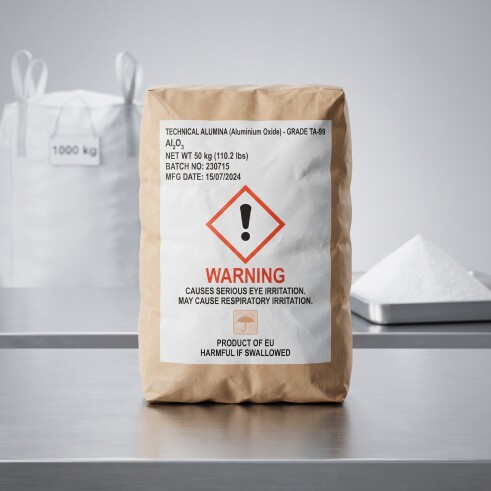
Technical aluminium oxide is not a dangerous good, so packaging must provide protection from moisture (the product is hygroscopic) and mechanical strength. Multi-wall paper bags with a polyethylene liner, polypropylene bags, and MKR flexible containers with a polyethylene liner are used.
Transport Marking
Transport marking is applied per GOST 14192 with the Keep Dry handling symbol. Alumina supplied in bulk is not marked; marking of packaged product is agreed between the consumer and the supplier. Since the product is not classified as a dangerous good, transport hazard labels are not applied. Under GHS, the product may be labeled with the GHS07 exclamation mark pictogram and the signal word Warning because dust causes irritation of the mucous membranes of the upper respiratory tract, mouth and eyes. Marking must contain the manufacturer name, batch number, alumina grade and standard designation.
Storage Conditions
The product is stored in closed packaging in dry, well-ventilated warehouses protected from atmospheric precipitation. Bulk storage must exclude moistening and contamination.
Regulatory Framework for Incoming Inspection
- GOST 30558-2017 - metallurgical alumina. Specifications.
- GOST 30559-98 - non-metallurgical alumina. Specifications.
- GOST 8136-85 - activated aluminium oxide. Specifications.
- GOST 28818-90 - abrasive materials from corundum. Specifications.
- GOST 12.1.007-76 - classification of hazardous substances. Alumina belongs to hazard class 4 (low-hazard substances).
- GOST 12.1.005-88 - maximum permissible concentration of alumina dust in the working area air is 6 mg/m3.
- GOST 14192 - cargo marking.
- GOST 30333-2022 - safety data sheet for chemical products.
For imported batches, the specification is based on manufacturer standards and harmonized methods. The batch specification is confirmed by the manufacturer certificate of quality and the results of incoming laboratory control by the recipient.
Mechanism of Action and Functional Role
In electrolytic aluminium production, alumina dissolves in the cryolite melt at about 950-960 degrees Celsius, after which aluminium is reduced at the cathode and oxygen is released at the anode. The key properties of alumina for this process are solubility in the electrolyte, granulometric composition (to prevent dusting and ensure uniform feed) and impurity content, especially iron and silicon, which pass into the metal.
In the ceramic industry, aluminium oxide acts as the main component or additive that increases mechanical strength, heat resistance and electrical insulating properties of products. The alpha phase provides high hardness and wear resistance, while the gamma phase provides high specific surface area and catalytic activity. In refractories, aluminium oxide increases the service temperature and resistance to melts of metals and slags.
In catalysts and desiccants, activated alumina acts as a carrier with a developed porous structure on which active components are deposited, and as an adsorbent for removing moisture from gases and liquids. In the abrasive industry, corundum based on aluminium oxide provides high hardness and cutting ability of grinding materials.
Applications by Industry
Primary Aluminium Production
The dominant consumption direction for metallurgical alumina. Aluminium oxide is the feedstock for electrolytic reduction of aluminium in the cryolite melt.
Ceramic and Refractory Industry
Non-metallurgical alumina with high alpha-phase content is used for electrical insulating, electro- and radio ceramics, special types of ceramics, electroporcelain, refractories, crucibles, substrates and insulators.
Abrasive Industry
Corundum based on aluminium oxide is used for the production of grinding wheels, discs, sandpaper and other abrasive tools.
Catalysts and Desiccants
Activated alumina of the gamma modification serves as a catalyst carrier, catalyst and desiccant in chemical and petrochemical processes.
High-Alumina Cement Production
Alumina with low alpha-phase content is used to produce high-alumina cements characterized by rapid hardening and resistance to high temperatures.
Other Industries
Used in the production of glass, enamels, as a filler in plastics and paints, in medicine (for implants), in optics and electronics.
Comparison with Alternative Materials
Compared with silicon dioxide (silica), aluminium oxide provides higher hardness, heat resistance and chemical resistance but is inferior in availability and cost. Compared with zirconium dioxide, aluminium oxide is cheaper and more available but is inferior in fracture toughness and thermal shock resistance in demanding ceramic articles.
In the abrasive industry, corundum competes with silicon carbide and cubic boron nitride. Corundum is cheaper and sufficiently effective for processing ordinary steels, while silicon carbide and CBN are used for hard alloys and high-precision operations. In catalysts, activated alumina competes with zeolites and silica gel, having an advantage in heat resistance and mechanical strength but being inferior to zeolites in specific adsorption selectivity.
Supplier Selection Criteria and Specification Development
The specification for technical aluminium oxide must include the grade (metallurgical alumina per GOST 30558-2017, non-metallurgical per GOST 30559-98, activated per GOST 8136-85), Al2O3 mass fraction, alpha-phase content, alkali, silica, iron and titanium oxide content, loss on ignition, granulometric composition and supply form (bulk, bags, big bags). For activated alumina, specific surface area, bulk density and attrition strength are additionally specified.
The supplier confirms batch-to-batch quality consistency, a valid safety data sheet under GOST 30333-2022, readiness to provide packaging that protects against moisture and to organize transport in compliance with cargo transport rules. For imported batches, it is important to verify labeling and actual parameters, as well as storage conditions at the warehouse before shipment.
Typical Processing, Storage and Logistics Errors
- Violation of storage conditions. Alumina is hygroscopic; storage in humid areas or in the open leads to caking and loss of flowability. The product is stored in closed warehouses protected from atmospheric precipitation.
- Use of contaminated packaging. Residues of other products can contaminate alumina, especially for metallurgy and ceramics where purity for iron and silicon is important.
- Neglecting dust protection. Aluminium oxide dust irritates the mucous membranes of the upper respiratory tract, mouth and eyes; a respirator, protective goggles and gloves are required when working with powder.
- Use of metallurgical alumina for ceramic purposes. Metallurgical alumina may not meet the requirements for alpha-phase and impurity content for the production of demanding ceramics.
- Labeling errors. Applying transport hazard labels that do not correspond to the product, or omitting the GHS07 label when irritant action is present, can mislead the consumer.
- Damage to packaging during transport. Damage to bags or big bags leads to moistening and contamination of the product, as well as losses during handling.
Quality Control and Laboratory Methods
Incoming inspection of aluminium oxide includes determination of the Al2O3 mass fraction (complexometric titration or atomic absorption spectrometry), alpha-phase content (X-ray diffraction or petrographic method), alkali (flame photometry), silica and iron and titanium oxides (spectrophotometry), loss on ignition (gravimetry). For activated alumina, specific surface area (BET method), bulk density and attrition strength are additionally determined. Sampling is performed by standardized methods; the combined sample is analyzed in the plant laboratory.
When changing supplier or batch for metallurgy or ceramics, a control run of the target product (electrolysis or ceramic mass) is recommended to confirm compatibility with the process.
Storage and Transportation Conditions
Technical aluminium oxide is not classified as a dangerous good. Storage is carried out in closed packaging in dry, well-ventilated warehouses at ambient temperature, protecting the product from atmospheric precipitation and direct sunlight. The shelf life is established by the manufacturer and is typically 12-24 months from the date of manufacture under proper transport and storage conditions.
Transportation is by rail, road and sea in covered vehicles or specialized hopper cars (for bulk). No special temperature regime is required, but moistening and contamination of the product must be excluded.
Finding Analogues and Interchangeability
When replacing aluminium oxide, a product of the same grade and group with similar Al2O3, alpha-phase and impurity parameters is selected. Replacing metallurgical alumina with non-metallurgical alumina is possible only in applications where special ceramic properties are not required, with confirmation of final product properties. Replacing activated alumina with other carriers (silica gel, zeolites) is possible with process adjustment and confirmation of catalytic or adsorption characteristics.
In the abrasive industry, replacing corundum with silicon carbide or CBN is possible but requires revision of processing conditions and economic evaluation. The replacement decision is based on laboratory testing and, for critical processes, pilot-scale verification.
Supply Routes: Russia, China and Other Regions
Domestic supply is provided by enterprises with alumina and corundum production capacity. Products are supplied to the domestic market and for export. Shipment is by rail in covered cars and hoppers, and by road in bags and big bags.
China is a large producer and exporter of alumina and aluminium oxide. Supplies are delivered by sea with subsequent transfer to rail or road transport. According to industry sources, Russia was a major buyer of Chinese alumina in 2025, accounting for about 75.8 percent of China exports in this segment. Other global producers are located in the Middle East, Southeast Asia and Europe. Suppliers from these regions are engaged when required, taking into account logistical and regulatory factors.
Logistics and Customs Clearance
Transportation of aluminium oxide is carried out in bulk in specialized rail cars and road transport, as well as in bags and big bags in covered vehicles. Customs clearance includes classification under HS code 2818200000, preparation of a safety data sheet under GOST 30333-2022 (if required) and conformity declaration. The portal provides customs broker services and supports all clearance stages.
Risk Factors and Safety Measures
Technical aluminium oxide belongs to hazard class 4 (low-hazard substances), is non-toxic, non-flammable and non-explosive, and is not classified as a dangerous good. The main risks are associated with dust generation: dust irritates the mucous membranes of the upper respiratory tract, mouth and eyes. The maximum permissible concentration of alumina dust in the working area air is 6 mg/m3.
Work is performed in ventilated rooms with filtering respirators (for example, ShB-1 Lepestok), protective goggles and gloves. In case of a spill, the product is collected mechanically, moistened if necessary to avoid dust generation, and disposed of in closed containers. Discharge of concentrated suspensions into water bodies without prior dilution is not permitted.
FAQ: Common Questions from Procurement and Process Specialists
How does metallurgical alumina differ from non-metallurgical alumina
Metallurgical alumina per GOST 30558-2017 is intended primarily for electrolytic aluminium production and is standardized for Al2O3, alkali and alpha-phase content to ensure solubility in the cryolite melt. Non-metallurgical alumina per GOST 30559-98 is produced for ceramics, refractories, abrasives and cements and has a wider range of grades with different alpha-phase and impurity contents.
Is aluminium oxide a dangerous good
No, the product is not classified as a dangerous good for transport, and no UN number is assigned. Transport hazard labels are not applied. However, under GHS the product may be labeled with the GHS07 pictogram and the signal word Warning due to the irritant action of dust.
Which packaging is used for aluminium oxide
Five- and six-ply paper bags of grade PM or BPM per GOST 2226 with a mass of up to 50 kg, MKR flexible specialized containers with a polyethylene liner, and SKB-1 or SKTs-1 specialized containers are used. Bulk supply in specialized hopper cars is possible.
What is the shelf life of aluminium oxide
The shelf life is established by the manufacturer and is typically 12-24 months from the date of manufacture under proper storage conditions (dry, ventilated areas, protection from precipitation). After this period, incoming inspection of Al2O3 content and moisture is required.
What documents are required for aluminium oxide import
Import requires a contract, invoice, packing list, safety data sheet under GOST 30333-2022 (if required), manufacturer certificate of quality and transport documents. The product is not classified as a dangerous good, so additional permits for the transport of dangerous goods are not required. The portal organizes the preparation of the document set and interaction with the customs broker.
Conclusion
Technical aluminium oxide remains an indispensable large-tonnage feedstock for primary aluminium production, ceramics, refractories, abrasives and catalysts. GOST 30558-2017, GOST 30559-98 and GOST 8136-85 establish requirements for metallurgical, non-metallurgical and activated aluminium oxide respectively. For procurement teams, the practical task reduces to correct grade and group selection, confirmation of batch conformity to the standard, and organization of supplies with storage conditions that exclude moistening and contamination of the product, as well as dust protection measures during handling.
Contact Us
For procurement inquiries and supply chain organization, contact the portal team at info@apptrade.ru.